
Mental Health Medications Quiz
How the Scales are Structured
Who Usually Takes This Test?
See How You Compare
Below is a preview of how scores are typically distributed across each scale.
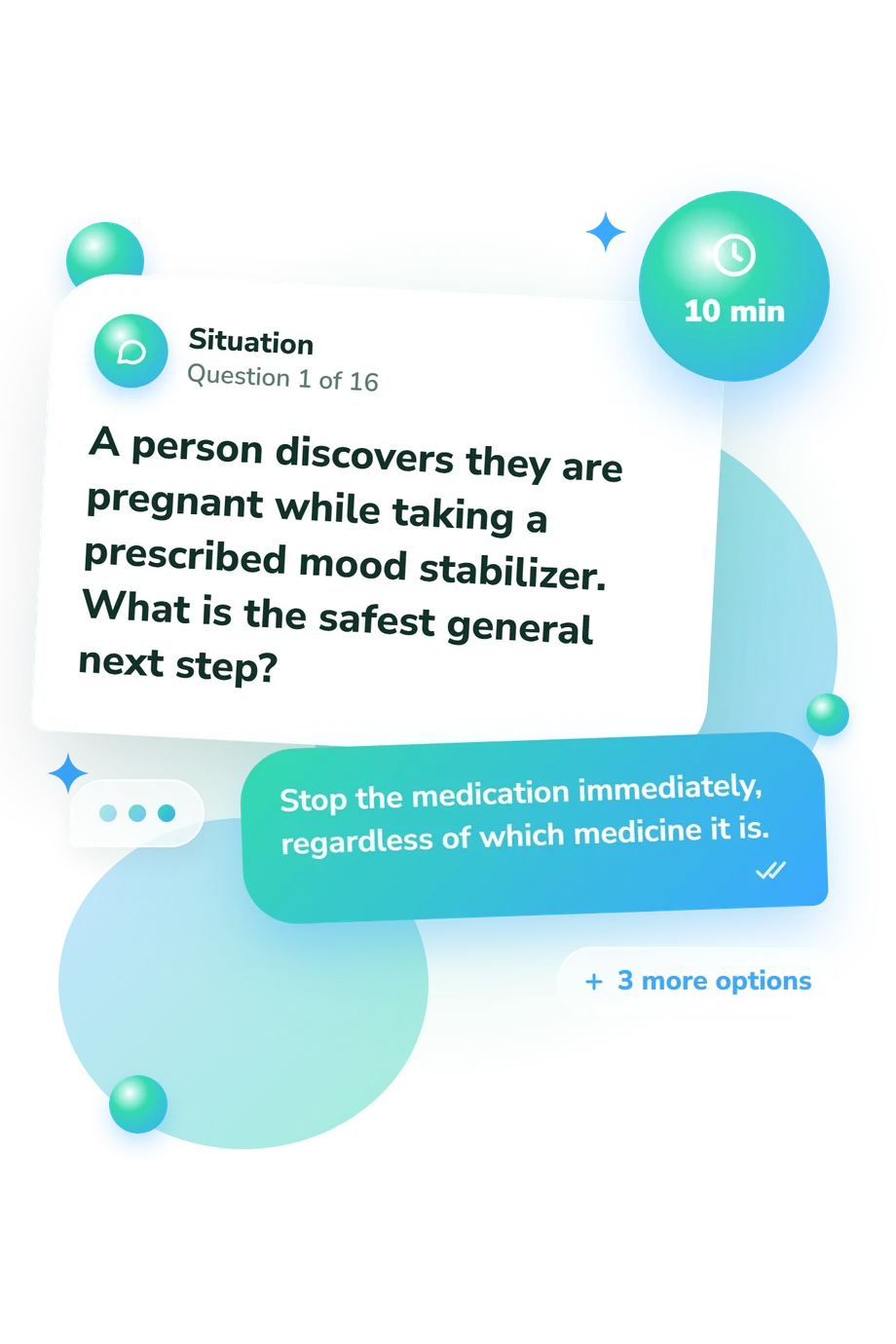
Example Questions From the Test
- Alcohol can prevent the medication from entering the bloodstream.
- Their sedating effects can combine, increasing impairment and the risk of dangerously slowed breathing.
- The two substances usually cancel out each other's effects.
- The main concern is that alcohol makes the medication taste unpleasant.
- Stop the medication immediately, regardless of which medicine it is.
- Continue without mentioning the pregnancy until the next annual appointment.
- Contact the prescriber promptly to discuss benefits, risks, and options before making changes.
- Replace it with an herbal product assumed to be safer during pregnancy.
- Take it only on especially difficult days so the body does not adapt to it.
- Double the next dose because the starting dose was ineffective.
- Stop immediately because an effective antidepressant always works within a few days.
- Keep taking it as prescribed and discuss progress with the prescriber; meaningful benefit can take several weeks.
Mental Health Medications Quiz - Description and methodology of the test
People seeking a clearer grasp of psychiatric medicine safety can use this mental health medications quiz before discussing treatment with a prescriber or pharmacist. It suits readers reviewing general principles for themselves or supporting someone who takes these medicines. Readers taking the psychiatric medications quiz can use the result to prepare informed questions for safer conversations. The result indicates an overall knowledge level and may suggest reviewing general medication-safety principles.
What This Assessment Explores
This questionnaire examines practical knowledge rather than symptoms, personality, or treatment response. Its scenarios focus on safe use, interactions, monitoring, side effects, and situations that call for professional or emergency help.
Questions group into four areas:
- Safe use and storage show awareness of directions, missed-dose guidance, sharing restrictions, and pregnancy discussions.
- Interactions and changes indicate understanding of alcohol, herbal products, washout periods, abrupt stopping, and prescriber input.
- Monitoring and treatment features cover blood tests, therapeutic ranges, long-acting injections, generic equivalence, and follow-up.
- Adverse effects and urgent reactions show whether common side effects are distinguished from warning signs.
Mental Health Medications Knowledge runs from 0-16: Foundations to build, 0-6; Developing knowledge, 7-12; Strong knowledge, 13-16. As a mental health medication test, it reports one overall educational knowledge level for self-reflection; the four areas describe item content rather than separate scores.
Methodology and Evidence Base
Each item gives a medication scenario or definition with several choices. The respondent selects the option that reflects safe practice, such as checking missed-dose instructions, recognizing a serious reaction, or seeking advice before combining medicines. This tests applied understanding rather than diagnosis recall.
Viewed as a medication safety quiz, the questionnaire uses an educational knowledge-check approach. Its structure is consistent with the PEAK test (Wauters et al., 2016), a psychotropic-drug knowledge assessment; PEAK is a conceptual comparator, not the source of this online questionnaire. Norman et al. (2014) address medication-education knowledge through Rasch analysis, while Begum et al. (2020) address side-effect knowledge in psychiatric education; these studies do not validate or norm this separate online questionnaire.
The result is one educational total; content groups have no separate scores. Because this is a selected-response knowledge check, performance can be affected by prior knowledge, guessing, and how a respondent interprets a scenario. The score is educational, has no diagnostic cutoff, and should not guide medication changes; severe symptoms, breathing difficulty, collapse, extreme confusion, or suspected overdose require urgent help regardless of the result.
- Wauters, Maartin, Majda Azermai, Sammi-Jo Perehudoff, Karen Versluys, Els Steeman, and Mirko Petrovic. "Development and validation of the Psychotropic Education and Knowledge (PEAK) test on psychotropic drugs for nurses in an acute geriatric care setting." European Geriatric Medicine, 2016, 7(2), 135-141. 10.1016/j.eurger.2016.02.002
- Norman, Sarah, Erica Davis, Lisa W. Goldstone, Lorenzo Villa Zapata, and Terri Warholak. "A Rasch analysis of a questionnaire designed to evaluate psychiatric patient attitudes and knowledge after attending a pharmacist-led patient medication education group." Research in Social and Administrative Pharmacy, 2014, 10(6), 867-876. 10.1016/j.sapharm.2014.03.001
- Begum, Fareha, Stanley Mutsatsa, Noreen Gul, Ben Thomas, and Chris Flood. "Antipsychotic medication side effects knowledge amongst registered mental health nurses in England: A national survey." Journal of Psychiatric and Mental Health Nursing, 2020, 27(5), 521-532. 10.1111/jpm.12600
Updated: