
Objects Quiz
How the Scales are Structured
Who Usually Takes This Test?
See How You Compare
Below is a preview of how scores are typically distributed across each scale.
Example Questions From the Test
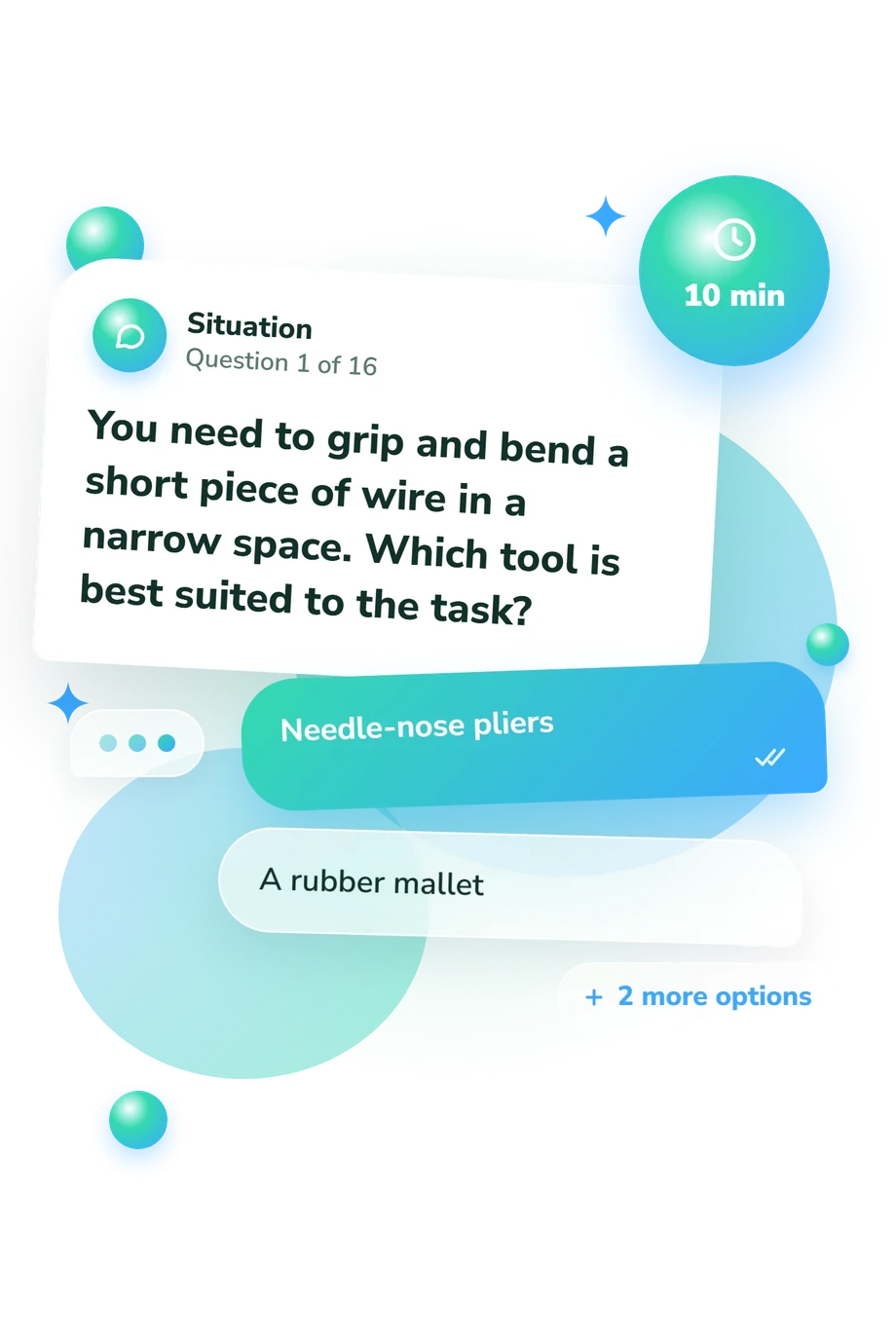
- Needle-nose pliers
- A rubber mallet
- A putty knife
- An adjustable wrench
- It reduces heat transfer by conduction and convection
- It makes the inner wall waterproof
- It creates extra space for the liquid to expand
- It increases the liquid's boiling point
- A thick handle
- A glossy glazed surface
- A printed maker's logo underneath
- Metallic gold trim
Objects Quiz - Description and methodology of the test
Curious people who enjoy practical puzzles can use this objects quiz to see whether they can reason from an object's design to its everyday function. The everyday objects assessment is a good fit for anyone interested in tools, household items, and the principles behind their design. It offers a concise way to identify topics worth exploring without requiring specialist background.
What This Assessment Explores
Questions connect parts, materials, and mechanisms. They ask you to choose a tool, recognize how a component works, or apply a principle involving force, heat, magnetism, elasticity, pressure, or leverage. The result reflects how you connect an object's features with its function, rather than specialist terminology.
This practical objects assessment examines four dimensions:
- Tool selection shows whether you match an object to a task.
- Materials and construction show whether design choices support safety, durability, and performance.
- Mechanisms and parts show how components guide, join, move, or hold.
- Physical principles show how force, heat, fields, pressure, and elasticity operate.
Results use the Objects Knowledge scale, 0-16: Foundation (0-6) indicates recognition with room to learn; Developing (7-12) indicates useful everyday knowledge with some technical gaps; Strong (13-16) indicates broad, practical knowledge of how objects are built, selected, and used.
Methodology and Scientific Basis
Each item presents an everyday problem with four answer choices, and one option best answers the practical question or identifies its relevant function or principle. The format tests applied recognition and reasoning: you link a concrete situation to a function or basic physical principle. Careless reading, guessing, and unequal familiarity with household tasks can affect the total.
The single result is reported through the three displayed bands. Attention, guessing, prior exposure, and familiarity with everyday tasks can affect the total, so a missed item may reflect an unfamiliar tool or momentary inattention rather than a broad gap in practical understanding.
The content is conceptually consistent with Wiesen (1997), whose work addresses mechanical understanding and practical problem solving, and with Chrysikou et al. (2011) on familiar-object knowledge across task formats. These sources do not establish evidence for this online questionnaire; they offer conceptual context for its practical object questions. The questionnaire is most useful for reflection and identifying further learning priorities.
- Wiesen, Joel P. (1997). Technical Manual for the Wiesen Test of Mechanical Aptitude (WTMA). Newton, MA: Applied Personnel Research.
- Bobrow, Warren. (1997). Development and Validation of a Personnel Assessment System for Selection of Tufting Machine Operators. The Context Group. ERIC ED415285.
- Chrysikou, Evangelia G., Tania Giovannetti, Denene M. Wambach, Abigail C. Lyon, Murray Grossman, and David J. Libon. (2011). The importance of multiple assessments of object knowledge in semantic dementia: The case of the familiar objects task. Neurocase, 17(1), 57-75. 10.1080/13554794.2010.497156
Updated: