
Music Rhythm Quiz
How the Scales are Structured
Who Usually Takes This Test?
See How You Compare
Below is a preview of how scores are typically distributed across each scale.
Example Questions From the Test
- Repeat the previous note at a softer volume
- Hold the previous note for the rest of the measure
- Pause the underlying beat
- Remain silent for a specified duration while the beat continues
- Rubato
- A rest
- Syncopation
- A downbeat
- One
- Three
- Four
- Two
Music Rhythm Quiz - Description and methodology of the test
People who want to check their understanding of rhythm concepts in notation, lyrics, and drumming situations can use this music rhythm quiz as a focused self-reflection tool. This music rhythm test suits learners, singers, instrumentalists, and curious listeners who want to review concepts and identify topics needing practice. It offers a concise picture of conceptual rhythm knowledge for musical learning.
What This Assessment Explores
The items examine steady beat, note and rest durations, meter, subdivision, and rhythmic patterns in musical contexts. Examples include ties, triplets, pickups, syncopation, backbeats, tempo changes, melisma, and the distinction between beat and rhythm. As a rhythm knowledge test, it asks whether rhythm terms and examples can be matched with their musical function.
The displayed Music Rhythm Knowledge score (0-16) summarizes correct answers across rhythm concepts and applications. Its result bands are Foundations to build (0-6), Developing rhythm knowledge (7-12), and Strong rhythm knowledge (13-16). It describes overall conceptual knowledge across the tested topics.
The main thematic groups are:
- Beat and meter concepts show whether you can identify pulses, time signatures, and grouping.
- Note values and rests show whether you understand duration, silence, ties, and subdivisions.
- Rhythmic patterns show whether you can connect syncopation, triplets, pickups, and backbeats with musical situations.
Methodology and Evidence Base
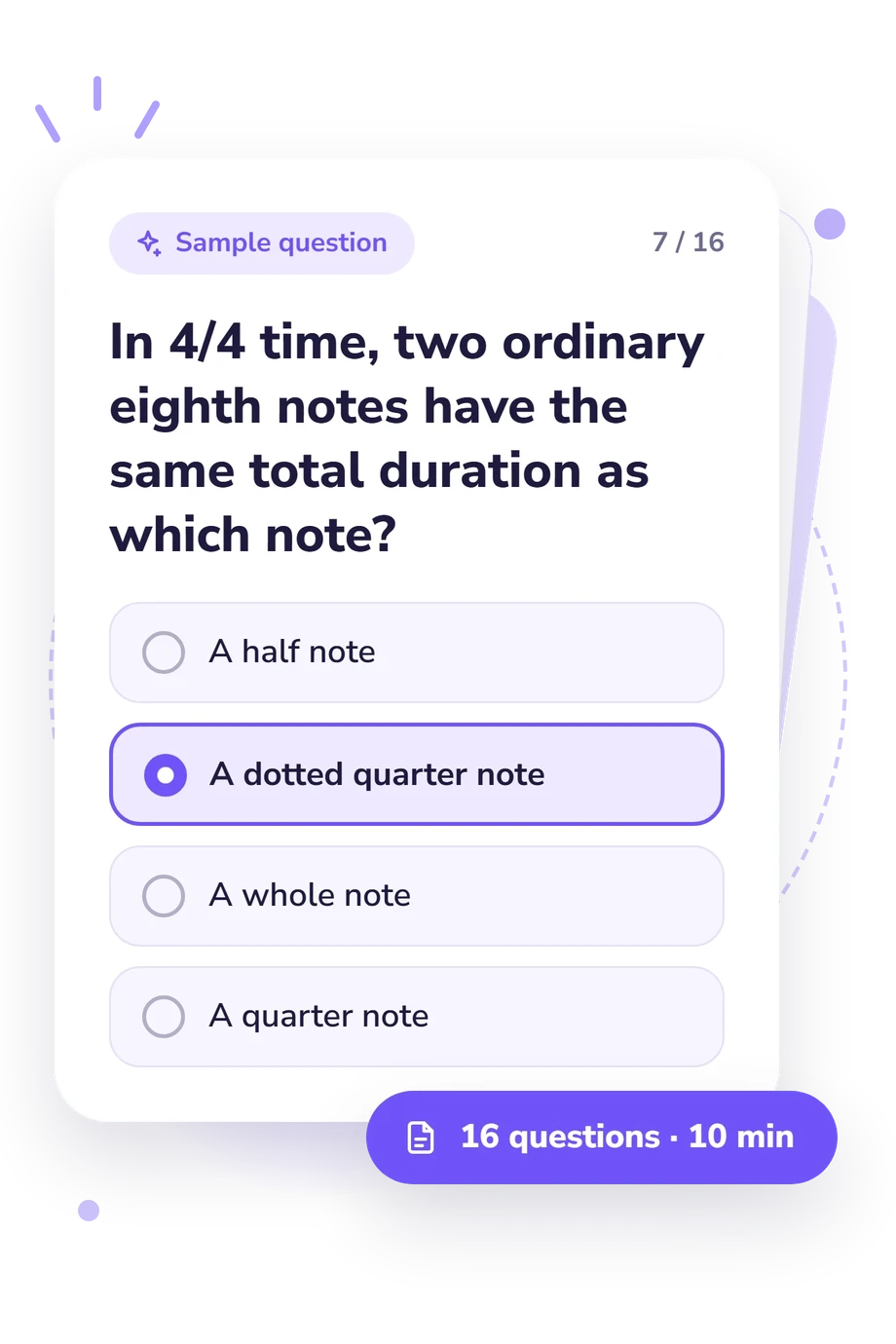
Each item in this music rhythm assessment presents a musical situation and four choices; the respondent selects the best explanation. The total reflects correct answers across represented concepts and is interpreted through the stated knowledge bands. It gives an overall knowledge result rather than a separate score for each topic.
The online questionnaire is conceptually consistent with the Musical Knowledge Test (Öztürk & Kalyoncu, 2020), a published measure of music knowledge, but it is not an adaptation of that instrument. Wu, Lin, and Yu (2025) offer a cognitive-diagnostic perspective on musical rhythm. Gordon (1970) provides an earlier music-literacy framework linking notation, terminology, listening, and performance contexts.
The questionnaire is an online educational self-check with no stated population norms or standardization. Its stated knowledge bands are categories, not universal cutoffs. Prior instruction, guessing, notation familiarity, and attention can influence answers. Recognizing a triplet or backbeat does not prove reproduction; the score does not assess live timing or physical performance. Results are best used to choose concepts for review and track learning.
- Öztürk, Özlem, and Nesrin Kalyoncu. "Development of a ‘Musical Knowledge Test’ for the Sixth Grade Music Lesson of Turkish Primary Education." Journal of Theoretical Educational Sciences, 13(3), 2020, 609-629.
- Wu, Huey-Min, Yu-Ching Lin, and Liang-Cheng Yu. "The Validation of a Cognitive Diagnostic Assessment for Musical Rhythm at the Test and Item Levels." Psychological Testing, 72(4), 2025, 475-503. 10.7108/PT.202512_72(4).0004
- Gordon, Edwin E. Iowa Tests of Music Literacy. Bureau of Educational Research and Service, University of Iowa, 1970.
Updated: