
General Science Quiz in Hindi
How the Scales are Structured
Who Usually Takes This Test?
See How You Compare
Below is a preview of how scores are typically distributed across each scale.
Example Questions From the Test
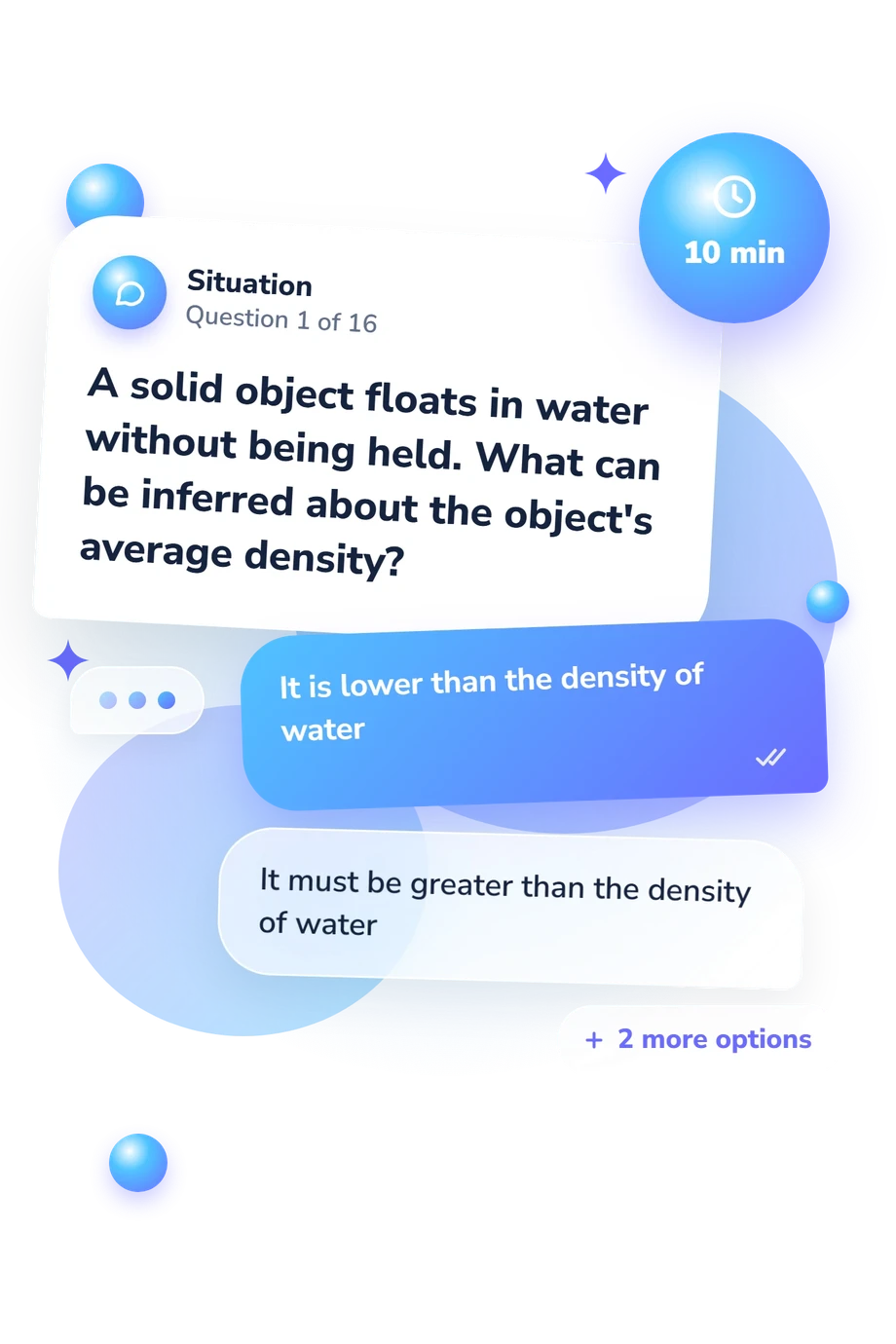
- It is lower than the density of water
- It must be greater than the density of water
- It must be equal to the density of every material it contains
- Density is unrelated to whether an object floats
- Nitrogen
- Hydrogen
- Methane
- Oxygen
- Carbon dioxide
- Helium
- Neon
- Argon
General Science Quiz in Hindi - Description and methodology of the test
Presented in Hindi, the questionnaire gives learners, curious adults, and anyone planning targeted revision a focused snapshot of general science knowledge. The Hindi science quiz reviews familiar concepts and their basic applications across subjects. The general science quiz in hindi indicates which topics may deserve another look for learners.
What This Assessment Explores
Questions sample content for the General Science Knowledge scale through everyday situations and foundational concepts. They cover biology, physics, chemistry, Earth and space science, ecology, health-related examples, and simple inference. Each asks the respondent to connect an observation with its best explanation, such as density and floating, inertia and seat belts, or dilution and pH.
The result uses one knowledge scale:
- General Science Knowledge (0-16) counts correct answers: Foundation to build (0-6) indicates that core ideas need review; Developing knowledge (7-12) reflects understanding with some concepts needing reinforcement; Strong knowledge (13-16) reflects accurate, wide-ranging command and effective application of key principles.
Presented as a science quiz in Hindi, it supports self-directed learning. A higher band means more answers matched the keyed principles, while the result reflects only the topics represented here.
Methodology and Scientific Basis
Each item presents a stem and four answer choices, with one option expressing the scientific explanation. Scoring is direct: every correct response adds one point to the total, and the score is interpreted using the displayed result bands. The format emphasizes recognition and application of principles across contexts instead of formula-heavy calculation.
Its closest reference is Laugksch’s (1996) account of scientific literacy, which discusses understanding scientific concepts and capabilities. This questionnaire is consistent with that framework, but it is not an adaptation of the work; its online version has no reported validation or standardization. A general science test in Hindi also connects with public-understanding research discussed by Allum and colleagues (2008).
Question format can affect knowledge: Tourangeau, Maitland, and Yan (2016) examine the effects of wording and “don’t know” options. Answers here may be influenced by guessing, attention, conditions, and familiarity with the Hindi wording. With no published population norms for this online version, the score is a snapshot for review; the displayed bands are descriptive and tied to the topics represented in the questionnaire.
- Durant, John R., Geoffrey A. Evans, and Geoffrey P. Thomas. (1989). The public understanding of science. Nature, 340(6228), 11-14. 10.1038/340011a0
- Allum, Nick, Patrick Sturgis, Dimitra Tabourazi, and Ian Brunton-Smith. (2008). Science knowledge and attitudes across cultures: A meta-analysis. Public Understanding of Science, 17(1), 35-54. 10.1177/0963662506070159
- Tourangeau, Roger, Aaron Maitland, and H. Yanna Yan. (2016). Assessing the Scientific Knowledge of the General Public: The Effects of Question Format and Encouraging or Discouraging Don’t Know Responses. Public Opinion Quarterly, 80(3), 741-760. 10.1093/poq/nfw009
- Laugksch, Rüdiger C. (1996). Development of a pool of scientific literacy test-items based on selected AAAS literacy goals. Science Education, 80(2), 121-143. 10.1002/(SICI)1098-237X(199604)80:2<121::AID-SCE1>3.0.CO;2-I
Updated: