
Funny Sports Quiz
How the Scales are Structured
Who Usually Takes This Test?
See How You Compare
Below is a preview of how scores are typically distributed across each scale.
Example Questions From the Test
- Made three fielding errors
- Struck out four times
- Was caught out three times
- Hit four foul balls in one at-bat
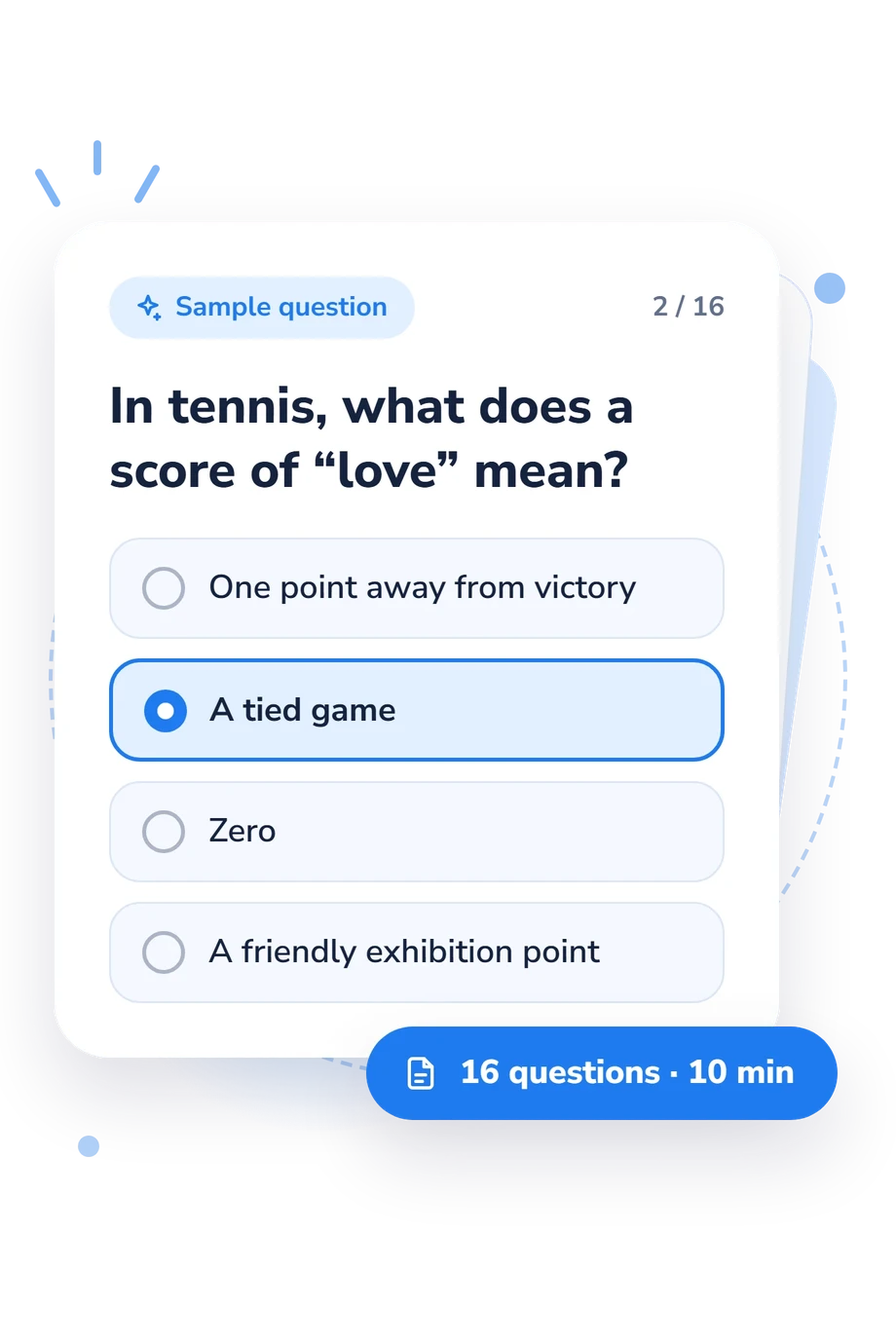
- One point away from victory
- A tied game
- Zero
- A friendly exhibition point
- A brick
- A bank shot
- A dead ball
- An air ball
Funny Sports Quiz - Description and methodology of the test
Readers who enjoy broad sports knowledge can use this assessment to test how well they recognize the language and situations that make games memorable. The funny sports quiz suits readers who like discovering how different sports name familiar events in surprising ways. The overall result reflects recognition of sporting terms, rules, and scenarios. Several sports trivia questions in the assessment invite recall across both widely followed and less familiar games.
What This Assessment Explores
This assessment measures recognition of sporting vocabulary, rules, scoring expressions, and named scenarios rather than physical skill. It suits readers who want to connect unusual phrases with the events they describe. The sports terminology quiz samples familiarity with terminology across different sports.
The items span team and individual sports, from baseball and tennis to cricket, hockey, and soccer. They test whether the respondent can identify a conventional score, distinguish a legal action from a fault, or interpret a commentator’s shorthand.
Funny Sports Knowledge (0-16) is divided into three result bands:
- Sideline Starter (0-6) indicates recognition of basics while unusual terms remain less familiar.
- Playful Contender (7-12) shows solid knowledge and can decode stranger expressions.
- Trivia Champion (13-16) reflects excellent command of quirky terminology, rules, and scenarios.
The result summarizes recognition of the sporting language and situations tested.
Methodology and Evidence Base
Each item uses a multiple-choice format with four answer options. The respondent selects the option that best identifies a term, rule, scoring expression, or game situation; distractors often come from the same sporting context, so the task rewards precise recognition rather than vague familiarity. The scoring logic is content-based: the displayed score summarizes performance across all 16 questions, while higher bands represent stronger command of the tested material.
Room (2010) is the closest terminology reference for expressions such as golden sombrero, air ball, maiden over, and nutmeg. Schrag (2019) supports cross-sport rule distinctions, Marylebone Cricket Club (2022) anchors cricket wording, and Aleixandre-Benavent et al. (2007) supports soccer terminology. The questionnaire is conceptually consistent with these sources, which support its terminology and rules content.
As a sports rules quiz, it is best read as a compact knowledge check. The score records recognition of the sporting terms and game situations included in the questionnaire. The bands are descriptive categories, not population norms. A missed answer can point to terminology worth exploring in a sport the reader follows less closely.
- Room, Adrian. Dictionary of Sports and Games Terminology. Jefferson, NC: McFarland & Company, 2010. ISBN 9780786442263.
- Human Kinetics and Myles Schrag. The Sports Rules Book. 4th ed. Champaign, IL: Human Kinetics, 2019. ISBN 9781492567592.
- Marylebone Cricket Club. The Laws of Cricket 2017 Code, 3rd Edition 2022. London: Marylebone Cricket Club, 2022.
- Aleixandre-Benavent, Rafael, Recaredo Agulló Albuixech, Víctor Agulló Calatayud, and Juan Carlos Valderrama-Zurián. Terminology and Sport Language of Soccer. Cultura, Ciencia y Deporte, 2(6), 117-123, 2007. 10.12800/ccd.v2i6.179
Updated: