
New Year's Resolutions Quiz
How the Scales are Structured
Who Usually Takes This Test?
See How You Compare
Below is a preview of how scores are typically distributed across each scale.
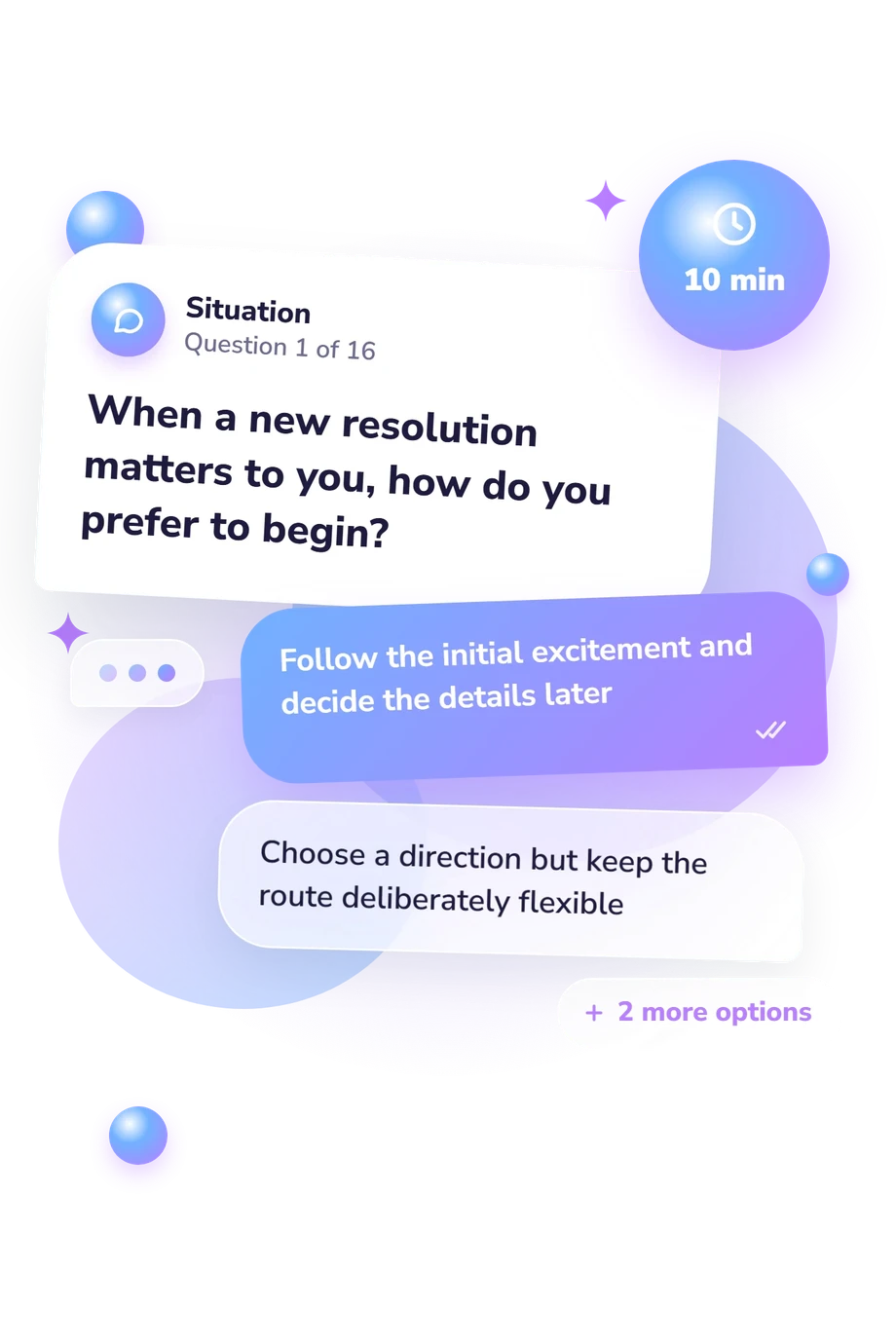
Example Questions From the Test
- Follow the initial excitement and decide the details later
- Choose a direction but keep the route deliberately flexible
- Tell supportive people and build momentum together
- Define milestones, resources, and a workable schedule
- Spend it on a memorable new experience
- Add comfort or breathing room to everyday life
- Use it for a shared project or someone I care about
- Invest it in tools, training, or savings tied to a long-term goal
- Choose a worthwhile option that involves less personal exposure
- Talk it through with someone and then decide whether to proceed
- Prepare until I feel more capable of handling the uncertainty
- Acknowledge the fear and act because the step reflects my values
New Year's Resolutions Quiz - Description and methodology of the test
People who want to turn an intention into meaningful direction can use this questionnaire to reflect on motivation. The new year's resolutions quiz is intended for anyone curious about how competing priorities appear in a comparative profile. It highlights your responses to change, uncertainty, social expectations, and sustained effort rather than judging whether a resolution is good. This resolution quiz gives those competing tendencies a concrete pattern to discuss.
What This Assessment Explores
These situations sample facets of exploration, courage, creativity, and practical ambition. The result is a comparative affinity profile. This resolution profile shows the highest displayed score as your strongest affinity, while scores within one point indicate a blend.
The four dimensions are:
- Moana - Courageous Explorer (0-12) reflects curiosity, wayfinding, connection to purpose, and moving beyond the familiar; Familiar Shores (0-4), Open Horizon (5-8), Wayfinder Spirit (9-12).
- Mulan - Brave Transformer (0-12) reflects courage under pressure, strategic adaptability, authenticity, and questioning limiting expectations; Harmony Keeper (0-4), Emerging Challenger (5-8), Brave Transformer (9-12).
- Rapunzel - Creative Optimist (0-12) reflects creativity, curiosity, expressive energy, and playfulness toward long-awaited goals; Grounded Focus (0-4), Curious Spark (5-8), Creative Optimist (9-12).
- Tiana - Purposeful Builder (0-12) reflects practical ambition, sustained effort, resourcefulness, and turning visions tangible; Flexible Dreamer (0-4), Steady Maker (5-8), Purposeful Builder (9-12).
Methodology and Evidence Base
Each item describes a resolution situation and offers four response options. The options represent different ways of approaching the same challenge, so the questionnaire compares affinity across four dimensions. Results are read comparatively: the highest displayed scale score marks the strongest affinity, while scores within one point form a blended result. Band labels describe present alignment, so a lower or middle result can still show a meaningful preference.
Its structure is conceptually consistent with Dickson et al. (2023), who connect flexible goal pursuit and underlying motives with wellbeing and resolutions. It also relates to Oscarsson et al. (2020) on approach-oriented goals and Koestner et al. (2002) on self-concordant goals, implementation intentions, and attainment. These studies offer comparison points, not norms for this questionnaire.
For your new year's resolution assessment, the useful question is what the pattern suggests you might try next: choose a personally endorsed aim, define one action, and revise the route when circumstances change. Mood, context, and self-awareness can influence self-report responses, so read the result as a current perspective rather than a fixed forecast.
- Dickson, Joanne M., Amelia Hart, Caitlin Fox-Harding, and Christopher D. Huntley. (2023). Adaptive Goal Processes and Underlying Motives That Sustain Mental Wellbeing and New Year Exercise Resolutions. International Journal of Environmental Research and Public Health, 20(2), 901. 10.3390/ijerph20020901
- Oscarsson, Martin, Per Carlbring, Gerhard Andersson, and Alexander Rozental. (2020). A Large-Scale Experiment on New Year's Resolutions: Approach-Oriented Goals Are More Successful Than Avoidance-Oriented Goals. PLOS ONE, 15(12), e0234097. 10.1371/journal.pone.0234097
- Koestner, Richard, Natasha Lekes, Theodore A. Powers, and Emanuel Chicoine. (2002). Attaining Personal Goals: Self-Concordance Plus Implementation Intentions Equals Success. Journal of Personality and Social Psychology, 83(1), 231-244. 10.1037/0022-3514.83.1.231
Updated: