
Harry Potter 7 Minutes in Heaven Quiz
How the Scales are Structured
Who Usually Takes This Test?
See How You Compare
Below is a preview of how scores are typically distributed across each scale.
Example Questions From the Test
- Ask him to restate it without the competitive edge
- Return an equally sharp compliment and enjoy the tension
- Accept the interest but shift toward a more sincere conversation
- Decide that teasing has no place in romantic chemistry
- A clever debate that continues long after everyone else has gone
- A polished evening arranged to make a memorable impression
- A peculiar little gift with a story only the two of us understand
- Showing up when it matters and speaking with unpolished sincerity
- Treating the search as a sincere adventure, wherever it leads
- Enjoying the walk while staying undecided about the creature
- Suggesting a museum visit where the creatures are documented
- Replacing the search with a predictable dinner reservation
Harry Potter 7 Minutes in Heaven Quiz - Description and methodology of the test
For readers deciding whether an imaginative fandom questionnaire suits them, the Harry Potter 7 Minutes in Heaven Quiz presents short, hypothetical encounters rather than factual trivia. Within a Harry Potter seven minutes in heaven quiz scenario, you choose reactions to privacy, competition, investigation, uncertainty, gifts, and unexpected interruptions. The structure helps you judge whether these imagined situations feel engaging before you begin.
What This Assessment Explores
Imagined romantic situations in this Harry Potter romance quiz probe vulnerability, intellect, competition, spontaneity, planning, evidence, sincerity, and imagination; the resulting profile shows which character's interaction style best matches your chemistry preferences.
The result dimensions are:
- Draco Malfoy Affinity (0-12) captures appeal toward guarded polish and competitive ambition: Different Rhythms (0-4), Intriguing Tension (5-8), Strong Affinity (9-12).
- Harry Potter Affinity (0-12) captures appeal toward loyal courage and spontaneous action: Different Rhythms (0-4), Shared Spark (5-8), Strong Affinity (9-12).
- Hermione Granger Affinity (0-12) captures appeal toward structured learning and principled debate: Different Rhythms (0-4), Meeting of Minds (5-8), Strong Affinity (9-12).
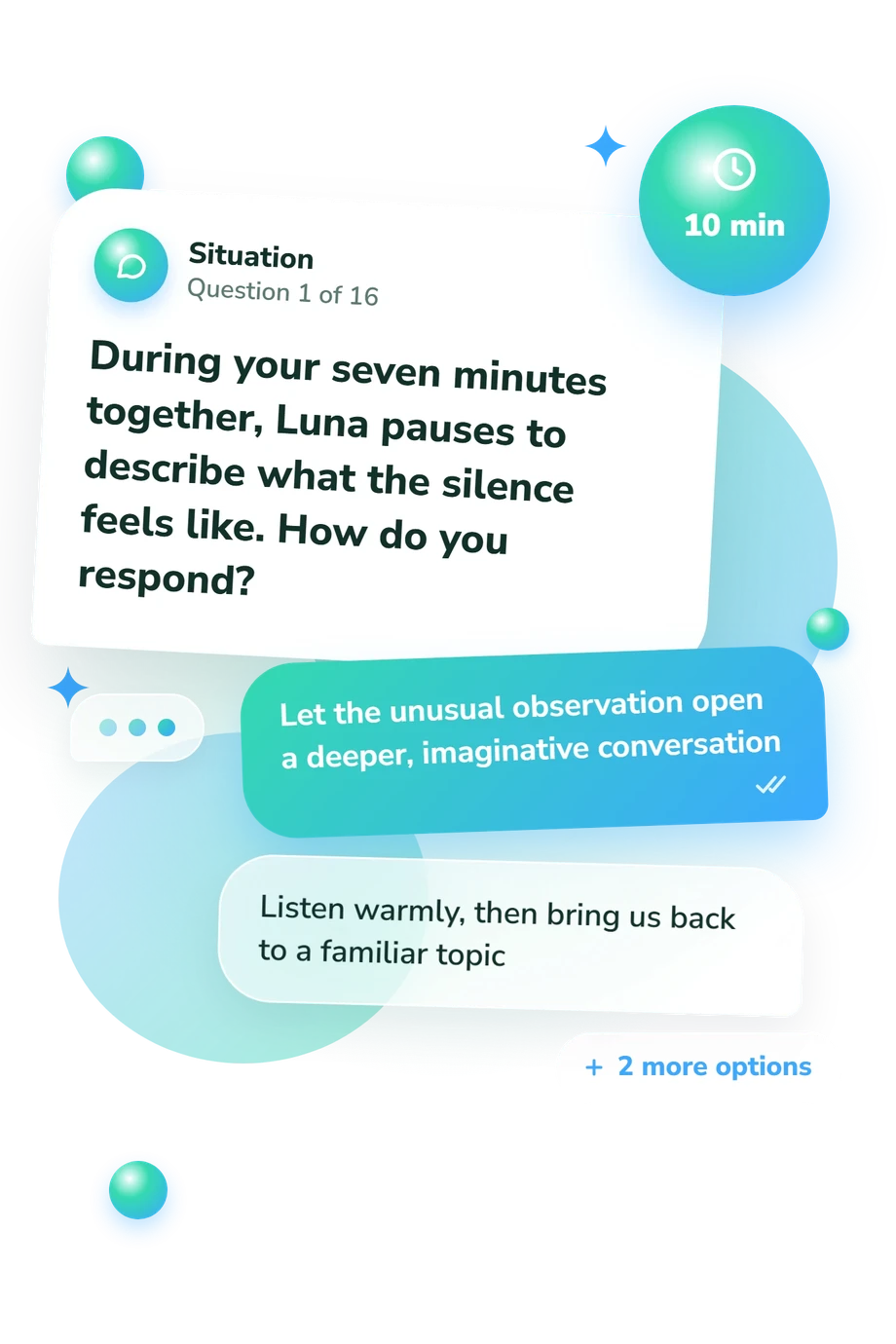
- Luna Lovegood Affinity (0-12) captures appeal toward imaginative freedom and unconventional honesty: Different Rhythms (0-4), Curious Connection (5-8), Strong Affinity (9-12).
Methodology and Evidence Base
Each item presents an imagined scenario involving one character and four responses. Choices vary intimacy pace, openness, uncertainty tolerance, and balance between structure and spontaneity. They are forced-choice indicators of situational compatibility, not separate personality traits.
Selections become four character-affinity scores. Response choices explore openness, pace, uncertainty, challenge, planning, and spontaneity, so the result connects your preferences with each character's style. The highest score is the strongest affinity; scores within one point form a blended result. The displayed bands are interpretive labels for those ranges. The resulting profile from this Harry Potter character compatibility quiz identifies which character received the strongest affinity. Because responses are self-reported, answers may shift with mood, character familiarity, and the imagined scene.
Conceptually, it is consistent with Wang and Teoh (2026) on fictional crushes and ideal standards, Karhulahti and Välisalo (2021) on romantic engagement with fictional characters, and Rain and Mar (2021) on adult attachment, character engagement, and appeal. Those studies place the questionnaire's themes within research on fictional attraction, while the profile itself is determined by the four displayed character scores.
- Wang, N. Z. M., & Teoh, A. N. (2026). Do the traits of fictional crushes and real-life ideals align? An investigation into ideal standards based on fictional fandoms. Psychology of Popular Media, 15(3), 389-397. 10.1037/ppm0000646
- Karhulahti, V.-M., & Välisalo, T. (2021). Fictosexuality, fictoromance, and fictophilia: A qualitative study of love and desire for fictional characters. Frontiers in Psychology, 11, 575427. 10.3389/fpsyg.2020.575427
- Rain, M., & Mar, R. A. (2021). Adult attachment and engagement with fictional characters. Journal of Social and Personal Relationships, 38(9), 2792-2813. 10.1177/02654075211018513
Updated: