
On This Day Quiz
How the Scales are Structured
Who Usually Takes This Test?
See How You Compare
Below is a preview of how scores are typically distributed across each scale.
Example Questions From the Test
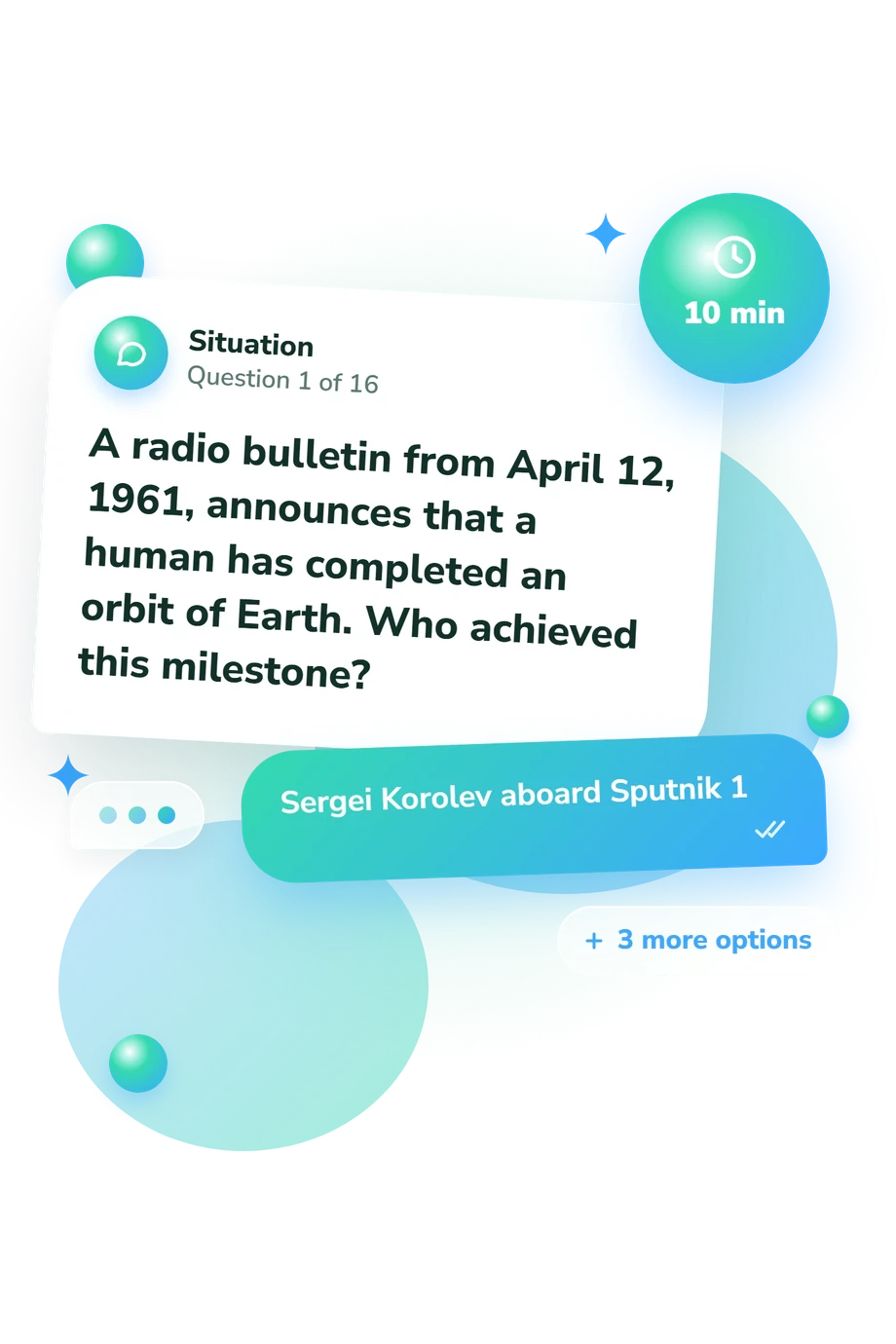
- Sergei Korolev aboard Sputnik 1
- Neil Armstrong aboard Apollo 11
- Valentina Tereshkova aboard Vostok 6
- Yuri Gagarin aboard Vostok 1
- Yuri Gagarin became the first human in space
- The United States launched Explorer 1
- The Soviet Union launched Sputnik 1
- Apollo 8 entered lunar orbit
- Mercury-Atlas 6, the first U.S. crewed orbital flight
- Apollo 11, the first mission to land humans on the Moon
- Apollo 8, the first crewed mission to orbit the Moon
- Apollo 13, which returned safely after an onboard explosion
On This Day Quiz - Description and methodology of the test
People who enjoy history or want to strengthen their recall of landmark anniversaries can use the On This Day Quiz to connect calendar clues with major events. It suits curious general readers who want a focused historical dates quiz, whether they are testing familiar knowledge or discovering periods worth revisiting. The result offers a concise picture of date-event recognition across eras and regions.
What This Assessment Explores
The calendar-centered format makes this a today in history quiz, asking you to match a precise date, historical clue, or public milestone with the correct event. The central dimension is chronological knowledge: knowing when events occurred and distinguishing related developments.
Questions draw on space exploration, war and diplomacy, political and civic milestones, independence, documents, and ancient and modern turning points. The result reflects how readily you connect dates with people, institutions, missions, conflicts, and decisions.
The displayed scale, On This Day Knowledge (0-16), summarizes overall date-event recognition. Its bands mean:
- Starting Point (0-6) indicates recognition of some major anniversaries, with dates and events still easy to confuse.
- Developing Chronology (7-12) reflects a useful grasp of prominent dates, while less familiar periods need strengthening.
- Strong Date Knowledge (13-16) shows accurate links between anniversary clues and events across multiple eras and regions.
Methodology and Scientific Basis
Each item presents a dated clue or event description with four answer choices. The options test recognition and discrimination because distractors may involve related people, missions, wars, documents, or nearby dates. The questionnaire presents one overall scale; separate period scores and item-weighting rules are not specified.
In practice, the questionnaire functions as a historical date quiz built around accessible public knowledge. It is conceptually consistent with the Yearly News Memory Test (Janssen et al., 2008), which examined memory for public events across time, but it is not presented as an adaptation of that instrument. Noone et al. (2014) offer a related method for measuring memory of public events, while Perlmutter et al. (1980) examined memory for historical events.
The questionnaire's score has no established norms or standardization in the cited research; it reflects performance on these date-linked recognition questions. Interpretation is strongest when you consider missed events and familiar periods. Prior exposure, education, cultural context, wording, and guessing can shift performance, so the score reflects accessible historical knowledge at completion rather than complete understanding.
- Steve M. J. Janssen, Jaap M. J. Murre, and Martijn Meeter. "Reminiscence bump in memory for public events." European Journal of Cognitive Psychology, 20(4), 738-764 (2008). 10.1080/09541440701554409
- Martha Noone, Maria Semkovska, Mary Carton, Ross Dunne, John-Paul Horgan, Breige O'Kane, and Declan M. McLoughlin. "Construction and updating of a public events questionnaire for repeated measures longitudinal studies." Frontiers in Psychology, 5, Article 230 (2014). 10.3389/fpsyg.2014.00230
- M. Perlmutter, R. Metzger, K. Miller, and T. Nezworski. "Memory of historical events." Experimental Aging Research, 6(1), 47-60 (1980). 10.1080/03610738008258345
Updated: