
Intellectual Property Rights Quiz
How the Scales are Structured
Who Usually Takes This Test?
See How You Compare
Below is a preview of how scores are typically distributed across each scale.
Example Questions From the Test
- An automatic transfer of every intellectual property right the photographer owns
- A patent claim covering the magazine's printing process
- A declaration that the photograph is in the public domain
- A copyright license limited by its agreed scope
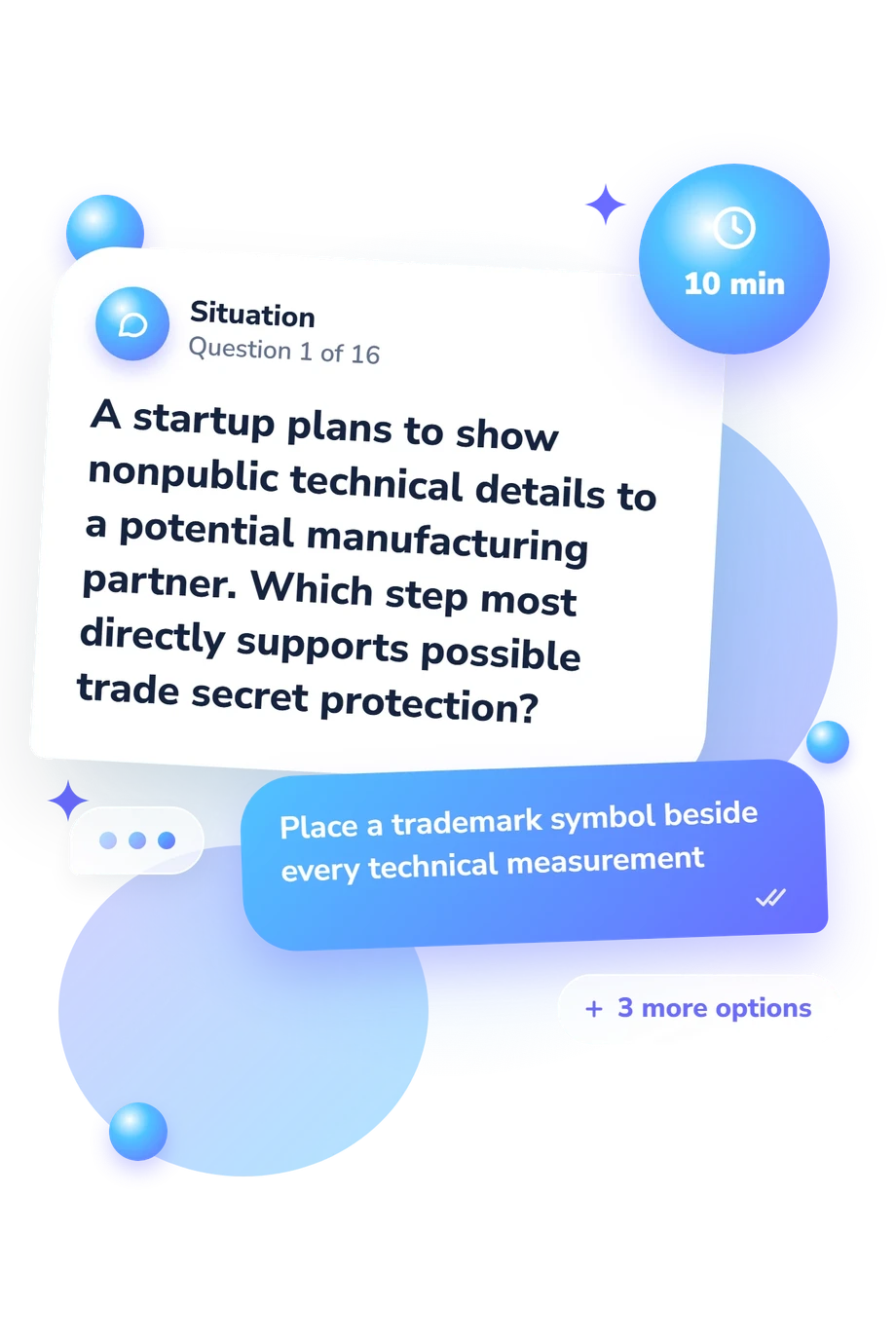
- Place a trademark symbol beside every technical measurement
- Post the complete details publicly so the date is documented
- Limit access and use an appropriate nondisclosure agreement before sharing the details
- Assume that all business conversations are protected without taking further measures
- Different features may qualify for different, potentially overlapping forms of intellectual property protection
- Copyright automatically protects the brand, mechanism, and secret method in the same way
- Patent protection prevents the company from using trademark or trade secret protection
- The company must choose exactly one form of intellectual property for the whole product
Intellectual Property Rights Quiz - Description and methodology of the test
Designed for readers who want a practical orientation to copyright, trademarks, patents, and trade secrets, this intellectual property rights quiz tests whether you can distinguish the rights that protect creative expression, commercial source, inventions, and confidential information. Students, creators, founders, and professionals can use this intellectual property assessment to identify learning priorities and sharpen everyday legal awareness without treating a score as a case-specific conclusion.
What This Assessment Measures
The questionnaire focuses on distinctions that arise in creative situations. Its scenarios cover licensing scope, expression versus ideas, public-domain status, trademark confusion, patent novelty, and trade-secret safeguards. They test how agreements affect commissioned work and uses.
The main themes in the items are:
- Copyright principles show how expression, permissions, quotations, and independent creation affect the result.
- Trademark principles indicate whether a name or logo identifies commercial source and may create confusion.
- Patent principles test disclosure, novelty, and a limited right to exclude.
- Trade-secret principles assess whether nonpublic information is protected through restricted access and safeguards.
- Overlapping rights clarify why one feature may involve several forms of protection.
On this IPR quiz, the score summarizes general knowledge rather than a personal legal position. Intellectual Property Rights Knowledge (0-16) is reported as Foundation Building (0-6), Developing Knowledge (7-12), or Strong Knowledge (13-16).
Methodology and Evidence Base
Each item presents a legal situation and four answer choices. The respondent selects an accurate general principle, so the assessment tests recognition and application rather than recall of statutory wording. Each correct answer earns one point, and the total is interpreted through the displayed bands.
Fast et al. (2017) offer a conceptual comparison limited to copyright and plagiarism-related items, rather than validating this questionnaire's coverage of trademarks, patents, or trade secrets. It examines gaps between intuitive judgments and legal principles but does not claim that this questionnaire reproduces its instrument or validation.
NIST, USPTO, and WIPO sources provide broader category or perception context, not validation of this questionnaire. They establish neither reliability nor population norms or validated interpretive thresholds for this version. The bands are educational result categories, not validated population cutoffs.
As an IP rights assessment, the result is a snapshot of responses to scenarios. Performance may shift with prior study, wording interpretation, attention, and the respondent’s recognition of jurisdiction-sensitive exceptions. Because rules vary by jurisdiction, the bands identify learning priorities rather than settle a dispute.
- Fast, Anne A., Kristina R. Olson, and Gregory N. Mandel (2017). Intuitive intellectual property law: A nationally-representative test of the plagiarism fallacy. PLoS ONE, 12(9), e0184315. 10.1371/journal.pone.0184315
- National Institute of Standards and Technology and United States Patent and Trademark Office (2012). IP Awareness Assessment. National Institute of Standards and Technology.
- World Intellectual Property Organization (2023). WIPO Pulse: Global intellectual property perception survey 2023. Geneva: World Intellectual Property Organization. 10.34667/tind.48527
Updated: