
GCF and LCM Quiz
How the Scales are Structured
Who Usually Takes This Test?
See How You Compare
Below is a preview of how scores are typically distributed across each scale.
Example Questions From the Test
- Use only the shared prime factors to get 6
- Multiply the original numbers to get 540
- Use each prime at its greatest exponent to get 90
- Use each prime at its smallest exponent to get 30
- 1, 2, and 3
- 1, 2, 3, 6, and 9
- 1, 2, 3, and 6
- 1, 2, 3, 4, and 6
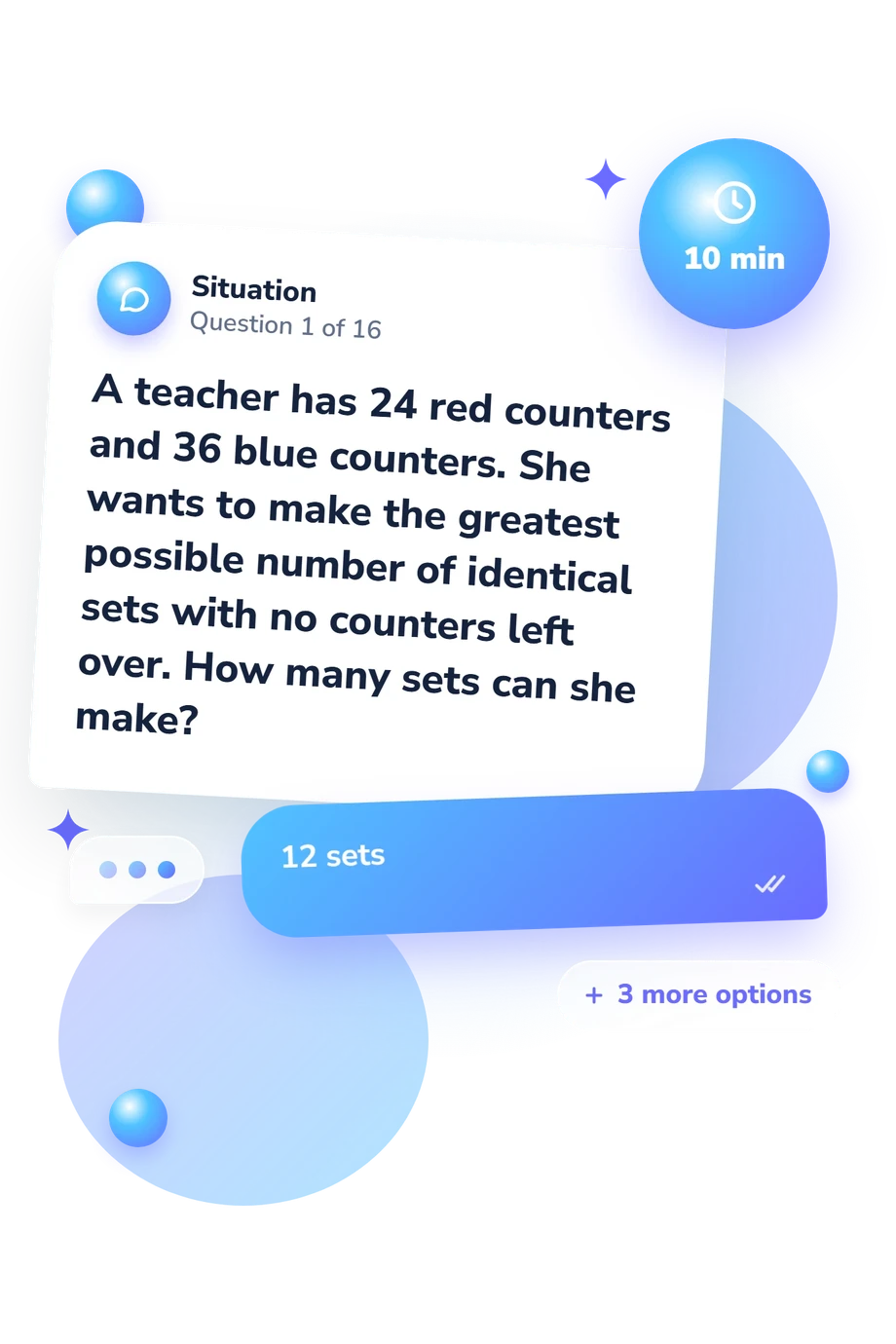
- 12
- 6
- 24
- 30
GCF and LCM Quiz - Description and methodology of the test
Students, teachers, and independent learners who want to check their readiness for more demanding arithmetic can use the GCF and LCM Quiz as a focused review. This quiz on GCF and LCM helps a learner decide whether to revisit core methods, practise selected skills, or move on to harder work with greater confidence.
What This Assessment Explores
This GCF and LCM assessment checks whether a learner can define, compare, calculate, and apply these concepts. Items cover shared divisors, common multiples, prime factorization, relatively prime numbers, and relationships between GCF and LCM. Grouping, tiling, fractions, and recurring schedules show whether knowledge transfers beyond definitions.
The main skill groups are:
- Concepts show whether you understand what GCF and LCM mean and how they relate.
- Procedures show whether you can list factors, use prime exponents, and identify common multiples.
- Applications show whether you can use these methods with quantities, measurements, fractions, and repeating events.
Results appear on GCF and LCM Knowledge (0-16): Foundations to build (0-6) suggests review of core ideas; Developing knowledge (7-12) reflects many standard solutions with room to strengthen application; Strong knowledge (13-16) indicates reliable performance across calculations and practical problems.
Methodology and Evidence Base
Each item presents a definition, calculation, comparison, or scenario with four choices. Solving requires recognizing the task, selecting a factor or multiple method, and checking the result against the conditions. The format combines conceptual, procedural, and applied reasoning.
The GCF-and-LCM misconception study by Sutarto and colleagues offers the closest comparison because it examines misunderstandings around GCF, LCM, factor lists, and prime factorization. Related work by Li and Tsai provides evidence on problem-based work, mathematical performance, and attitudes. Materials from the Mathematics Assessment Resource Service add a practical framework for factors and multiples. The quiz's topics are consistent with these sources, which provide context for its focus on definitions, procedures, and applications.
When used for GCF and LCM practice, the questionnaire converts answers into a total score, but the point assignment is not specified. The displayed bands describe performance on these questions and can help the learner decide which skills to revisit. Guessing, attention, prior instruction, and confidence can affect answers, so missed items are best used to direct study, not as a fixed measure of ability.
- Sutarto, Intan Dwi Hastuti, Tomi Listiawan, Sutopo, Aan Komariah, and Mohammadreza Dabirnia. (2021). Fourth-Grade Primary School Students’ Misconception on Greatest Common Factor and Least Common Multiple. Education Research International, 2021, Article 6581653, 11 pages. 10.1155/2021/6581653
- Hui-Chuan Li and Tsung-Lung Tsai. (2022). The effects of a problem-based learning intervention on primary students’ performance on greatest common factor and least common multiple and on their attitudes towards mathematics. International Journal of Innovation and Learning, 31(1), 51-69. 10.1504/IJIL.2022.119636
- Mathematics Assessment Resource Service. (2015). Finding Factors and Multiples. Nottingham: Shell Centre, University of Nottingham.
Updated: