
Noun and Adjective Quiz
How the Scales are Structured
Who Usually Takes This Test?
See How You Compare
Below is a preview of how scores are typically distributed across each scale.
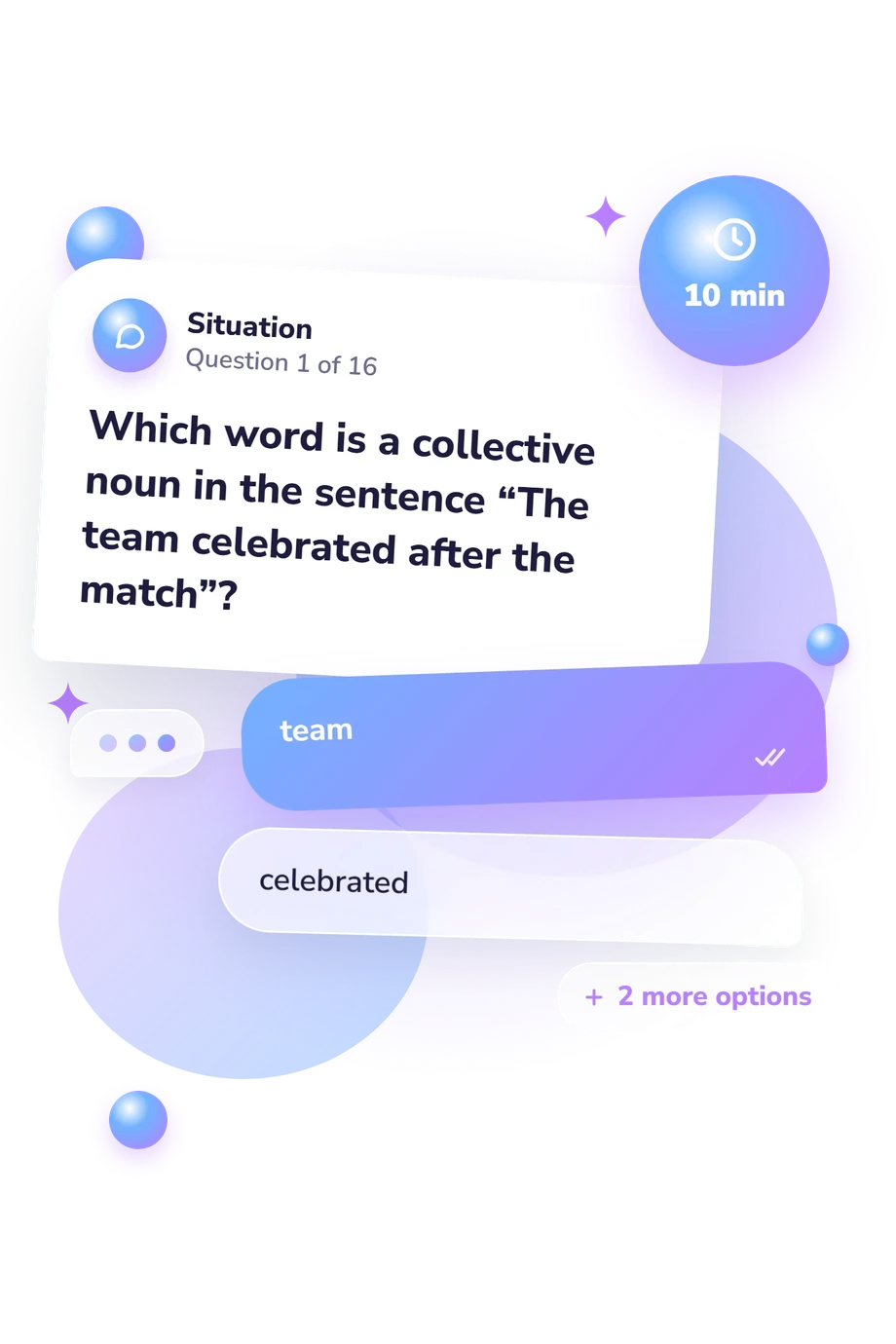
Example Questions From the Test
- team
- celebrated
- after
- match
- Please light the candle.
- She carried a light suitcase.
- The light shone through the window.
- The suitcase felt light.
- kindly
- kinder
- kindest
- kindness
Noun and Adjective Quiz - Description and methodology of the test
Designed for learners who want to check practical English grammar, the noun and adjective quiz focuses on recognizing word classes in ordinary sentences. It suits students, teachers planning revision, and independent learners who want a clear snapshot of current understanding. Its focus on whether words function as nouns or adjectives makes this grammar quiz useful for choosing which grammar concepts to practise next.
What This Assessment Measures
Rather than testing vocabulary in isolation, the assessment examines how you recognize grammatical roles in context. Items distinguish nouns, adjectives, and verbs while sampling collective, proper, abstract, and possessive nouns, plus noun formation, plurals, comparatives, and context-sensitive use.
Your result appears on the Noun and Adjective Knowledge scale (0-16), with three catalogue bands:
- Foundations to build (0-6) indicates that core definitions and examples need review.
- Developing knowledge (7-12) shows recognition of many forms, with context and less familiar examples still requiring practice.
- Strong knowledge (13-16) reflects accurate application across varied sentences.
These bands describe performance on this quiz, not overall English proficiency. The result offers a focused map for revision and, as a noun and adjective test, shows how accurately you identify and apply these particular concepts in sentence contexts.
Methodology and Evidence Base
Each item presents a sentence or short phrase with four answer choices. You select the option that identifies a word’s class, supplies a suitable form, or explains its function in context. The format combines recognition with limited application rather than asking for definitions alone.
The displayed score summarizes performance across the items; higher results indicate stronger performance within these tasks. Its bands are descriptive levels for these quiz items, not norm-referenced cutoffs, so they do not rank performance against a wider population.
The quiz's focus on word-class awareness is conceptually consistent with a 2026 study by Silmawati and Tursina, while it is not an adaptation or standardized administration of that study. Huddleston and Pullum provide a broader account of English word classes and their behavior in sentences, supporting the quiz's treatment of nouns and adjectives.
As a parts of speech quiz, it can reveal misunderstandings shaped by current learning, attention, or familiarity with particular examples. Use the result to choose targeted exercises and explanations, treating it as a focused learning check rather than a complete measure of English ability.
- Silmawati, S., & Tursina, P. (2026). EFL College Students’ Understanding and Use of Nouns, Verbs, and Adjectives: Examining Word Class Awareness in Writing. Journal Informatic, Education and Management (JIEM), 8(2), 895-903. 10.61992/jiem.v8i2.415
- Huddleston, R., & Pullum, G. K. (2002). The Cambridge Grammar of the English Language. Cambridge University Press.
Updated: