
Leap Year Quiz
How the Scales are Structured
Who Usually Takes This Test?
See How You Compare
Below is a preview of how scores are typically distributed across each scale.
Example Questions From the Test
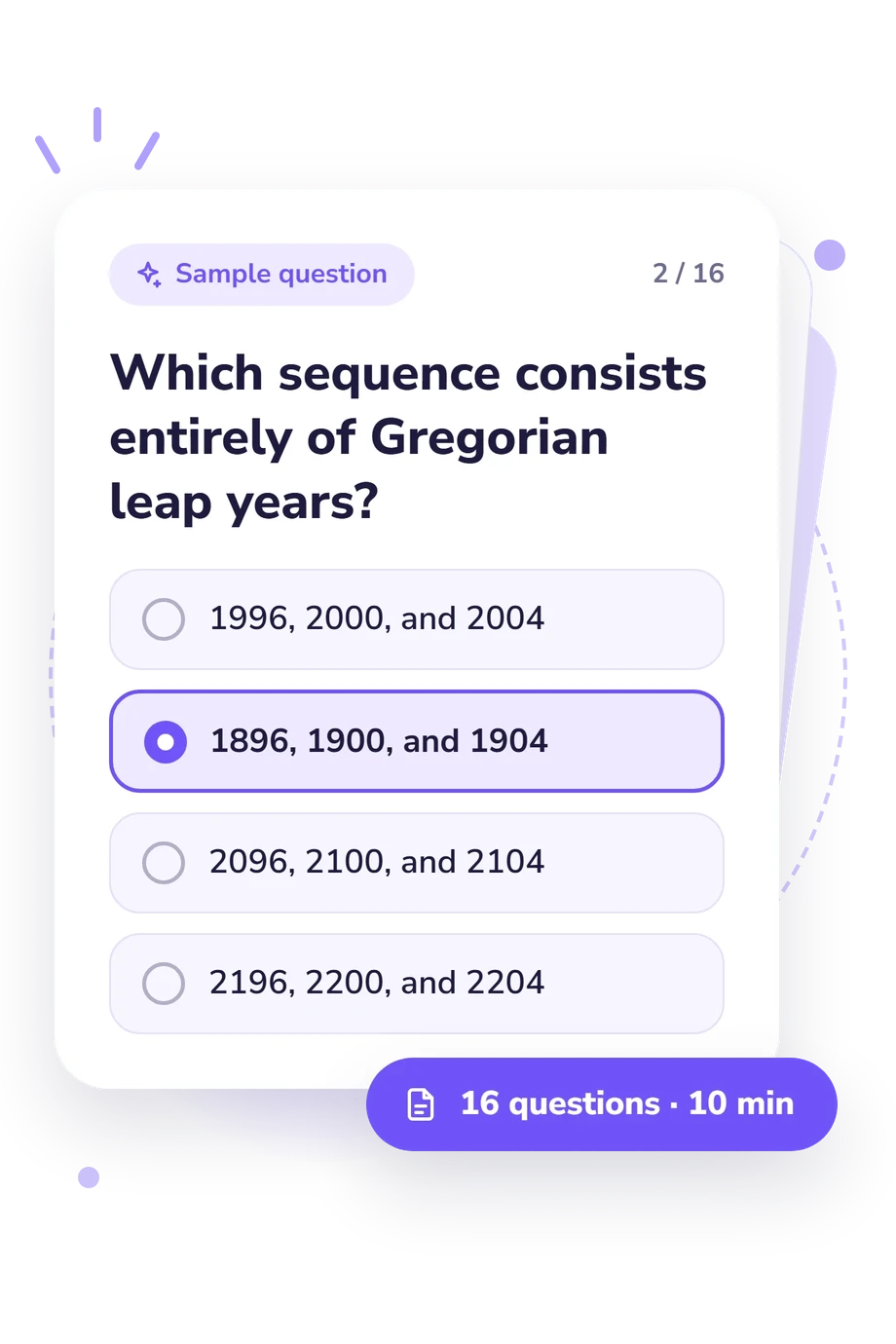
- 1996, 2000, and 2004
- 1896, 1900, and 1904
- 2096, 2100, and 2104
- 2196, 2200, and 2204
- 27
- 30
- 31
- 29
- Tuesday
- Thursday
- Wednesday
- Monday
Leap Year Quiz - Description and methodology of the test
Anyone who wants a clearer grasp of calendar rules can use this assessment to check whether familiar date calculations rest on solid understanding. Rather than rewarding memorized dates alone, this leap year quiz focuses on the reasoning behind extra days and calendar exceptions. This leap year trivia quiz helps learners, curious adults, and anyone who wants to identify gaps in everyday calendar knowledge.
What This Assessment Explores
Calendar knowledge here concerns how the Gregorian system decides when an extra day is needed and how that choice affects dates across years and centuries. The questions connect rules with consequences, including why 1900 and 2000 differ. This Gregorian calendar quiz suits learners reviewing chronology or date arithmetic.
The result covers four areas:
- Rule recognition checks whether you can apply divisibility by 4, 100, and 400.
- Calendar arithmetic shows whether you can calculate year lengths, weekday shifts, and date intervals.
- Century exceptions measure how well you handle cases that differ from the simple four-year pattern.
- Calendar purpose connects leap days with keeping dates aligned with Earth’s seasonal year.
Together, these areas form Leap Year Knowledge, 0-16. Foundations to build (0-6) signals gaps; Developing knowledge (7-12) shows core understanding with some exceptions to review; Strong knowledge (13-16) reflects accurate command of the rules and applications.
Methodology and Scientific Basis
Each item uses a question with four answer choices and one best answer. Scoring is additive: every correct response contributes one point, so the total reflects performance across rules, calculations, exceptions, and applications without separate weighting. The result is easy to inspect, although it does not show which misconception caused an error.
Reingold and Dershowitz (2018) supplies the calendrical framework for the Gregorian rules, while the United States Naval Observatory explains the leap-year convention in astronomical terms. Seidelmann and Urban add context on calendar timekeeping and the relationship between civil calendars and Earth’s motion. These sources support the content; they do not make this questionnaire an adaptation of their works.
With its educational role, the leap year test is a structured knowledge check rather than a standardized instrument. It has no population norms, reliability estimate, or independently established diagnostic cutoff. Performance can reflect attention, arithmetic slips, prior exposure, or uncertainty about wording. Reviewing missed rules against calendar logic can show what deserves further study, but one score cannot measure every aspect of mathematical or astronomical ability.
- Reingold, Edward M., and Nachum Dershowitz. Calendrical Calculations: The Ultimate Edition. 4th ed., Cambridge University Press, 2018. 10.1017/9781107415058
- United States Naval Observatory, Astronomical Applications Department. Leap Years. n.d.
- Seidelmann, P. Kenneth, and Sean E. Urban, eds. Explanatory Supplement to the Astronomical Almanac. 3rd ed., University Science Books, 2013.
Updated: