
Freedom Struggle Quiz
How the Scales are Structured
Who Usually Takes This Test?
See How You Compare
Below is a preview of how scores are typically distributed across each scale.
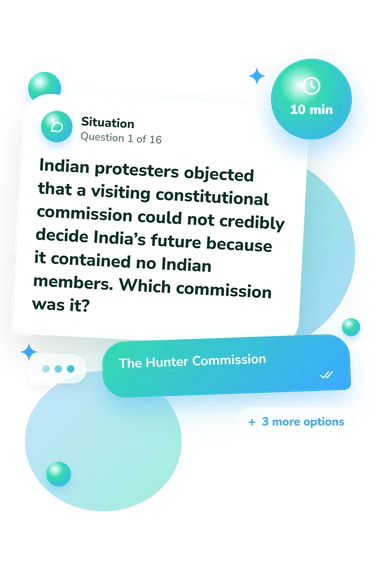
Example Questions From the Test
- The British accepted the demand for dominion status
- Congress decided to support the Simon Commission
- Protesters killed police personnel at Chauri Chaura
- The Khilafat leaders withdrew before the campaign began
- Detaining people without trial
- Dividing provinces along religious lines
- Restricting Indians from buying salt
- Ending elected representation in municipalities
- 1875
- 1885
- 1905
- 1919
Freedom Struggle Quiz - Description and methodology of the test
Designed for learners, students, and anyone revisiting the history of independence, this assessment checks whether major events can be connected rather than recalled as isolated facts. The freedom struggle quiz is useful when you want a focused measure of historical understanding rather than a broad survey of world history. This assessment uses an Indian independence quiz format to support focused review of the subject.
What This Assessment Explores
Questions cover India’s anti-colonial struggle from early resistance and mass movements to constitutional change, partition, and independence. The assessment suits readers who want to connect leaders, organizations, laws, strategies, and turning points.
The four-option structure asks you to select one of four historical answer choices, so this Indian freedom-struggle quiz with answers to choose from tests whether you can distinguish related events, dates, and policies.
The main areas represented are:
- Colonial institutions show whether you recognize commissions, repressive measures, and reforms.
- Protest strategies show whether you distinguish non-cooperation, civil disobedience, boycott, satyagraha, and Quit India.
- Leaders and organizations connect Gandhi, Bose, Congress bodies, and nationalist groups with their roles.
- Chronology tests whether you can place sessions, agreements, campaigns, and independence decisions in sequence.
The displayed result is Indian Freedom Struggle Knowledge (0-16): Foundation to build (0-6), Developing knowledge (7-12), and Strong knowledge (13-16).
Methodology and Evidence Base
Each item presents a historical prompt with four answer choices. Some identify commissions, movements, laws, organizations, or agreements; others require chronology or matching a campaign with its objective. The questionnaire is an Indian history knowledge test: its multiple-choice items assess historical knowledge and recognition of relationships, not just isolated facts. This is a structured multiple-choice knowledge assessment, not a personality scale.
The result is a total from 0 to 16, with no stated weighting rule for individual options. Its bands are descriptive levels for this questionnaire, not population norms or a standardized educational grade: higher performance indicates stronger knowledge of the tested material, while lower performance points to topics for review.
Chandra et al. (1989) and Sarkar (1989) provide historical content on mass action, organizations, constitutional change, chronology, and movement relationships reflected in the questions. The questionnaire is not an adaptation of either book, and neither source establishes psychometric properties for its online format.
Prior knowledge, language familiarity, attention to wording, and guessing can affect performance. The result captures recognition at completion, not the full depth of historical understanding.
- Chandra, Bipan, Mridula Mukherjee, Aditya Mukherjee, K. N. Panikkar, and Sucheta Mahajan. India's Struggle for Independence, 1857-1947. New Delhi: Penguin Books, 1989.
- Sarkar, Sumit. Modern India, 1885-1947. London: Palgrave Macmillan, 1989. DOI 10.1007/978-1-349-19712-5
Updated: