
Geometry Transformation Quiz
How the Scales are Structured
Who Usually Takes This Test?
See How You Compare
Below is a preview of how scores are typically distributed across each scale.
Example Questions From the Test
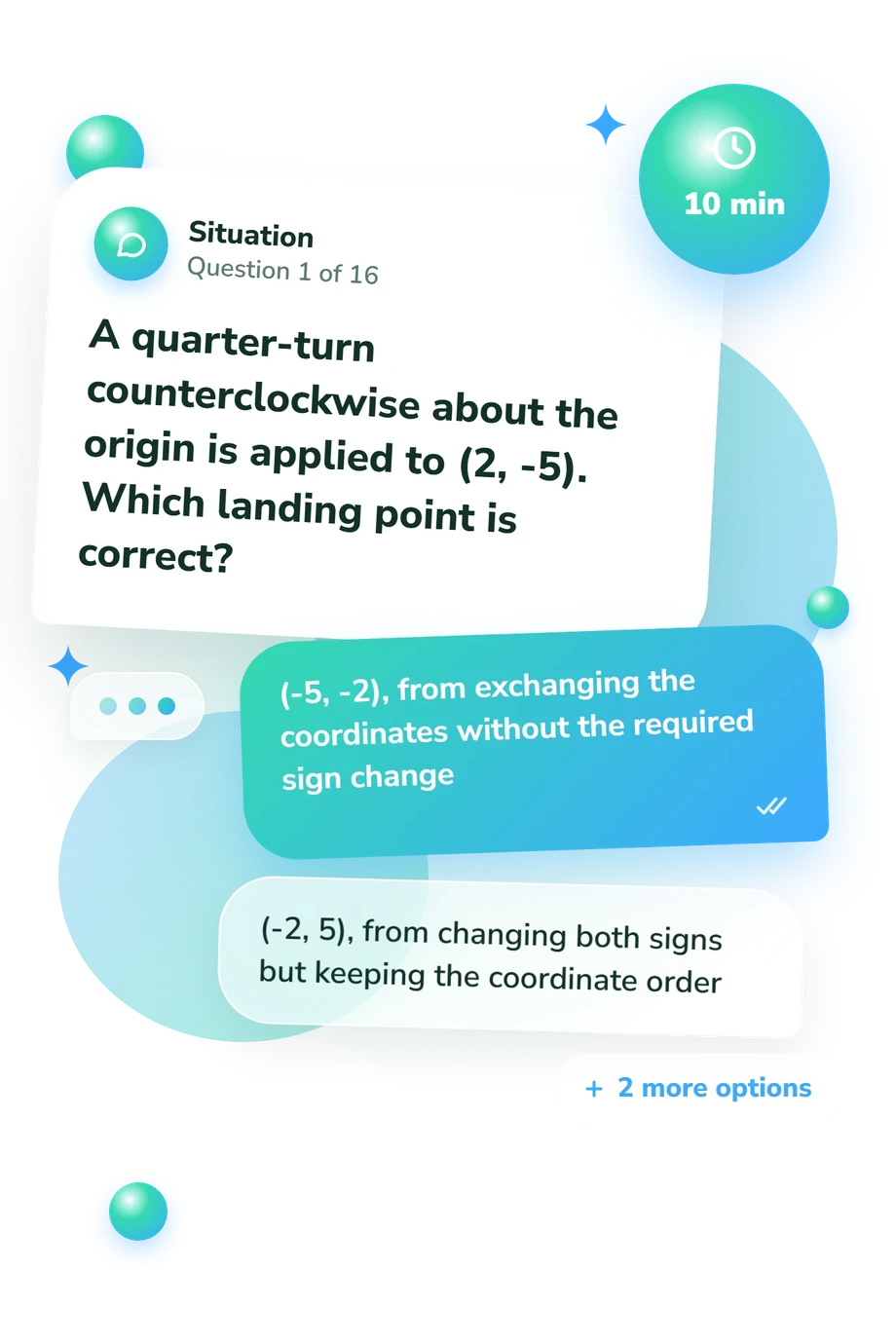
- Swap the coordinates: x′ = y and y′ = x
- Keep x and reverse the sign of y: x′ = x and y′ = -y
- Reverse the sign of x and keep y: x′ = -x and y′ = y
- Swap the coordinates and reverse both signs: x′ = -y and y′ = -x
- 12 units
- 5 units
- 5 units
- 3 units
- Add 1 to x and subtract 5 from y
- Subtract 7 from x and add 3 to y
- Add 7 to x and subtract 3 from y
- Subtract 1 from x and add 5 to y
Geometry Transformation Quiz - Description and methodology of the test
Students and independent learners can use the geometry transformation quiz to check their command of coordinate-based movements. It gives an overall indication of current knowledge and whether further practice may be useful; reviewing individual answers, rather than the score alone, can help locate specific topics. Before revision or after instruction, this quiz on transformations in geometry can reveal a useful study focus.
What This Assessment Explores
The assessment asks you to reason with four transformation families and their effects on coordinates and figures. Rotations cover quarter-turns and half-turns; reflections test mirror lines and sign changes; translations examine movement vectors; dilations test scale factors, distance from a center, and preserved properties. Other items connect these rules with congruence, orientation, area, perimeter, and angle measures.
The displayed Geometry Transformation Knowledge scale runs from 0-16. Its result bands are:
- Foundations to Review (0-6) indicates that transformation rules, coordinate changes, and preserved properties need review.
- Developing Knowledge (7-12) indicates that core ideas are present, with practice useful for compositions, orientation, or dilation reasoning.
- Strong Knowledge (13-16) indicates consistent command of common transformations in coordinate-based situations.
Because it covers coordinate transformations, the assessment can help identify a practical study focus.
Methodology and Evidence Base
Each item presents four answer choices for a coordinate or figure problem. Distractors expose errors such as exchanging coordinates without the needed sign change, altering the wrong coordinate, confusing a preimage with its image, or treating a dilation as rigid. The format checks rule application rather than definition recall.
Selected responses are summarized on the questionnaire’s knowledge scale and placed in a displayed band. No population norms or grade placement are attached. Performance can reflect prior instruction, time pressure, careful reading, attention, and familiarity with coordinate notation. Use the result to guide geometric transformation practice and revisit the rule behind an uncertain answer.
Conceptually, the content aligns with Hollebrands (2003), which examined students’ understanding of transformations in a technology-supported setting. Fife, James, and Bauer (2019) described a learning progression, while Yanik and Flores (2009) addressed learning translation. Together, these studies support the focus on coordinate reasoning and development, but they do not show that this online questionnaire is an adaptation, standardized instrument, or validated diagnostic measure. It is a snapshot of current performance.
- Hollebrands, K. F. (2003). High school students’ understandings of geometric transformations in the context of a technological environment. The Journal of Mathematical Behavior, 22(1), 55-72. 10.1016/S0732-3123(03)00004-X
- Fife, J. H., James, K., & Bauer, M. (2019). A learning progression for geometric transformations. ETS Research Report Series, 2019(1), 1-16. 10.1002/ets2.12236
- Yanik, H. B., & Flores, A. (2009). Understanding rigid geometric transformations: Jeff’s learning path for translation. The Journal of Mathematical Behavior, 28(1), 41-57. 10.1016/j.jmathb.2009.04.003
Updated: