
Present Progressive English Quiz
How the Scales are Structured
Who Usually Takes This Test?
See How You Compare
Below is a preview of how scores are typically distributed across each scale.
Example Questions From the Test
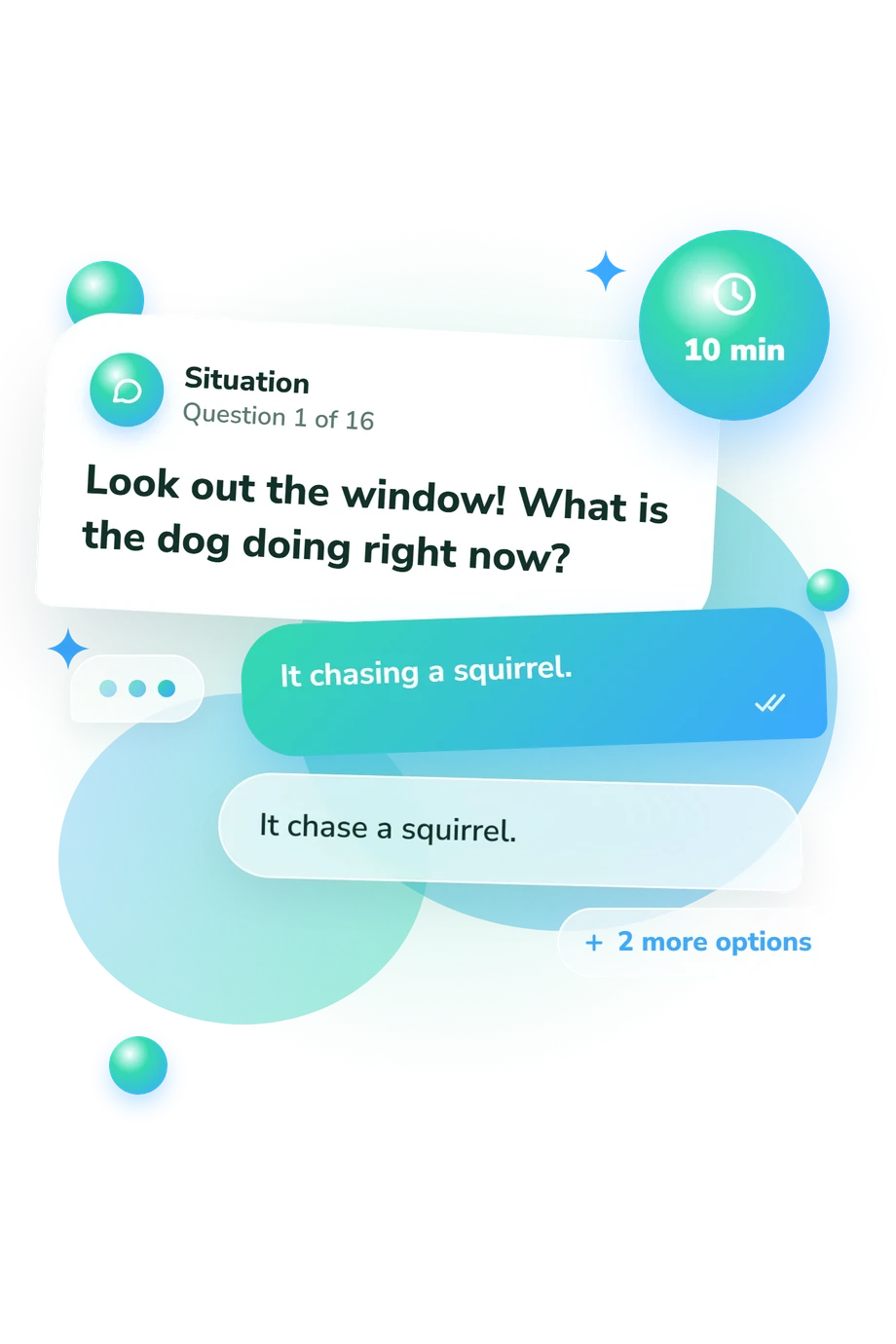
- It chasing a squirrel.
- It chase a squirrel.
- It is chasing a squirrel.
- It does chase a squirrel.
- We meet the dentist right now tomorrow.
- We meeting the dentist tomorrow at 10:00.
- We are meet the dentist tomorrow at 10:00.
- We are meeting the dentist tomorrow at 10:00.
- Maya isn't wearing a coat.
- Maya not wearing a coat.
- Maya doesn't wearing a coat.
- Maya aren't wearing a coat.
Present Progressive English Quiz - Description and methodology of the test
Whether you are revising English grammar, checking a recurring classroom difficulty, or looking for a focused self-check, Present Progressive Quiz English examines how accurately you use actions in progress and temporary situations. It gives a practical snapshot of form and meaning for learners who want to target practice efficiently. As a present progressive tense quiz, it connects grammar choices with ordinary contexts rather than isolated verb patterns.
What This Assessment Explores
The items place the tense in short situations, showing why each form is needed. They check be, -ing spelling, simple-present contrasts, and grammar in context. As a present progressive grammar test, this quiz groups items by the situations that require the tense. The question themes are:
- Actions happening now are identified through descriptions of events in progress.
- Temporary situations are distinguished from routines and permanent facts.
- Questions, negatives, and short answers show whether sentence structure remains accurate.
- Verb choice and spelling reveal control of forms such as lying, running, and knowing.
The single result is reported as Present Progressive Knowledge (0-16). Foundation (0-6) indicates that you may need to review forms of be, verb endings, and common uses; Developing (7-12) shows understanding with some areas to strengthen; Strong command (13-16) indicates accurate use across common forms and contexts. These bands describe performance on this quiz, not overall English proficiency.
Methodology and Scientific Basis
Each item offers four answer choices, and the reader selects the sentence that best fits the context. The set samples affirmative, negative, and interrogative forms, short answers, temporary arrangements, changing situations, and the passive. One displayed score summarizes performance across these contexts; it cannot separate the reader’s strengths and weaknesses by topic.
The method is contextual multiple-choice grammar testing. It is conceptually consistent with Jabbari and Salimi (2015), whose research examined acquisition of the simple and present progressive tenses. Römer’s corpus-driven account clarifies how progressive forms vary with event type and discourse context, while Huddleston and Pullum describe their grammatical form and uses. These sources provide conceptual context rather than evidence validating the quiz. This online quiz has no reported standardisation or norm-based interpretation and is not an adaptation of those works.
Practice with the present progressive can use this aggregate result as a broad check of overall performance, not as a guide to which forms need attention. Since the quiz samples selected written contexts, guessing can affect performance, and the result cannot show consistency in spontaneous speech or writing.
- Jabbari, Ali Akbar, and Hemrah Salimi. "L3 Acquisition of Simple and Present Progressive Tenses by Iranian EFL Learners." SAGE Open, vol. 5, no. 4, 2015, pp. 1-9. 10.1177/2158244015615163
- Römer, Ute. Progressives, Patterns, Pedagogy: A Corpus-Driven Approach to English Progressive Forms, Functions, Contexts and Didactics. Studies in Corpus Linguistics, vol. 18, John Benjamins Publishing Company, 2005. 10.1075/scl.18
- Huddleston, Rodney D., and Geoffrey K. Pullum. The Cambridge Grammar of the English Language. Cambridge University Press, 2002.
Updated: