
Is My Relationship One Sided Quiz
How the Scales are Structured
Who Usually Takes This Test?
See How You Compare
Below is a preview of how scores are typically distributed across each scale.
Example Questions From the Test
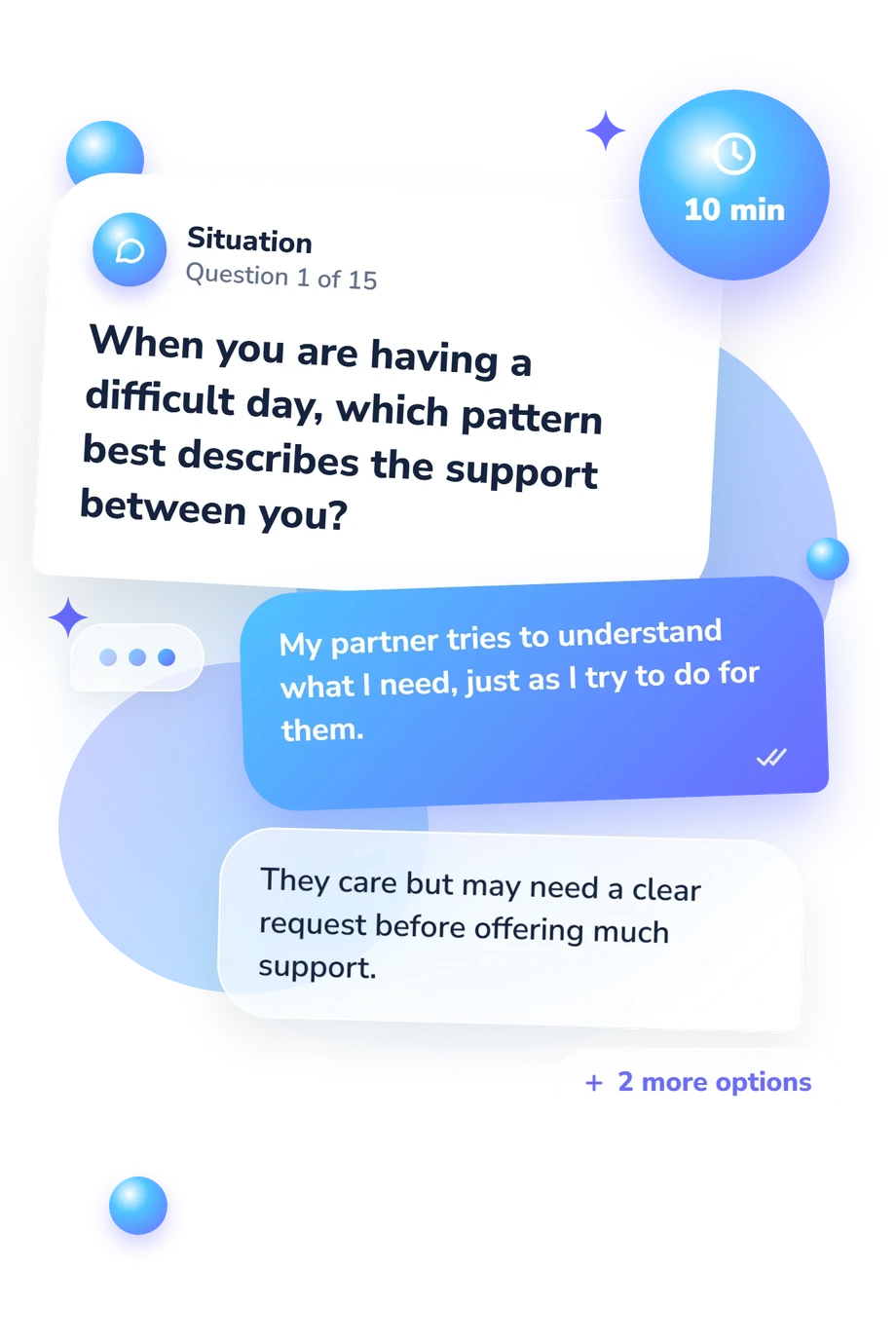
- My partner tries to understand what I need, just as I try to do for them.
- They care but may need a clear request before offering much support.
- I often receive limited attention even after explaining what would help.
- There is little room for my distress, while I am still expected to hold theirs.
- We divide tasks in a way we both regard as workable, even if the split is not identical.
- I handle somewhat more, while my partner reliably completes agreed responsibilities.
- I carry most of the planning and must often remind my partner about their part.
- I am expected to manage nearly everything, including problems caused by their lack of follow-through.
- My partner adjusts expectations and takes on more where possible, as I would for them.
- They are understanding, although I still coordinate most of the changes.
- I remain responsible for keeping things running despite clearly communicating my limits.
- My limits are disregarded, and I face pressure or consequences for not continuing my usual effort.
Is My Relationship One Sided Quiz - Description and methodology of the test
For readers who are questioning whether effort and care are moving in both directions, the Is My Relationship One Sided Quiz offers a structured way to examine recurring relationship patterns. It is suited to anyone reflecting on emotional support, contact, planning, and follow-through. As a one-sided relationship quiz, it helps turn a vague sense of imbalance into specific areas to discuss, observe, or reconsider.
What This Assessment Explores
It examines reciprocity across emotional care, contact, planning, and responsibility. The questionnaire separates emotional attention from practical effort, clarifying relationship imbalance.
The three displayed dimensions are:
- Emotional Reciprocity (0-15) reflects less attention to feelings, experiences, or repair needs: Mutual Care (0-5) suggests two-way attention; Uneven Care (6-10) may be weighted toward your partner; Emotional Effort Falls to You (11-15) may mean more repair effort from you.
- Initiative and Availability (0-15) reflects carrying contact, time arrangements, or connection: Shared Momentum (0-5) suggests mutual effort; Uneven Momentum (6-10) may involve more; Mostly Carried by You (11-15) may reflect connection relying on you.
- Shared Investment and Responsibility (0-15) reflects disproportionate compromise, follow-through, practical effort, planning, flexibility, or commitment: Shared Investment (0-5) suggests shared; Uneven Investment (6-10) may involve compensation; Responsibility Rests With You (11-15) may reflect reliance on labor.
Methodology and Scientific Basis
Each item is a self-report scenario with four ordered response choices. The options move from broadly mutual functioning toward patterns where one partner carries more emotional or practical work. The result screen displays the three dimensions on their stated ranges, with reflective bands rather than validated norms; no per-answer scoring rule is stated. The questionnaire is not presented as an adaptation or digital administration of the cited measures.
Crasta et al. (2021) on perceived partner responsiveness and Okuda’s (1994) analysis of equity, investment, and reciprocity provide conceptual parallels for responsiveness, reciprocal effort, and equity. The Investment Model Scale (Rusbult et al., 1998) is relevant only to investment, while Bringle, Winnick, and Rydell (2013) offer a limited parallel for unreciprocated feeling.
Its method treats relationship reciprocity as a pattern across repeated situations rather than one disagreement. Current stress, memory, self-awareness, and a partner’s different perspective can affect answers. Read the result as a prompt to examine examples and discuss needs, not as proof of motives, relationship quality, or diagnosis; threats, coercion, humiliation, fear, force, or injury warrant support independently of the score.
- Bringle, Robert G., Terri Winnick, and Robert J. Rydell. (2013). The Prevalence and Nature of Unrequited Love. SAGE Open, 3(2), 1-15. 10.1177/2158244013492160
- Crasta, Dev, Ronald D. Rogge, Michael R. Maniaci, and Harry T. Reis. (2021). Toward an optimized measure of perceived partner responsiveness: Development and validation of the perceived responsiveness and insensitivity scale. Psychological Assessment, 33(4), 338-355. 10.1037/pas0000986
- Rusbult, Caryl E., John M. Martz, and Christopher R. Agnew. (1998). The Investment Model Scale: Measuring commitment level, satisfaction level, quality of alternatives, and investment size. Personal Relationships, 5(4), 357-387. 10.1111/j.1475-6811.1998.tb00177.x
- Okuda, Hidetaka. (1994). Social exchange processes in romantic relationships: A test of equity, investment and reciprocity models. Japanese Journal of Experimental Social Psychology, 34(1), 82-91. 10.2130/jjesp.34.82
Updated: