
Future Car Quiz
How the Scales are Structured
Who Usually Takes This Test?
See How You Compare
Below is a preview of how scores are typically distributed across each scale.
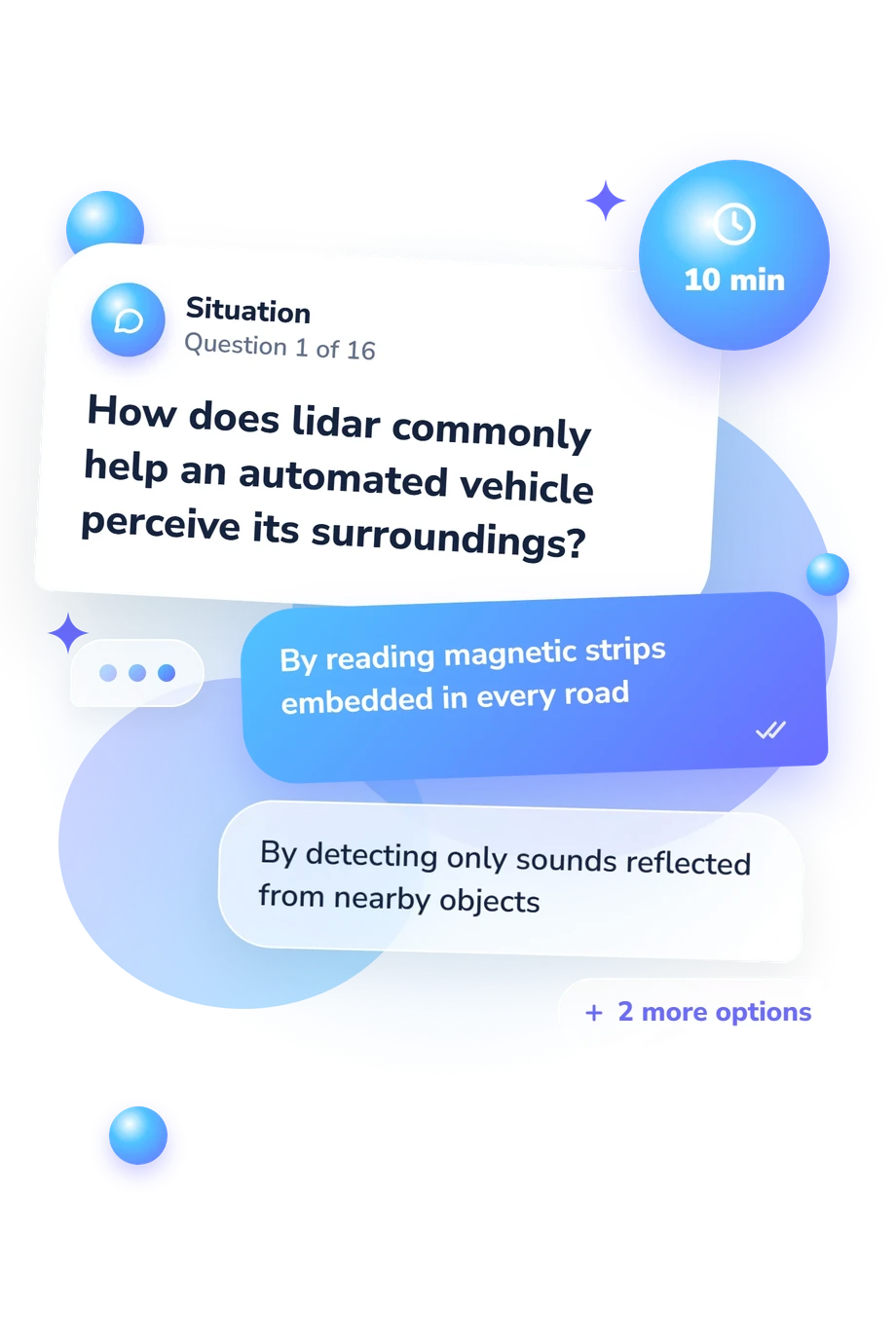
Example Questions From the Test
- Discharge the battery completely before plugging in
- Turn off regenerative braking for the entire journey
- Precondition the battery before reaching the charger
- Inflate the tires beyond the vehicle maker’s specified pressure
- It stores energy mechanically in rotating components
- It uses a solid material to conduct ions between its electrodes
- It generates electricity by combining hydrogen and oxygen
- It can operate without positive and negative electrodes
- To apply only the mechanical brakes at lower speeds
- To cool the battery by increasing airflow beneath the car
- To disconnect the motor so the car can coast indefinitely
- To recover some of the car’s kinetic energy as electrical energy
Future Car Quiz - Description and methodology of the test
Drivers, students, and curious readers can use this assessment to check how well they understand the systems shaping modern mobility. The future car quiz connects charging, range, automation, and battery care with the technical ideas behind them. As a future car test, it offers a practical snapshot of current knowledge and points toward topics worth reviewing. The result is educational rather than a measure of driving skill or personal suitability.
What This Assessment Explores
The questionnaire measures practical knowledge of technologies shaping electric, connected, and automated vehicles. It suits readers who want to understand how these systems work and how they affect real driving situations.
Topics include battery balancing, AC charging, thermal management, regenerative braking, sensor fusion, automation levels, software updates, grid exchange, life-cycle impact, and hydrogen propulsion. This electric vehicle knowledge test focuses on mechanisms and decisions rather than brand trivia.
The assessed areas are represented by these result themes:
- Future Car Knowledge: 0-16 counts correct answers; Foundation Builder (0-6) indicates emerging familiarity, Developing Navigator (7-12) shows broad working knowledge, and Future-Mobility Expert (13-16) shows strong coverage.
- Electrification and batteries show your grasp of storage, charging, heating, and energy recovery.
- Automation and perception show whether you distinguish sensing, data fusion, and driver supervision.
- Connected mobility and sustainability show whether you recognize updates, grid exchange, and life-cycle comparison.
Methodology and Evidence Base
Each item uses a multiple-choice format with one technically strongest answer among four options. The questions test recognition and application, asking the respondent to connect a component or principle with a consequence such as aerodynamic drag, battery preconditioning, or continuous supervision during Level 2 assistance.
Scoring is knowledge-based: the result reflects the total of correct responses, so a higher result indicates broader command of the tested concepts, not greater driving ability or ownership experience. Unfamiliar terminology, guessing, and attention can affect this snapshot.
The content is conceptually consistent with Larminie and Lowry (2012), whose work supports the electric-vehicle, battery, charging, and efficiency items. Automation terminology follows SAE J3016_202104, while the sensing questions align with distinctions reviewed by De Jong Yeong and colleagues (2021). Vehicle-to-grid content is consistent with principles discussed by Kempton and Tomic (2005).
As an electric car technology test, it rewards system understanding rather than brand memorization. The sources provide a technical evidence base, but they do not make this online questionnaire standardized or norm-referenced; use the result to identify topics for further learning.
- Larminie, James, and John Lowry. Electric Vehicle Technology Explained, Second Edition. John Wiley & Sons, 2012. 10.1002/9781118361146.
- SAE International. J3016_202104: Taxonomy and Definitions for Terms Related to Driving Automation Systems for On-Road Motor Vehicles. SAE International, revised April 2021. 10.4271/J3016_202104.
- De Jong Yeong, Gustavo Velasco-Hernandez, John Barry, and Joseph Walsh. "Sensor and Sensor Fusion Technology in Autonomous Vehicles: A Review." Sensors 21, no. 6 (2021): 2140. 10.3390/s21062140.
- Kempton, Willett, and Jasna Tomic. "Vehicle-to-grid power fundamentals: Calculating capacity and net revenue." Journal of Power Sources 144, no. 1 (2005): 268-279. 10.1016/j.jpowsour.2004.12.025.
Updated: