
Make Do Quiz
How the Scales are Structured
Who Usually Takes This Test?
See How You Compare
Below is a preview of how scores are typically distributed across each scale.
Example Questions From the Test
- Hyphenate the entire phrase as “make-do-with”
- Hyphenate the two-word verb as “make-do”
- Join the verb into the single word “makedo”
- Write the verb as two separate words: “make do”
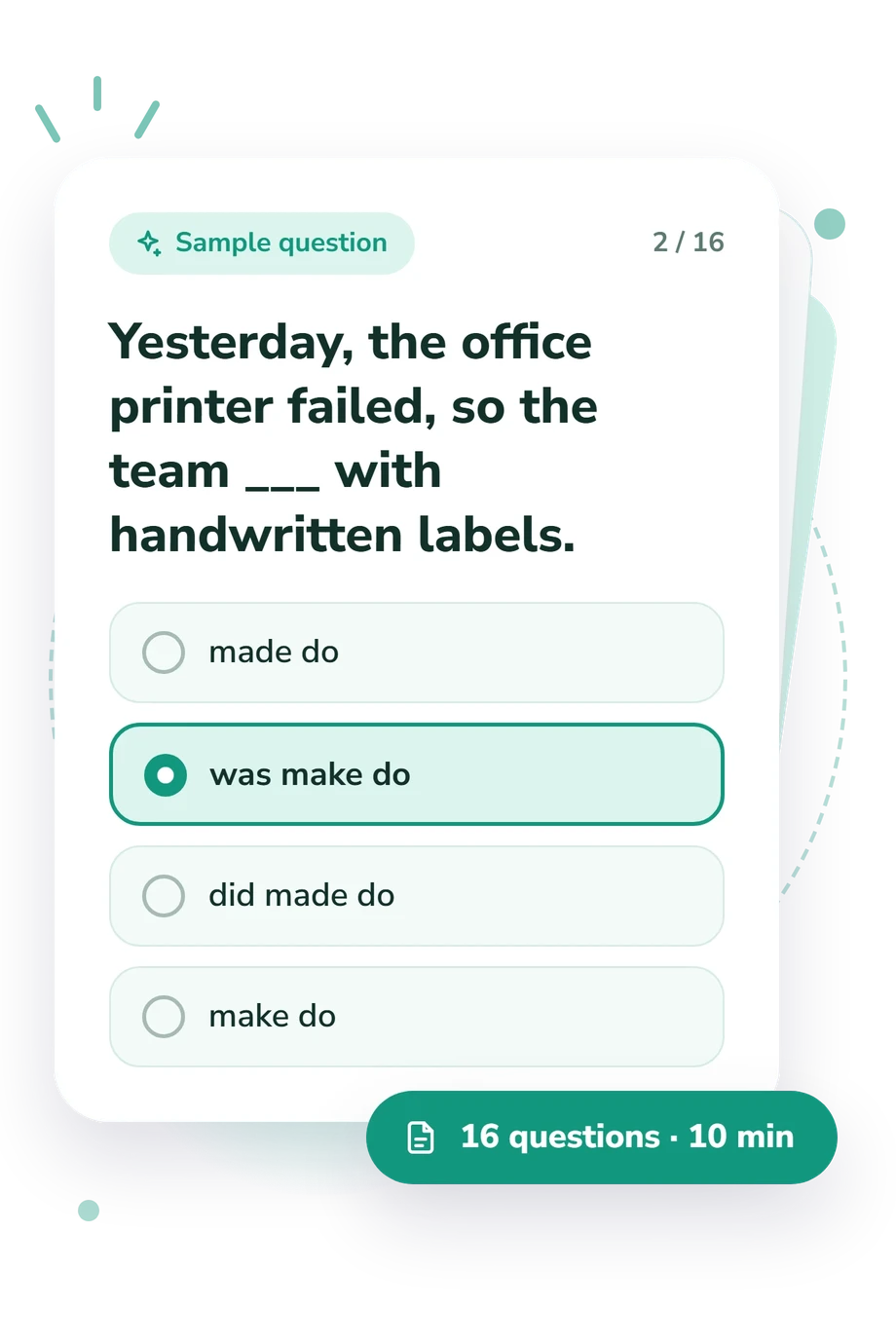
- made do
- was make do
- did made do
- make do
- Use the open phrase: “It is a make do desk.”
- Use the participial compound: “It is a making-do desk.”
- Use the hyphenated adjective: “It is a make-do desk.”
- Use the extended past form: “It is a made-do-with desk.”
Make Do Quiz - Description and methodology of the test
Readers who want to use a common English expression accurately can take this make or do quiz, whether they are checking classroom learning or refining writing. For learners who need a practical check of form and meaning, the make do quiz indicates how accurately they handle the expression’s meaning, forms, and use from related constructions, including repair, creation, ideal choice, and doing without something.
What This Assessment Explores
The assessment focuses on the make do expression, a fixed phrase meaning to manage with what is available when a preferred option is unavailable. Language questions about the meaning of make do distinguish the expression from repairing, creating, choosing an ideal option, and doing without something.
Items cover three areas:
- Meaning in context shows whether the respondent understands the expression in practical situations rather than treating it as a synonym for repair.
- Grammar and verb forms show whether learners can choose make do, made do, making do, and related structures as tense changes.
- Written conventions show whether they can keep the verb phrase separate and form hyphenated adjectives correctly.
The result is reported as Make Do Knowledge: 0-16, with Foundation (0-6), Developing (7-12), and Strong (13-16). These bands describe performance on the tested language points, not general English ability.
Methodology and Scientific Basis
Each item presents a sentence or short situation with four answer choices. Four answer choices test grammar and make do verb forms, compounds, hyphenation, and contextual meaning through plausible errors: wrong tense, misplaced words, unnecessary hyphenation, incorrect compounds, or a meaning that does not fit the context. Items contrast make do with and do without; others require the learner to complete a sentence naturally.
Scoring stays internal to the questionnaire: responses are summarized on its displayed scale and read through the displayed performance categories rather than compared with a population norm. These categories describe performance on the tested language points and are not presented as a population comparison.
The questions are conceptually consistent with the corpus study by Gilquin and Viberg, but this questionnaire is not an adaptation of that study. Standard dictionary definitions support the meanings, verb forms, and written conventions assessed.
Because the format is an online multiple-choice language task, attention, prior instruction, and guessing can affect performance. Use the result as a learning signal, then confirm uncertain forms through reading, writing, or instruction.
- Gilquin, Gaëtanelle, and Åke Viberg. “How to make do with one verb: A corpus-based contrastive study of DO and MAKE.” Revue française de linguistique appliquée 14, no. 1 (2009): 67-82. 10.3917/rfla.141.0067.
- McIntosh, Colin, ed. Cambridge Advanced Learner’s Dictionary & Thesaurus. 4th ed. Cambridge University Press, 2013.
- Collins English Dictionary. “Make do.” HarperCollins Publishers, n.d. Accessed September 22, 2026.
Updated: