
Internet Terms Quiz
How the Scales are Structured
Who Usually Takes This Test?
See How You Compare
Below is a preview of how scores are typically distributed across each scale.
Example Questions From the Test
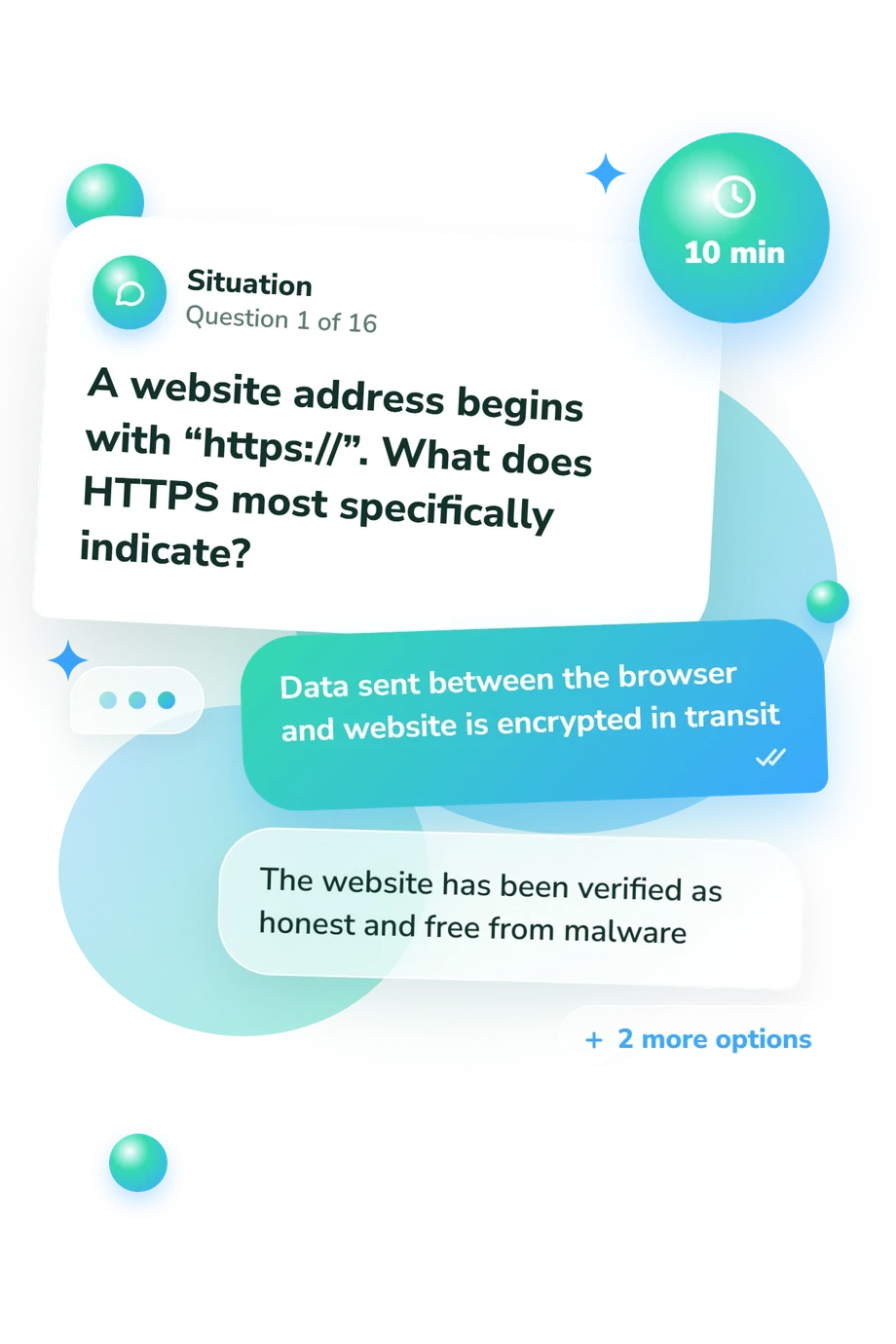
- Data sent between the browser and website is encrypted in transit
- The website has been verified as honest and free from malware
- The website can be opened only through a private network
- The website does not collect cookies or browsing information
- A search engine
- A web browser
- An internet service provider
- A domain registrar
- Streaming
- Uploading
- Downloading
- Caching
Internet Terms Quiz - Description and methodology of the test
People who want a clearer grasp of everyday digital language can use the Internet Terms Quiz to check whether familiar words match their practical meanings. This internet vocabulary quiz asks learners and regular internet users to match basic terms with concrete situations involving browsers, accounts, networks, and websites. The result points to areas where further reading or practice may be useful.
What This Assessment Measures
The questions test recognition: respondents distinguish related terms in short situations involving browsers, domains, data movement, and online safety. Rather than measuring personality or symptoms, this internet terminology test asks whether definitions support ordinary online decisions. It suits learners and regular internet users reviewing core digital concepts.
The main topic groups are:
- Web language covers browsers, hyperlinks, cookies, caches, and domain details used in browsing.
- Network concepts cover DNS, IP addresses, latency, synchronization, uploading, and storage.
- Security terminology covers HTTPS, firewalls, VPNs, authentication, malware, and suspicious links.
These themes produce one Internet Terms Knowledge scale from 0-16. Results appear as Foundations to build (0-6), Developing knowledge (7-12), or Strong knowledge (13-16). Higher bands indicate stronger command of tested internet and antivirus terms, not proof that a device or connection is secure.
Methodology and Evidence Base
With concrete items about encrypted connections, malware, suspicious links, and account protection, this online security terms quiz is a short, self-administered knowledge assessment. Each item presents a practical prompt with four answer choices, and the respondent selects the option that best matches the definition or situation. The questions test recognition and application rather than attitudes or symptoms.
The questionnaire is conceptually consistent with the iKnow measure (Potosky, 2007), a published measure of internet knowledge. Its cybersecurity content also overlaps with topics discussed in Pew Research Center’s 2017 public-knowledge survey and with digital competence areas organized in DigComp 2.2. The shared terminology and themes do not make the quiz equivalent to iKnow or show these works produced or validated it.
Interpret the result as performance on the selected definitions and scenarios. Guessing, wording familiarity, prior experience, and current attention can affect performance, while the single score does not cover every aspect of digital competence. The bands describe performance on this set of terms and can guide broader review of definitions such as encrypted connections, network delays, malware, and authentication methods.
- Potosky, Denise. (2007). The Internet knowledge (iKnow) measure. Computers in Human Behavior, 23(6), 2760-2777. DOI 10.1016/j.chb.2006.05.003
- Olmstead, Kenneth, and Aaron Smith. (2017, March 22). What the Public Knows About Cybersecurity. Pew Research Center.
- Vuorikari, Riina, Stefano Kluzer, and Yves Punie. (2022). DigComp 2.2: The Digital Competence Framework for Citizens: With New Examples of Knowledge, Skills and Attitudes. Publications Office of the European Union. DOI 10.2760/115376
Updated: