
Hazen and Shaver Love Quiz
How the Scales are Structured
Who Usually Takes This Test?
See How You Compare
Below is a preview of how scores are typically distributed across each scale.
Example Questions From the Test
- I welcome more connection while preserving some separate interests.
- I am open to selected shared routines but want clear areas that remain my own.
- I become concerned about losing independence and resist most of the changes.
- I agree to some changes but pull back if shared expectations keep expanding.
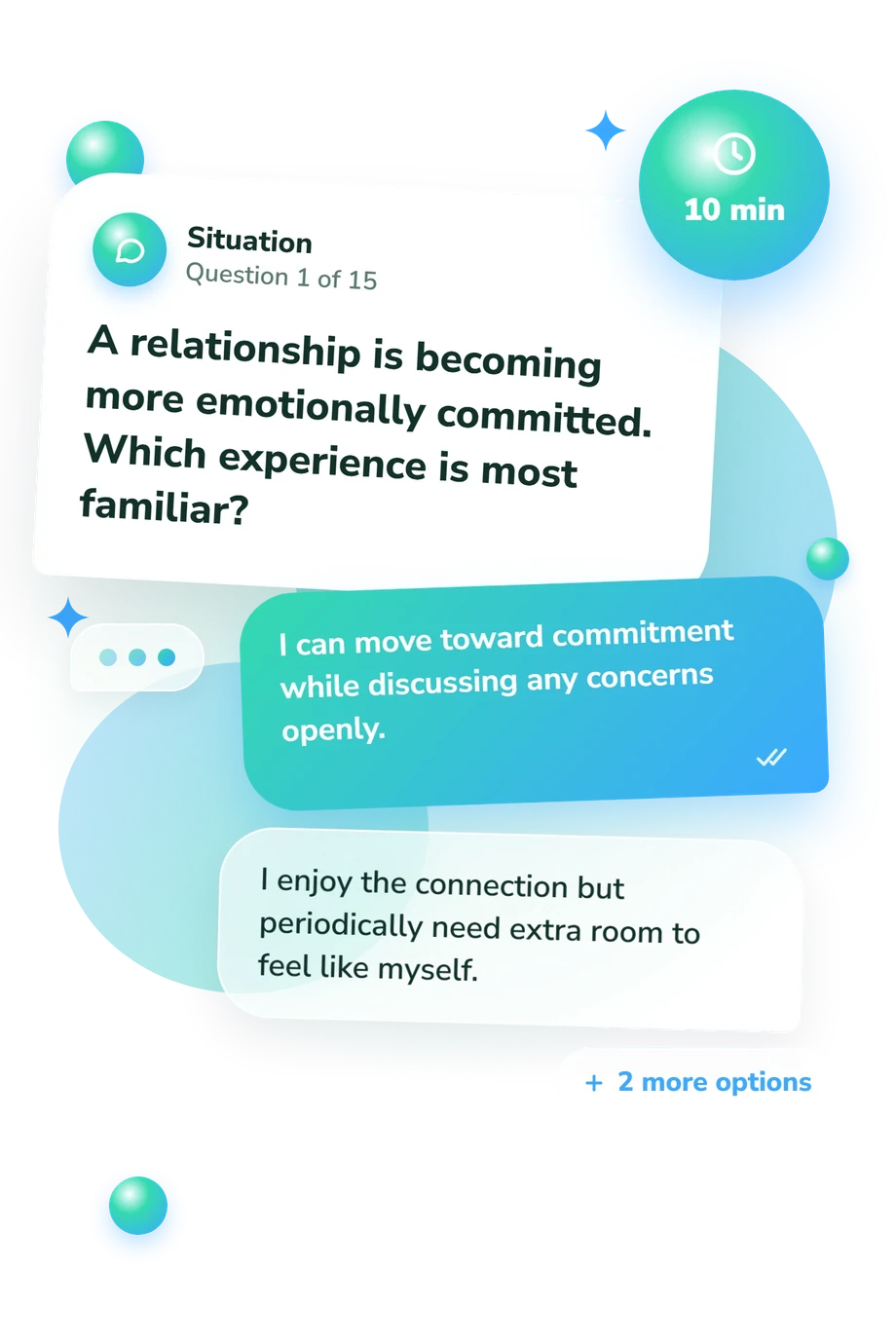
- I can move toward commitment while discussing any concerns openly.
- I enjoy the connection but periodically need extra room to feel like myself.
- I start focusing on the relationship's limitations and feel an urge to retreat.
- I maintain the relationship but reduce how much of my inner life I share.
- Seek immediate reassurance that the relationship is intact before discussing the issue itself.
- Take space and generally prefer to let the issue fade rather than revisit it.
- Name the unresolved issue and make room for both perspectives when you reconnect.
- Discuss it once the other person begins and the tone feels manageable.
Hazen and Shaver Love Quiz - Description and methodology of the test
People who want a clearer way to think about closeness, independence, reassurance, and trust may use this questionnaire to reflect on recurring relationship responses. The hazen and shaver love quiz organizes those responses into three attachment-related tendencies. As an adult attachment quiz, it offers a practical starting point for comparing how different situations may bring out different ways of relating.
What This Assessment Explores
Questions place you in situations involving commitment, delayed replies, conflict, requests for space, emotional support, reliance, and separation. The alternatives distinguish reassurance-seeking, protective distance, and comfort with trust, mutual support, direct communication, and balanced closeness and independence, showing how responses cluster across intimacy.
The displayed scales describe these dimensions:
- Anxious/Ambivalent Affinity (0-15) reflects rejection sensitivity, uncertainty about availability, and a pull toward reassurance: Limited affinity 0-5, Mixed affinity 6-10, or Strong affinity 11-15.
- Avoidant Affinity (0-15) reflects protecting independence, limiting emotional reliance, and creating distance when vulnerability feels demanding: Limited affinity 0-5, Mixed affinity 6-10, or Strong affinity 11-15.
- Secure Affinity (0-15) reflects trust, mutual support, direct communication, and balanced closeness and independence: Limited affinity 0-5, Mixed affinity 6-10, or Strong affinity 11-15.
Readers can use this attachment style questionnaire to consider whether reassurance, distance, or open reciprocity tends to guide them.
Methodology and Scientific Basis
Each item presents a relationship scenario with four response options. The alternatives range from seeking reassurance to tolerating space, discussing needs, or limiting emotional dependence. Scores combine responses into three results, but no point value is stated for each option, so the ranges are result bands rather than a formula to reverse-engineer.
Hazan and Shaver (1987) provide the closest conceptual reference for secure, anxious, and avoidant romantic attachment. Collins and Read (1990) add adult working models and relationship quality, while Fraley, Waller, and Brennan (2000) examine self-report attachment measures. The cited works offer a conceptual framework; they do not establish this online questionnaire as validated or a direct administration of those instruments.
Interpret the profile comparatively: a higher band means that the named tendency is more prominent in the described situations, while mixed results can show context-dependent responses. As a romantic attachment style test, it can support reflection through specific relationship examples.
Because results appear in descriptive bands and depend on self-report, current circumstances, memory, self-awareness, and response bias may shift them; they do not establish a diagnosis.
- Hazan, Cindy, and Phillip R. Shaver. (1987). Romantic love conceptualized as an attachment process. Journal of Personality and Social Psychology, 52(3), 511-524. 10.1037/0022-3514.52.3.511
- Collins, Nancy L., and Stephen J. Read. (1990). Adult attachment, working models, and relationship quality in dating couples. Journal of Personality and Social Psychology, 58(4), 644-663. 10.1037/0022-3514.58.4.644
- Fraley, R. Chris, Niels G. Waller, and Kelly A. Brennan. (2000). An item response theory analysis of self-report measures of adult attachment. Journal of Personality and Social Psychology, 78(2), 350-365. 10.1037/0022-3514.78.2.350
Updated: