
Framed Movie Quiz
How the Scales are Structured
Who Usually Takes This Test?
See How You Compare
Below is a preview of how scores are typically distributed across each scale.
Example Questions From the Test
- Flash Gordon
- Dune
- Star Wars: Episode VI – Return of the Jedi
- Star Trek III: The Search for Spock
- Inception
- Shutter Island
- Memento
- The Prestige
- Flight of the Navigator
- The Last Starfighter
- Explorers
- E.T. the Extra-Terrestrial
Framed Movie Quiz - Description and methodology of the test
Anyone who enjoys identifying films from a text-described scene or memorable cinematic moment can use the Framed Movie Quiz as a focused check of scene recognition. It is intended for viewers who want to connect described cinematic details with titles rather than test broad cinema history. As a movie scene recognition test, it shows how accurately the respondent recognized the clues and which performance band followed.
What This Assessment Explores
The prompts test recognition of distinctive cinematic imagery rather than broad film trivia. Each description combines visual or narrative details with four title choices, so the result reflects how readily a respondent links a remembered scene to its film. Because the challenge is framed around linking scenes to film titles, this framed quiz suits viewers curious about which movie moments remain accessible from description.
The main clue groups are:
- Visual compositions show whether settings, movement, lighting, or arrangements of people and objects trigger the correct title.
- Character-and-prop combinations show whether familiar figures, costumes, vehicles, or objects support recognition.
- Narrative moments show whether a suspense beat, performance, signature action, or ending identifies the intended film.
Framed Movie Knowledge (0-16) reports Opening Credits (0-6), Scene Spotter (7-12), or Frame Expert (13-16). The bands summarize performance on these clues, not complete film expertise.
Methodology and Scientific Basis
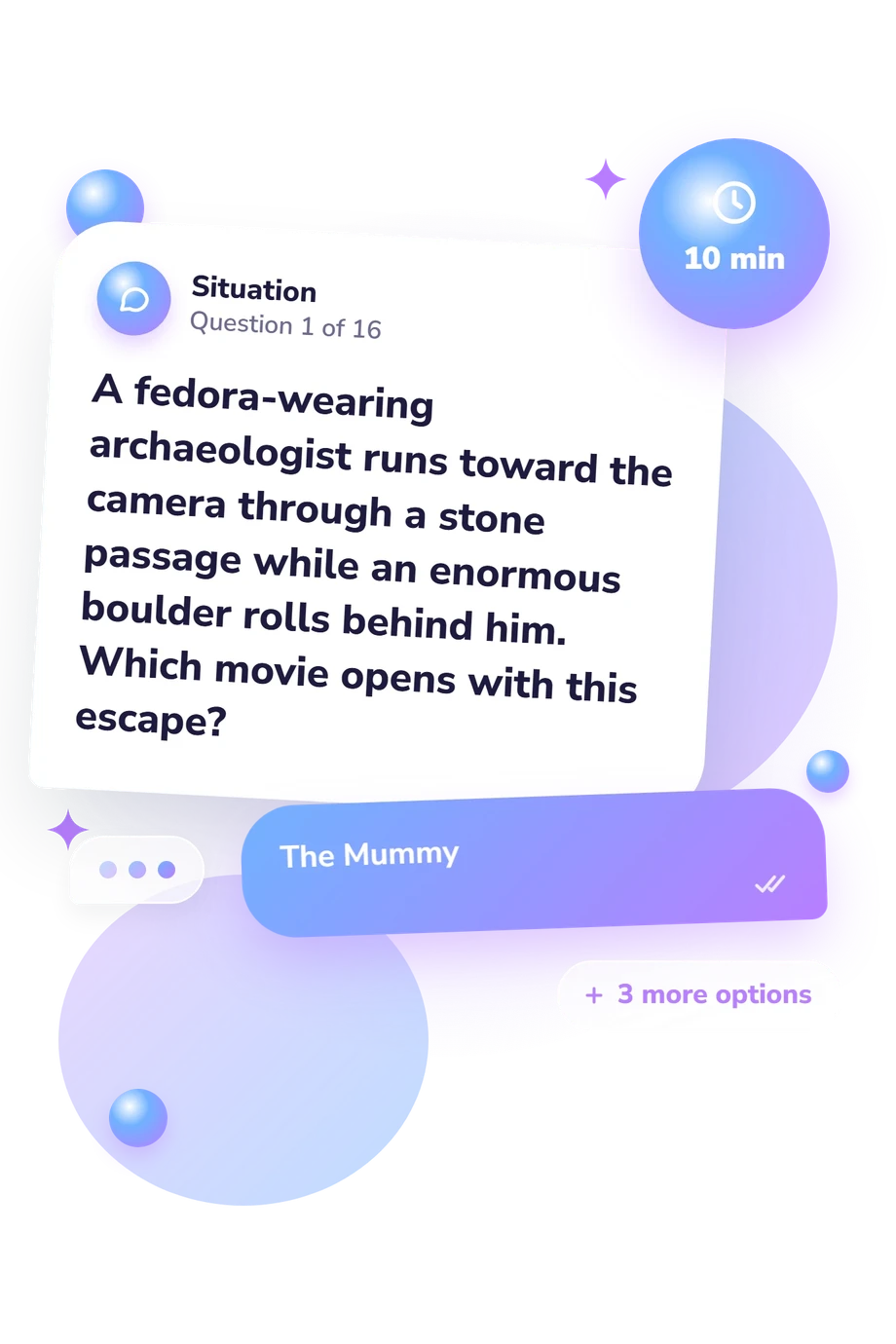
Each item presents a text-described scene with four film-title options. Selecting one answer makes the task a forced-choice recognition exercise rather than open-ended recall. The four-option format and displayed score bands summarize performance on these prompts; the questionnaire does not specify how individual responses are converted into points.
Potter’s study of recognition for briefly shown scenes offers a close conceptual comparison, while work by Furman and colleagues on event information in audiovisual narratives and by Meyerhoff and colleagues on audiovisual scene representations provides broader memory context. These studies do not validate this questionnaire or make it an adaptation of their instruments.
The questionnaire is not presented with standardized norms or clinical cutoffs. Scores should be read in relation to the selected clues, because performance can vary with prior viewing, cultural exposure, attention, wording, and confidence when options seem similar. As a film knowledge quiz, this assessment offers a snapshot of recognition, not a complete estimate of cinematic expertise.
- Furman, O., Dorfman, N., Hasson, U., Davachi, L., & Dudai, Y. (2007). They saw a movie: Long-term memory for an extended audiovisual narrative. Learning & Memory, 14(6), 457-467. 10.1101/lm.550407
- Meyerhoff, H. S., Jaggy, O., Papenmeier, F., & Huff, M. (2023). Long-term memory representations for audio-visual scenes. Memory & Cognition, 51, 349-370. 10.3758/s13421-022-01355-6
- Potter, M. C. (2012). Recognition and memory for briefly presented scenes. Frontiers in Psychology, 3, 32. 10.3389/fpsyg.2012.00032
Updated: