
Hand and Foot Care Quiz
How the Scales are Structured
Who Usually Takes This Test?
See How You Compare
Below is a preview of how scores are typically distributed across each scale.
Example Questions From the Test
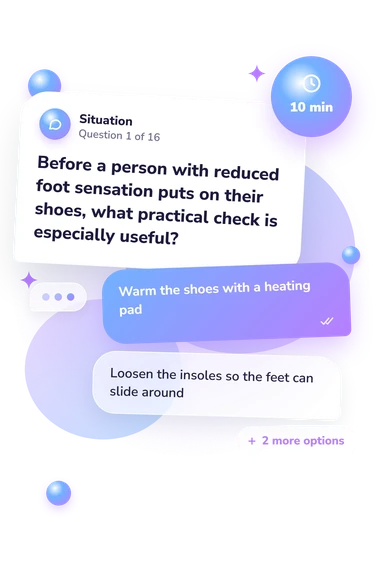
- Warm the shoes with a heating pad
- Loosen the insoles so the feet can slide around
- Apply moisturizer between the toes to reduce friction
- Inspect inside for stones, rough seams, or folded material
- Wear gloves instead of performing hand hygiene
- Cover your own hands with moisturizer before contact
- Perform hand hygiene and wear suitable disposable gloves
- Use the same gloves for nearby clean-care tasks
- A worsening wound with spreading redness, drainage, and fever
- Temporary nail whitening after brief pressure
- Mild dryness without cracks, redness, or discomfort
- A callus that has remained unchanged and is not painful
Hand and Foot Care Quiz - Description and methodology of the test
People who provide or oversee everyday personal care can use this hand and foot care quiz to check whether practical knowledge matches common safety needs. The questions connect routine choices with dignity, comfort, and timely escalation rather than testing dexterity or treatment skill. Patient comfort in hand and foot care guides choices that reduce avoidable pain, skin damage, infection risk, and delayed action. Results can guide focused review, supervision, or safer routine practice.
What This Assessment Measures
This assessment tests practical knowledge rather than dexterity. Its scenarios address footwear checks, washing and drying, nail care, pressure prevention, infection control, circulation, and escalation.
For a person choosing a hand and foot care assessment, the result indicates the knowledge demonstrated by the answers and the topics needing review. It suits people involved in personal care, home support, or supervision when sensation, skin integrity, or warning signs matter.
Results use the Hand and Foot Care Knowledge scale, scored from 0-16: Emerging Foundations (0-6), Developing Knowledge (7-12), or Strong Knowledge (13-16).
The main themes are:
- Hygiene and preparation cover clean hands and supplies.
- Skin and moisture care concerns gentle washing and drying.
- Nail, footwear, and pressure care reflect safer routine choices.
- Warning signs and escalation identify findings needing prompt attention.
Methodology and Evidence Base
Each item presents a practical situation with four answer choices. Answers yield a total assigned to one named educational band. This gives a knowledge snapshot; it does not observe technique, communication, or actual care under pressure.
As a hand and foot care knowledge test, the questionnaire is conceptually consistent with Fujii et al. (2020), whose study examined foot-care knowledge and practices among nurses and care workers, and with Stolt et al. (2015), which examined related knowledge in home-care nursing. It is not presented as an adaptation of either survey.
WHO supports hand hygiene and gloves. IWGDF 2023 covers footwear, pressure, skin protection, and warning signs. Studies and guidance provide context; this questionnaire is not adapted from or validated against them.
Interpret the result alongside prior training, local procedures, and the respondent’s ability to apply guidance. Honest self-report and current context can affect answers, while written items cannot show technique or capture every wound change. The total is educational, not a clinical credential or diagnosis; severe pain, spreading redness, fever, sudden coldness or discoloration, or a worsening wound warrants prompt professional assessment.
- Fujii K, Komoda T, Maekawa A, Nishikawa M. Foot care knowledge and practices among Japanese nurses and care workers in home care and adult service center: a cross-sectional study. BMC Nursing. 2020;19:75. 10.1186/s12912-020-00467-1
- Stolt M, Suhonen R, Puukka P, Viitanen M, Voutilainen P, Leino-Kilpi H. Nurses' knowledge of foot care in the context of home care: a cross-sectional correlational survey study. Journal of Clinical Nursing. 2015;24(19-20):2916-2925. 10.1111/jocn.12922
- Bus SA, Sacco ICN, Monteiro-Soares M, et al. Guidelines on the prevention of foot ulcers in persons with diabetes (IWGDF 2023 update). Diabetes/Metabolism Research and Reviews. 2024;40(3):e3651. 10.1002/dmrr.3651
- World Health Organization. WHO Guidelines on Hand Hygiene in Health Care: First Global Patient Safety Challenge Clean Care Is Safer Care. Geneva: World Health Organization; 2009. WHO/IER/PSP/2009/01.