
Future Children Quiz
How the Scales are Structured
Who Usually Takes This Test?
See How You Compare
Below is a preview of how scores are typically distributed across each scale.
Example Questions From the Test
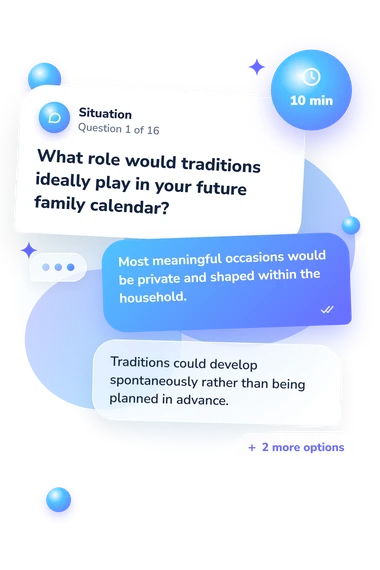
- Most meaningful occasions would be private and shaped within the household.
- Traditions could develop spontaneously rather than being planned in advance.
- A few larger gatherings would mark important moments during the year.
- Recurring cultural, neighborhood, or intergenerational traditions would anchor the calendar.
- A welcoming social atmosphere where they could build friendships.
- Something light and enjoyable that would not add much pressure.
- A chance to develop a useful skill through steady practice.
- Room to ask questions, experiment, and create in their own way.
- Improve a part of the home everyone uses regularly.
- Buy equipment or lessons that could support occasional outings.
- Split it between savings and several new local experiences.
- Plan a memorable trip somewhere the household has never visited.
Future Children Quiz - Description and methodology of the test
If you are thinking about parenthood, this assessment helps you examine how routines, relationships, and shared experiences might fit into the family life you imagine. The Future Children Quiz offers a structured way to notice which choices feel natural across ordinary situations. Its profile gives partners or individuals concrete topics for discussing expectations. In this future kid quiz, those reflections become a practical starting point for considering adventure, community, home, and learning.
What This Assessment Explores
This questionnaire suits people imagining parenthood. It examines preferences for novelty, routines, relationships, networks, home rituals, flexibility, and curiosity. The profile shows priorities at once; this future family quiz describes affinities, not fixed traits.
The dimensions are:
- Adventure Crew (0-12) measures outings: Familiar Horizons (0-4), Selective Explorer (5-8), Adventure Crew (9-12).
- Community Roots (0-12) measures household and wider networks: Close Household Circle (0-4), Connected Circle (5-8), Community Roots (9-12).
- Cozy Nest Builder (0-12) measures rituals and comfort: Home Is a Launchpad (0-4), Warm Home Base (5-8), Cozy Nest Builder (9-12).
- Curiosity Cultivator (0-12) measures questions and discovery: Life-Led Learning (0-4), Curiosity Supporter (5-8), or Curiosity Cultivator (9-12).
Together, affinities show your strongest preference: results within one point blend with the highest, with no hidden tie-breaker.
Methodology and Interpretation
Each item presents a family situation with four response options representing different ways of responding. The choices cover routines, household closeness, exploration, community participation, and active learning, so the respondent selects the response that feels most natural. This is an online self-report preference exercise.
Scores appear separately for the four dimensions. The bands sort each total into low, middle, or high affinity, but no per-answer point rule is stated. Interpretation should follow the combined profile and blended-result rule rather than an invented formula. The resulting future family profile is useful for comparing imagined priorities across ordinary family situations.
Its themes are conceptually consistent with the Future Expectation Scale for Adolescents and, in their attention to traditions and everyday patterns, with the Family Ritual Questionnaire and Family Routines Inventory. These are separate published instruments; the questionnaire is not presented as an adaptation, standardized version, or validation of them.
Because answers depend on honesty, self-awareness, and current circumstances, the bands describe reported preferences rather than stable facts about future behavior; use the profile to clarify priorities and conversation topics.
- McWhirter, Ellen Hawley, and Benedict T. McWhirter. “Adolescent Future Expectations of Work, Education, Family, and Community Development of a New Measure.” Youth & Society, 40(2), 2008, 182-202. 10.1177/0044118X08314257
- Fiese, Barbara H., and Christine A. Kline. “Development of the Family Ritual Questionnaire: Initial Reliability and Validation Studies.” Journal of Family Psychology, 6(3), 1993, 290-299. 10.1037/0893-3200.6.3.290
- Jensen, Eric W., Sherman A. James, W. Thomas Boyce, and Sue A. Hartnett. “The Family Routines Inventory: Development and Validation.” Social Science & Medicine, 17(4), 1983, 201-211. 10.1016/0277-9536(83)90117-X
Updated: