
Future Will Quiz
How the Scales are Structured
Who Usually Takes This Test?
See How You Compare
Below is a preview of how scores are typically distributed across each scale.
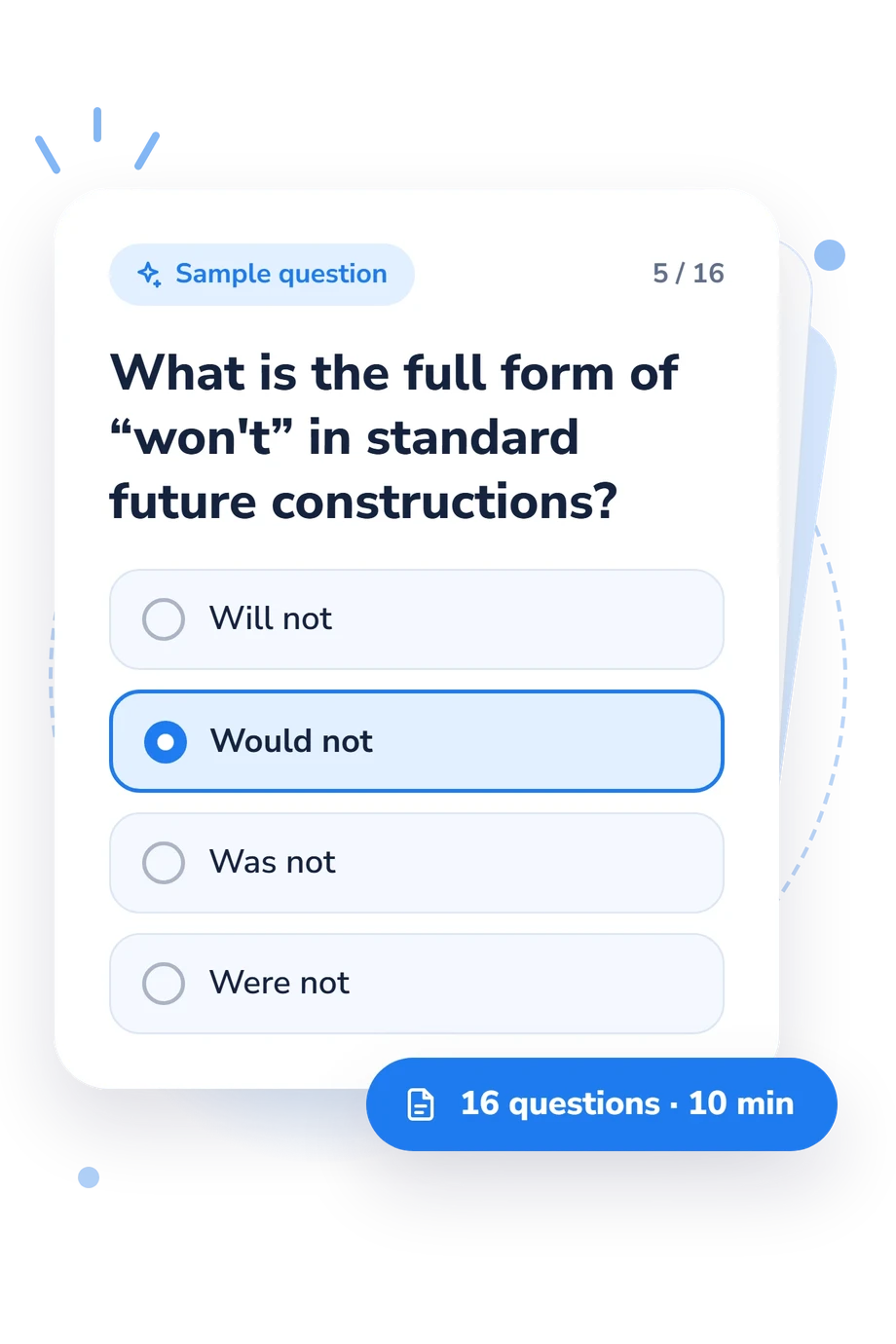
Example Questions From the Test
- What time the meeting will end?
- What time will the meeting end?
- What time will end the meeting?
- What time does the meeting will end?
- I can't; I'll be studying at 8.
- I can't; I'll studied at 8.
- I can't; I will be study at 8.
- I can't; I will studying at 8.
- The results will announce tomorrow.
- The results will be announce tomorrow.
- The results will be announced tomorrow.
- The results are will be announced tomorrow.
Future Will Quiz - Description and methodology of the test
Designed for learners who want a clearer picture of their English grammar, the Future Will Quiz checks how confidently you use will and related future constructions in practical sentences. It suits independent learners, teachers choosing follow-up practice, and anyone reviewing future forms before writing or conversation. A will grammar quiz can show whether an error reflects word order, verb form, meaning, or context.
What This Assessment Explores
The assessment measures practical knowledge of will in context rather than isolated definitions. Items cover questions, affirmative and negative statements, short answers, passives, conditionals, promises, predictions, timetables, and decisions made while speaking. Some contrast will with be going to or the present simple, so the result reflects meaning as well as form. This makes it useful as a future tense quiz for locating the rule or meaning that needs practice.
The recurring language situations are:
- Word order shows whether you can form questions with will correctly.
- Verb patterns show whether you can combine will with the base form, not, progressive, or passive structures.
- Context shows whether you can match future forms with evidence, schedules, promises, conditions, or spontaneous decisions.
Future Will Knowledge is the single displayed scale, ranging from 0-16. Foundation (0-6) signals emerging control, Developing (7-12) broader but incomplete control, and Strong (13-16) secure intermediate knowledge across varied contexts.
Methodology and Scientific Basis
Each item presents a short situation and four answer choices, with one choice matching the required grammar and meaning. The format tests application: respondents must notice question inversion, the base form after will, negative and passive patterns, and context-specific future choices.
Scoring is direct: each correct answer contributes one point to the displayed knowledge score. Its labels are supplied performance bands, not population norms; a higher result means more tested constructions were recognized, not mastery of every future form.
The treatment is conceptually consistent with Seog, Lee and Choi (2019), whose corpus research examines how will and be going to function across contexts. Huddleston and Pullum (2002) offer a grammatical framework for auxiliary will, negation, inversion, passives, conditionals, and related clause patterns. This questionnaire is not presented as an adaptation or standardized reproduction of either source.
When form and intended meaning seem to conflict, this will vs going to quiz can clarify the source of confusion. Results may vary with prior instruction and attention, so use this focused snapshot to guide review rather than treat it as a complete measure of English ability.
- Daria Soon-Young Seog, Yae-Sheik Lee, and Incheol Choi. 2019. “Use of English Futures, Will vs. Be Going to: A Corpus-Based Comparison Study.” Studies in Modern Grammar 102: 205-223. 10.14342/smog.2019.102.205
- Rodney Huddleston and Geoffrey K. Pullum. 2002. The Cambridge Grammar of the English Language. Cambridge University Press. 10.1017/9781316423530
Updated: