
Predicate Adjective Quiz
How the Scales are Structured
Who Usually Takes This Test?
See How You Compare
Below is a preview of how scores are typically distributed across each scale.
Example Questions From the Test
- It is an adjective modifying the noun “heat.”
- It is the predicate adjective describing “room.”
- It is the linking verb connecting “room” and “cool.”
- It is an adverb modifying the predicate adjective “cool.”
- The crowd cheered ecstatically.
- The winner was Elena.
- The ecstatic winner waved.
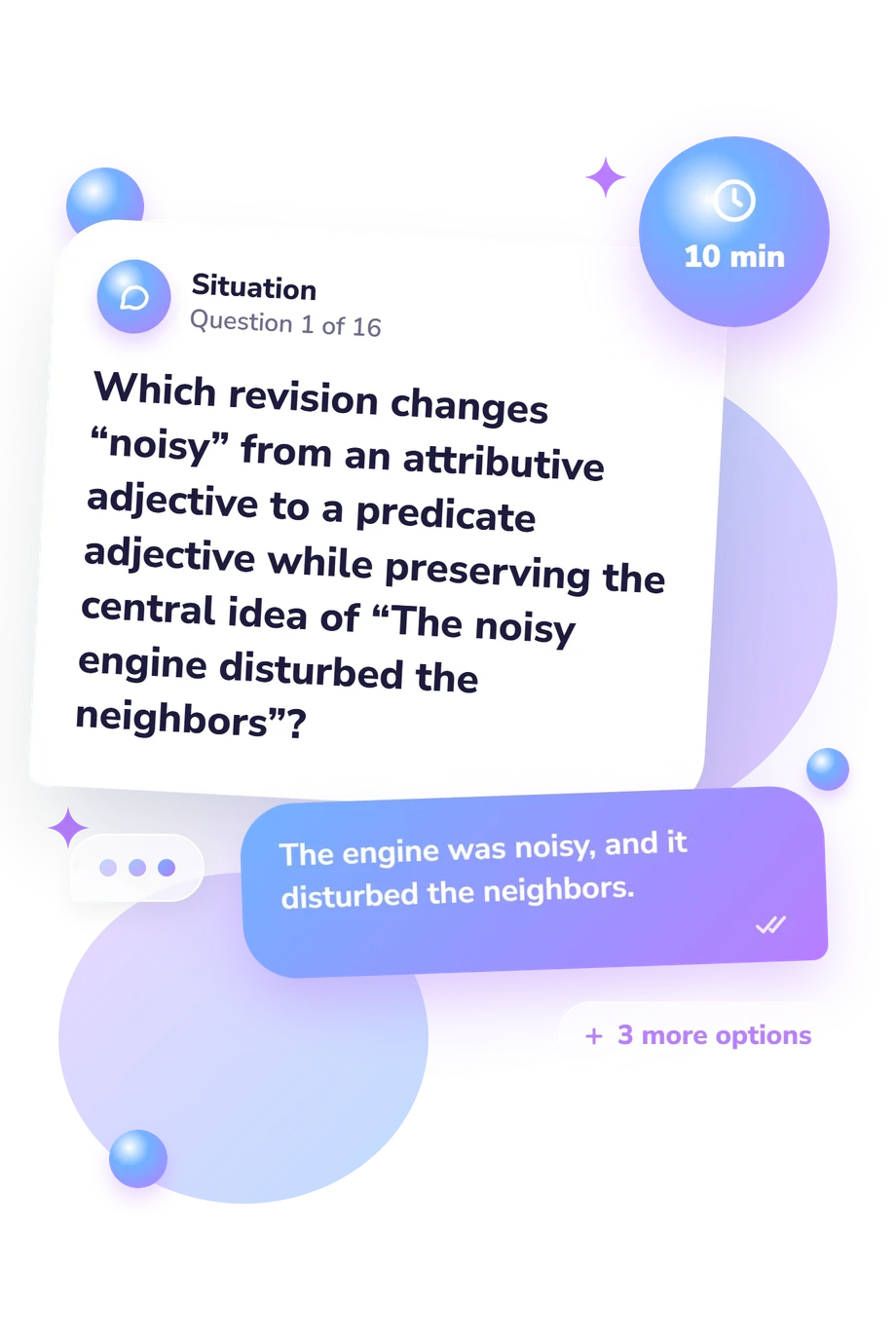
- The winner was ecstatic.
- The guests ate the soup eagerly.
- The chef prepared delicious soup.
- The soup smells delicious.
- The soup's delicious aroma filled the kitchen.
Predicate Adjective Quiz - Description and methodology of the test
For anyone reviewing English grammar, the predicate adjective quiz offers a focused way to check whether sentence complements are identified by function rather than position. It suits learners, writers, and teachers who want a clearer distinction between predicate adjectives, attributive adjectives, adverbs, predicate nominatives, and object complements. The result can guide predicate adjective practice by showing which contrasts deserve attention.
What This Assessment Explores
Predicate adjectives are complements linked to subjects by verbs such as be, seem, feel, become, look, smell, or turn. In “The pavement became slippery,” slippery describes pavement through became rather than modifying a noun. The questions also separate this role from adverbs, predicate nominatives, and object complements.
Sentence revisions and explanations require analysis in context, while predicate adjective examples show how one word can take different roles.
The questions cover three connected areas:
- Linking-verb recognition shows whether a complement is connected to the subject.
- Grammatical contrast shows whether related functions are kept distinct.
- Predicate Adjective Knowledge: 0-16 reports Foundations to build (0-6) for partial pattern recognition, Developing command (7-12) for many accurate identifications, including less obvious linking verbs, and Strong command (13-16) for consistent recognition across varied sentences.
Methodology and Scientific Basis
Methodologically, this is a multiple-choice grammar assessment. Each item presents a sentence or brief scenario with four answer choices, asking the respondent to identify a function, select a revision, or explain a contrast. The scoring is additive: each correct response contributes one point to the knowledge scale, and the displayed band summarizes the resulting total.
The approach is consistent with the treatment of predicative complements and adjective functions in Huddleston, Pullum, and Reynolds (2022), read alongside the broader grammatical framework of Huddleston and Pullum (2002). Those sources support distinctions among predicative adjectives, attributive adjectives, adverbs, predicate nominals, and object-related complements. This questionnaire is conceptually consistent with that framework, not a reproduction or standardized adaptation of either published work.
For a predicate adjective test, the result should be read as performance on the selected sentence judgments, not as a general measure of English ability. The displayed bands are instructional interpretations rather than independently established population norms. Attention, terminology familiarity, and the sentence patterns presented can influence answers, so broader learning evidence is needed to judge lasting mastery.
- Huddleston, Rodney D., Geoffrey K. Pullum, and Brett Reynolds. A Student's Introduction to English Grammar. 2nd ed. Cambridge University Press, 2022. 10.1017/9781009085748.
- Huddleston, Rodney, and Geoffrey K. Pullum. The Cambridge Grammar of the English Language. Cambridge University Press, 2002. ISBN 9780521431460.
Updated: