
Peace Quiz
How the Scales are Structured
Who Usually Takes This Test?
See How You Compare
Below is a preview of how scores are typically distributed across each scale.
Example Questions From the Test
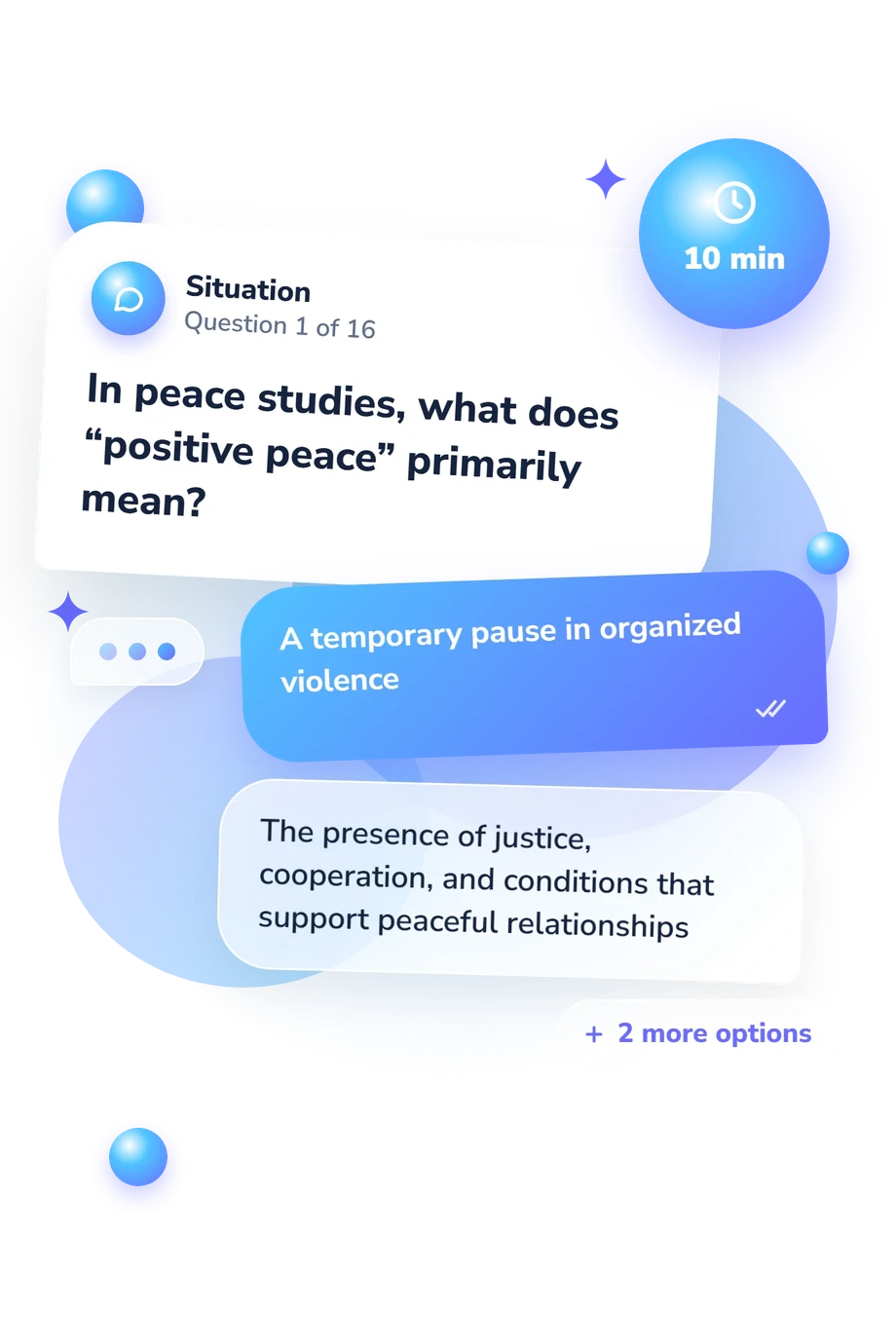
- A temporary pause in organized violence
- The presence of justice, cooperation, and conditions that support peaceful relationships
- A military balance that discourages either side from attacking
- The complete disappearance of disagreement
- September 21
- June 21
- August 6
- May 15
- Dag Hammarskjöld
- Henry Dunant
- Alfred Nobel
- Fridtjof Nansen
Peace Quiz - Description and methodology of the test
For readers seeking a clear introduction to peace studies, this peace quiz offers a focused knowledge check and helps learners, educators, and curious visitors decide what to revisit next. It is a peace studies quiz for anyone who wants to gauge readiness for further study, teaching, or guided reflection. The result can help shape a sensible next step, such as reviewing core material or pursuing a broader lesson.
What This Assessment Explores
The assessment tests whether you distinguish commonly confused ideas. Its quiz questions on peace cover positive and negative peace, peacebuilding, mediation, negotiation, restorative justice, conflict transformation, human dignity, institutions, and tension responses. Short quotations and scenarios require recognition and application. The Peace Knowledge result, scored 0-16, shows how well you recognize and apply ideas, not how you behave.
The main groups are:
- Peace concepts show whether you distinguish quiet from justice, cooperation, reconciliation, and durable relationships.
- Conflict processes show whether you recognize mediation, negotiation, restorative responses, transformation, and de-escalation.
- Institutions and texts show how accurately you connect peace with the United Nations, UNESCO, human rights, and notable statements.
Foundational (0-6) reflects partial recognition; Developing (7-12) reflects broader understanding with gaps; Strong (13-16) reflects broad, accurate knowledge. It applies only to these 16 questions.
Methodology and Evidence Base
The format is multiple-choice: many items use definitions, quotations, and short scenarios with four answer choices, while others test recall of dates, people, institutions, and principles; the respondent selects the best answer. The mix tests both recall and application without requiring a written explanation.
Scoring is reported as an educational total interpreted through the displayed performance bands rather than separate clinical subscales. For planning next steps, the peace education quiz can help identify topics to revisit and guide further study.
Bashir and Akbar's 2021 study of peace education knowledge provides a conceptual comparison for this approach; this is a separate online knowledge questionnaire, not an established adaptation of their instrument. Galtung’s positive and negative peace distinction and Lederach’s account of sustained reconciliation clarify the ideas behind the questions.
Those works support the framework, not standardization of this exact version. No norms, reliability estimates, or independent validation are stated for the online questionnaire. Prior learning, attention, and interpretation of wording can affect the total, so use it as a focused learning signal when deciding what to study next.
- Bashir, Samra, and Rafaqat Ali Akbar. (2021). Determining the Effect of Peace Education on Knowledge and Attitude of Prospective Teachers: An Experimental Study. Bulletin of Education and Research, 43(3), 47-66.
- Galtung, Johan. (1969). Violence, Peace, and Peace Research. Journal of Peace Research, 6(3), 167-191. 10.1177/002234336900600301
- Lederach, John Paul. (1997). Building Peace: Sustainable Reconciliation in Divided Societies. Washington, DC: United States Institute of Peace Press.
Updated: