
Intermediate English Quiz
How the Scales are Structured
Who Usually Takes This Test?
See How You Compare
Below is a preview of how scores are typically distributed across each scale.
Example Questions From the Test
- Nora has worked at the library since 2021.
- Nora works at the library since 2021.
- Nora is working at the library since 2021.
- Nora worked at the library since 2021.
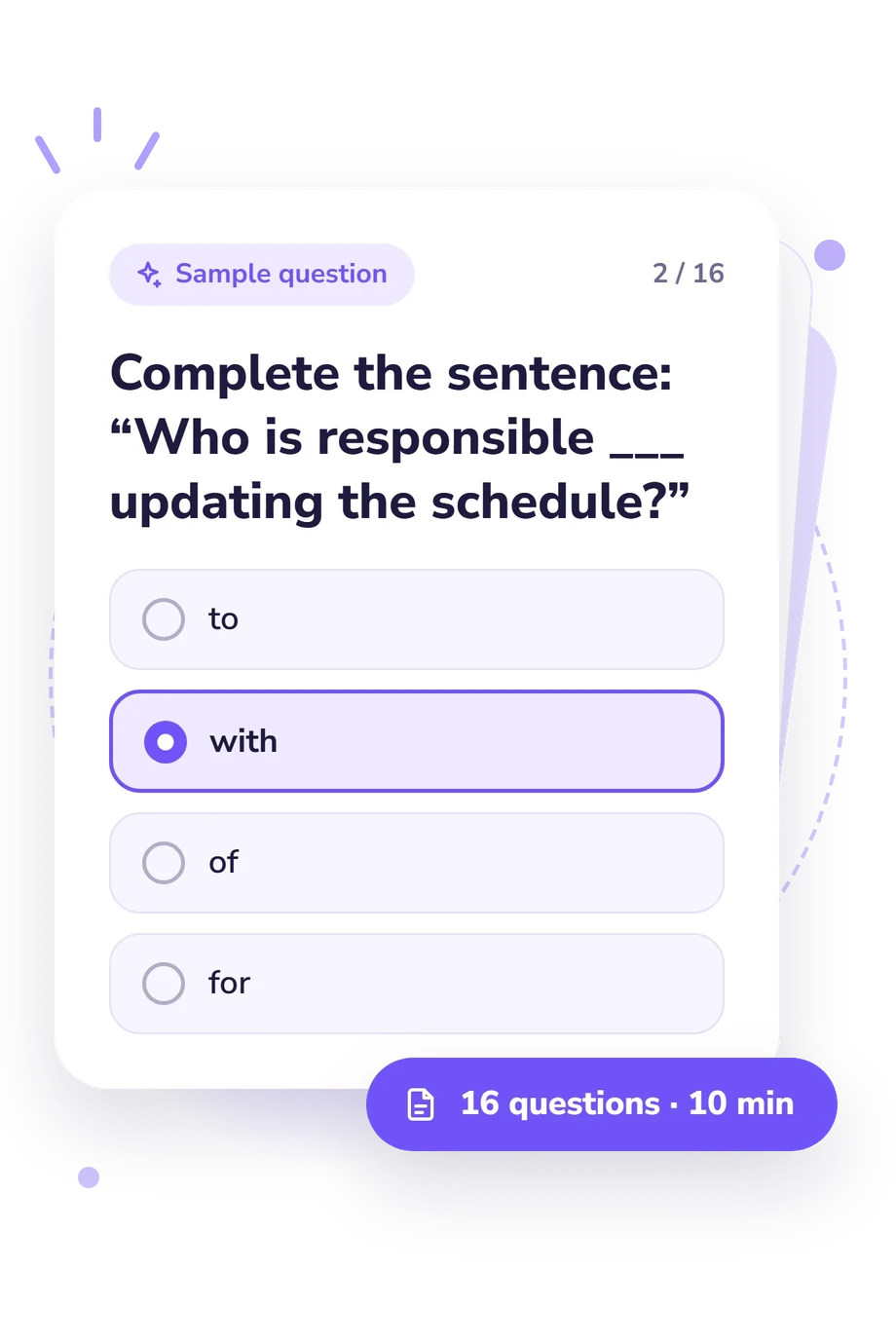
- to
- with
- of
- for
- will learn
- would have learned
- learned
- would learn
Intermediate English Quiz - Description and methodology of the test
Learners who want a practical check of their current grammar control can use the intermediate english quiz as a focused starting point. It suits people reviewing intermediate English before further study, workplace communication, or everyday use. Presented as an intermediate quiz, this assessment gives an overall indication of performance on the grammar and usage sampled here, rather than offering a broad measure of every language skill.
What This Assessment Explores
These items sample grammar and usage choices used in practical communication. As an English grammar quiz, it focuses on forms that fit sentence structure and intended meaning.
The main thematic groups are:
- Tense and aspect show whether you can connect actions with time, duration, sequence, or hypothetical meaning.
- Sentence patterns and linking reveal how well you handle conditionals, conjunctions, question tags, and relative clauses.
- Word choice and form indicate control of articles, prepositions, comparison, agreement, and quantifiers in context.
- Meaning in context tests reported speech, passive constructions, modal conclusions, and repeated past habits.
Responses are summarized on one displayed scale, Intermediate English Knowledge (0-16). The bands are Building Foundations (0-6), Developing Control (7-12), and Strong Intermediate Knowledge (13-16). They describe increasing control of the grammar and usage sampled here, so the result is most useful for choosing what to review next.
Methodology and Evidence Base
Each prompt in this intermediate English test presents a sentence or short context with four choices, and the respondent selects the option that best completes or interprets it. The selected-response format measures recognition and contextual judgment, not extended writing or speaking.
The total is presented without an item-by-item weighting rule, so it is best read as a summary of performance on these tasks rather than a finely calibrated proficiency estimate.
Conceptually, the item selection aligns with English Grammar Profile (O'Keeffe and Mark, 2017), which describes learner grammar competence through corpus-informed evidence. The CEFR Companion volume provides general proficiency context, but it does not provide the score interpretation or thresholds for this questionnaire; this questionnaire is not an official CEFR placement instrument or an adaptation of either source.
The online questionnaire has no stated population norms or diagnostic status. Results may shift with recent study, test familiarity, attention, and uncertainty between options. Use the outcome to choose practice targets, then add writing, speaking, listening, or teacher feedback for a fuller picture.
- O'Keeffe, Anne, and Geraldine Mark. "The English Grammar Profile of learner competence: Methodology and key findings." International Journal of Corpus Linguistics, 22(4), 2017, pp. 457-489. 10.1075/ijcl.14086.oke
- Council of Europe. Common European Framework of Reference for Languages: Learning, teaching, assessment - Companion volume. Council of Europe Publishing, Strasbourg, 2020.
Updated: