
How Clean Is Your House Quiz
How the Scales are Structured
Who Usually Takes This Test?
See How You Compare
Below is a preview of how scores are typically distributed across each scale.
Example Questions From the Test
- At least 60 seconds every time
- About 5 seconds if warm water is used
- Exactly 10 seconds, followed by air-drying
- At least 20 seconds
- The underside of a rarely moved wardrobe
- The center of a bedroom ceiling
- Light switches
- The back edge of a framed wall picture
- Fold it tightly and place it on a shelf
- Leave it in a pile until the next laundry load
- Store it in a closed hamper to keep bathroom moisture contained
- Hang or spread it out where it can dry thoroughly
How Clean Is Your House Quiz - Description and methodology of the test
People who want to check their everyday cleaning know-how can use the How Clean Is Your House Quiz as a focused review of household safety principles. It is especially suitable for readers looking for a house cleaning knowledge check while making decisions about kitchens, bathrooms, laundry, food-preparation surfaces, or cleaning products. The result measures cleaning knowledge rather than the visible tidiness or condition of the home.
What This Assessment Explores
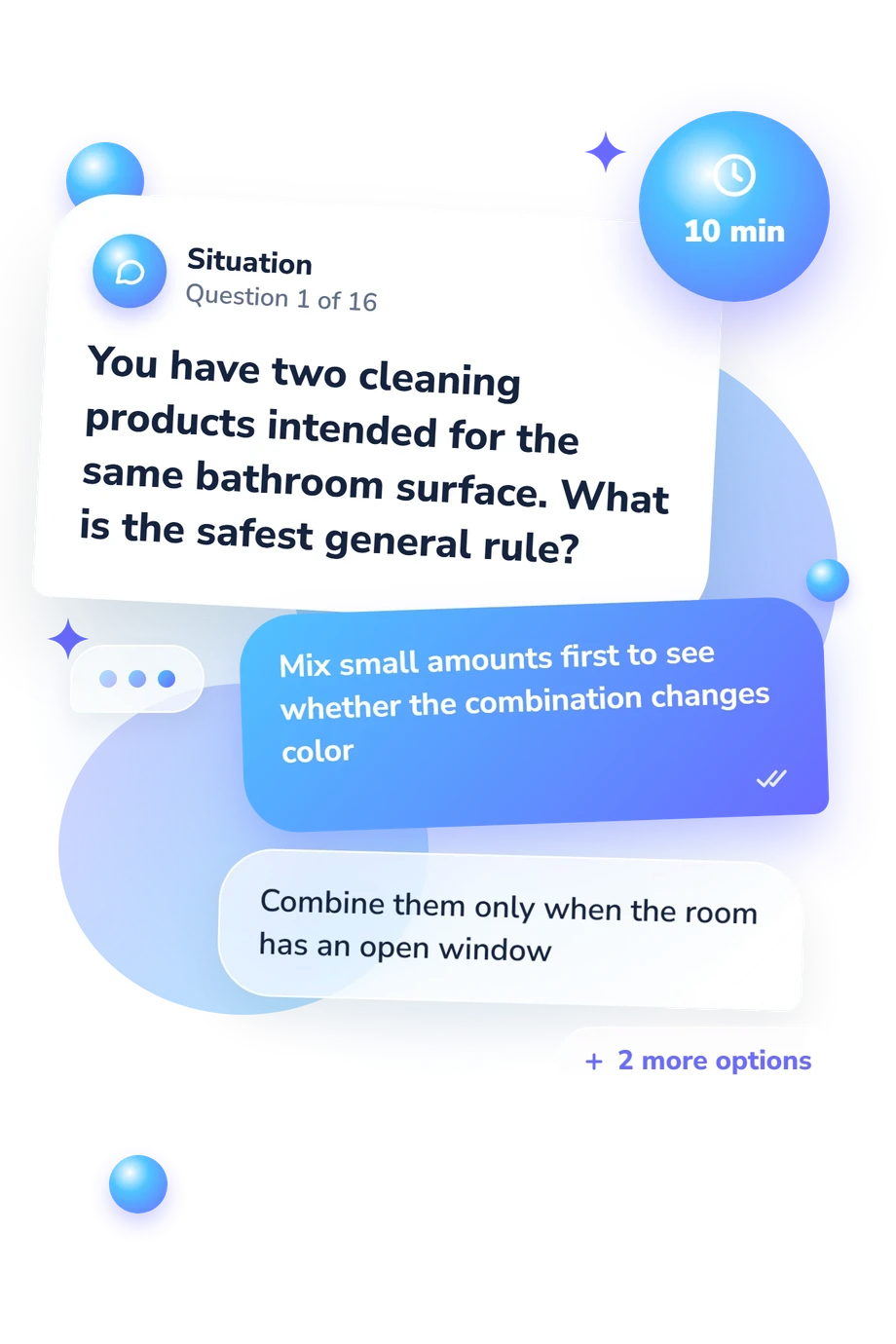
The questionnaire checks practical knowledge behind safer household cleaning. Its situations cover product compatibility, cleaning before disinfection, contact time, handwashing, cross-contamination, moisture, high-touch areas, dusting order, filtration, and bleach hazards. For readers seeking a practical check, it tests household cleaning knowledge by asking respondents to recognize sound procedures in everyday situations.
The displayed scale is Household Cleanliness Knowledge (0-16). It measures knowledge of safe principles, not the condition of a home or a person’s consistency. The result appears in three bands:
- Foundations to Build (0-6) indicates that core distinctions and safety routines need review.
- Developing Know-How (7-12) indicates that many sound practices are understood, while some habits or label checks need refinement.
- Strong Practical Knowledge (13-16) indicates a reliable grasp of the principles covered.
These bands identify learning priorities rather than rank a person’s housekeeping.
Methodology and Evidence Base
Each item presents four answer choices, with one representing the safest or most accurate principle. One point is awarded for every correct response. Items are grouped by theme rather than reported as separate subscales, covering chemical safety, disinfection, cross-contamination, food hygiene, moisture, and routine maintenance.
The closest evidence is the 2020 work by Gharpure and colleagues, which examined household knowledge and practices around safe cleaning and disinfection. This questionnaire is conceptually consistent with that study, not an adaptation of it. Food-safety content also aligns with the home-kitchen audit and knowledge instrument developed by Byrd-Bredbenner and colleagues.
Those sources support contamination routes, product handling, and cleaning sequences. The displayed bands describe knowledge levels for this questionnaire, and no norm-based interpretation is supplied for this particular score.
The score identifies concepts or procedures the reader may want to revisit, especially when label directions or order matter, making it a useful cleaning safety assessment. Guessing, wording, and prior exposure can affect performance, and the score cannot confirm actual behavior or room conditions. It is best used as a structured knowledge check.
- Gharpure R, Hunter CM, Schnall AH, Barrett CE, Kirby AE, Kunz J, Berling K, Mercante JW, Murphy JL, Garcia-Williams AG. Knowledge and Practices Regarding Safe Household Cleaning and Disinfection for COVID-19 Prevention - United States, May 2020. MMWR Morbidity and Mortality Weekly Report. 2020;69(23):705-709. 10.15585/mmwr.mm6923e2
- Byrd-Bredbenner C, Schaffner DW, Maurer Abbot J. How Food Safe Is Your Home Kitchen? A Self-directed Home Kitchen Audit. Journal of Nutrition Education and Behavior. 2010;42(4):286-289. 10.1016/j.jneb.2010.01.008
- Byrd-Bredbenner C, Wheatley V, Schaffner D, Bruhn C, Blalock L, Maurer J. Development and Implementation of a Food Safety Knowledge Instrument. Journal of Food Science Education. 2007;6(3):46-55. 10.1111/j.1541-4329.2007.00029.x
Updated: