
General Knowledge Quiz for 13 Year Olds
How the Scales are Structured
Who Usually Takes This Test?
See How You Compare
Below is a preview of how scores are typically distributed across each scale.
Example Questions From the Test
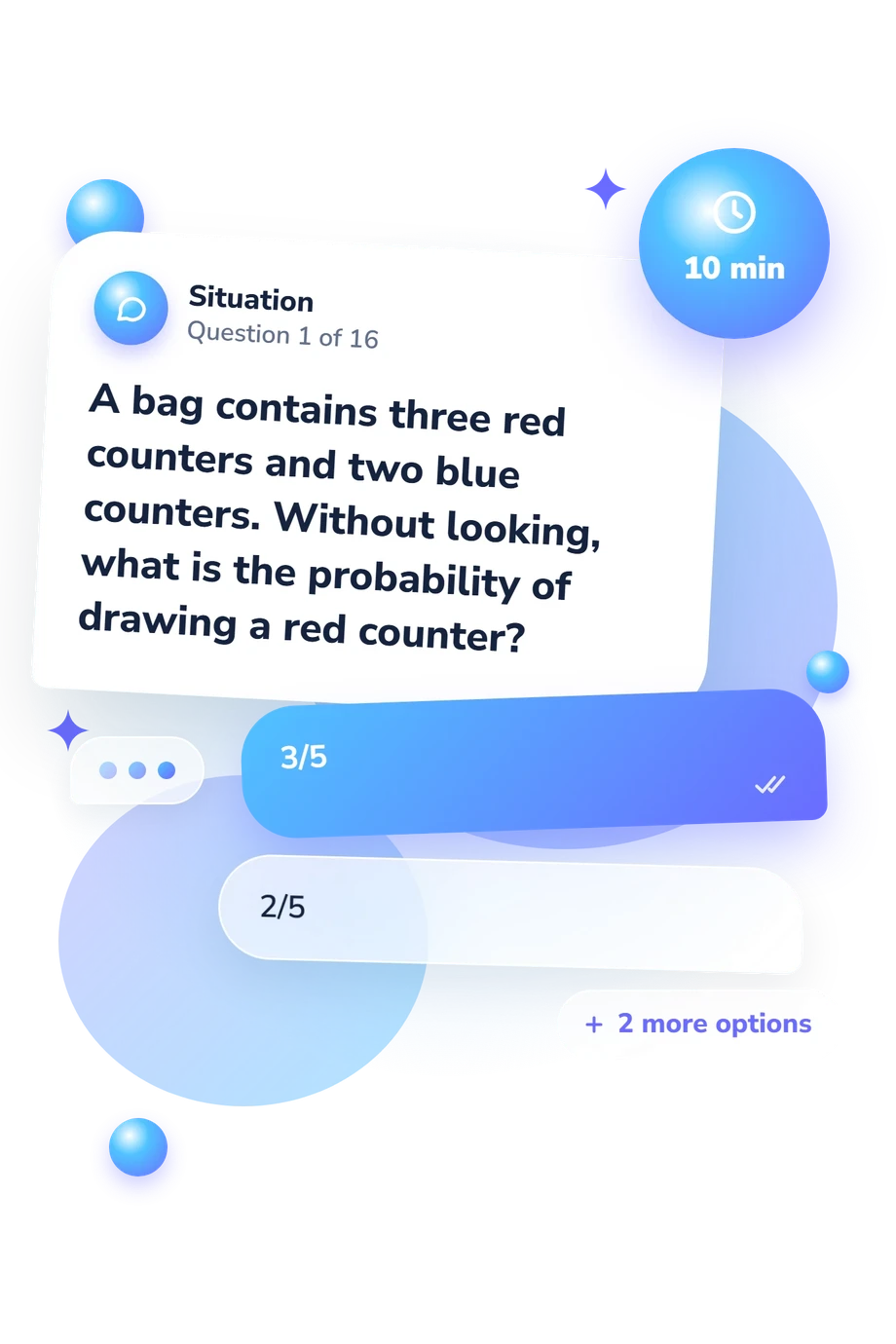
- 3/5
- 2/5
- 1/2
- 3/2
- Chloroplast
- Nucleus
- Vacuole
- Mitochondrion
- Maya
- Inca
- Roman
- Aztec
General Knowledge Quiz for 13 Year Olds - Description and methodology of the test
For curious learners, families, and educators, this assessment offers a compact way to check how confidently someone recalls and applies everyday knowledge across school-related subjects. A general knowledge quiz for 13 year olds can reveal which areas feel secure and which deserve review without turning one result into a judgment about intelligence. The general knowledge quiz questions for 13 year olds reward careful reading as well as memory.
What This Assessment Explores
The quiz samples factual recall and simple application across school-related subjects. A mixed general knowledge test for teenagers can show how a respondent moves between science, history, geography, language, maths, culture, and practical reasoning.
The main content areas are:
- Science and environmental reasoning apply ideas about plants, energy, ecosystems, and physical processes.
- History, geography, and culture use evidence, maps, places, and artistic facts.
- Mathematics covers proportions, scale, and basic probability.
- Language, research, and digital safety assess grammar, source judgment, fair testing, and suspicious messages.
One broad scale summarizes performance: General Knowledge Knowledge, 0-16, with Building Foundations (0-6), Developing Range (7-12), and Strong General Knowledge (13-16). Lower results identify topics to revisit; higher results indicate confident performance across the quiz's range.
Methodology and Scientific Basis
Each item uses four-option multiple choice, asking the respondent to select the answer that best fits. The content mixes recall with short reasoning tasks such as calculating a proportion, identifying a primary source, interpreting a food chain, judging a fair experiment, and recognizing a suspicious message. This is a broad content sample rather than a personality questionnaire.
Closest published comparison is the General Knowledge Test (GKT; Tran et al., 2014). This quiz is conceptually consistent with that work, not an adaptation of it. Lynn, Irwing, and Cammock (2001) likewise describe general knowledge as a domain-spanning construct, which fits the varied subject coverage here.
The scoring logic is descriptive: responses are summarized into the displayed performance band. No population norm, reliability coefficient, or diagnostic cutoff should be inferred. Edelsbrunner, Simonsmeier, and Schneider (2025) show why short, mixed knowledge tests can be sensitive to item selection and content coverage. A general knowledge test for 13 year olds is best read alongside classroom work, interests, and opportunities to learn; honest answers, self-awareness, and current context also matter.
- Tran, U. S., Hofer, A. A., & Voracek, M. (2014). Sex Differences in General Knowledge: Meta-Analysis and New Data on the Contribution of School-Related Moderators among High-School Students. PLOS ONE, 9(10), e110391. 10.1371/journal.pone.0110391
- Lynn, R., Irwing, P., & Cammock, T. (2001). Sex Differences in General Knowledge. Intelligence, 30(1), 27-39. 10.1016/S0160-2896(01)00064-2
- Edelsbrunner, P. A., Simonsmeier, B. A., & Schneider, M. (2025). The Cronbach’s Alpha of Domain-Specific Knowledge Tests Before and After Learning: A Meta-Analysis of Published Studies. Educational Psychology Review, 37, Article 4. 10.1007/s10648-024-09982-y
Updated: