
Frog Muscle Anatomy Quiz
How the Scales are Structured
Who Usually Takes This Test?
See How You Compare
Below is a preview of how scores are typically distributed across each scale.
Example Questions From the Test
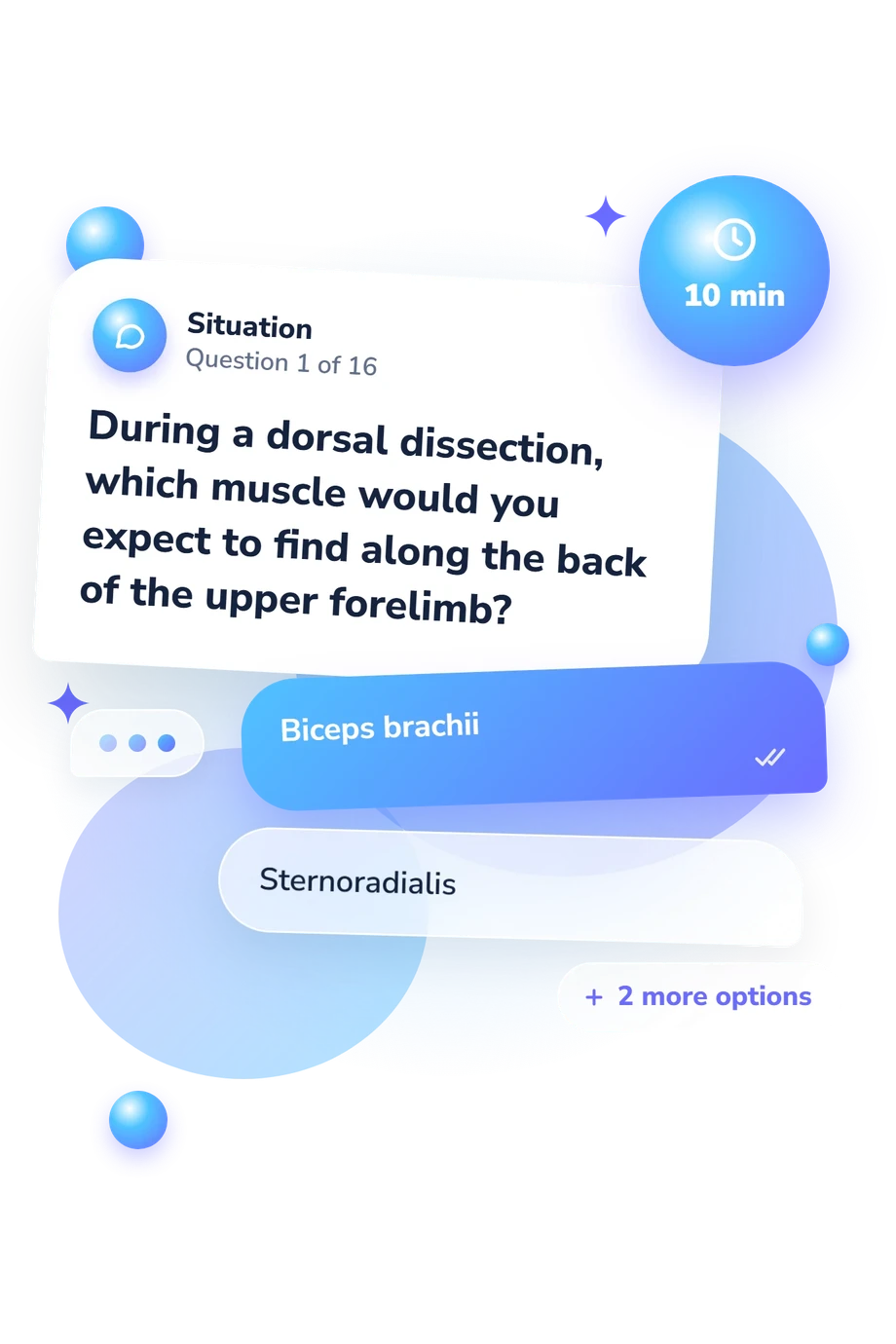
- Biceps brachii
- Sternoradialis
- Pectoralis
- Triceps brachii
- Sternoradialis
- Triceps brachii
- External oblique
- Deltoid
- Rectus abdominis
- Gracilis major
- Latissimus dorsi
- Tibialis anticus longus
Frog Muscle Anatomy Quiz - Description and methodology of the test
Before a frog-dissection lesson, the frog muscle anatomy quiz lets learners check whether anatomical terminology translates into movement. It suits students who want a focused way to test recall before practical work. This quiz about frog muscles can show which parts of the topic feel secure and which deserve another pass.
What This Assessment Explores
The questions focus on identification in context rather than naming. In this frog muscle anatomy test, you recognize a muscle from its region, orientation, shape, attachment, or action, such as flexing the forearm, extending the shank, adducting the thigh, or compressing the abdomen. Some items ask you to predict which movement would weaken if a muscle or tendon were impaired.
These areas are:
- Forelimb muscles show whether you can connect biceps, triceps, and sternoradialis with position and elbow movement.
- Shoulder and back muscles test recognition of structures that move or draw the forelimb.
- Thigh muscles show whether you can distinguish extension, flexion, and adduction roles.
- Abdominal and lower hindlimb muscles link identification with trunk compression and foot movement.
Together, these themes make the result an indicator of knowledge of commonly taught superficial frog muscles, including positions, identification, and basic functions.
Methodology and Evidence Base
Each item presents four answer options and asks you to select the alternative that fits a described muscle, location, action, or injury scenario. The questionnaire yields one overall result rather than regional subscores. Frog Muscle Anatomy Knowledge runs from 0-16: Foundation Needed (0-6) calls for review; Developing Knowledge (7-12) shows many recognized structures with movement links still developing; Strong Knowledge (13-16) reflects solid command of position and function.
The question themes are conceptually consistent with anatomical and dissection literature from Ecker and Haslam (1889), Collings and Richards (2019), and Vera and colleagues (2022). The questionnaire is neither an adaptation of nor a validation of those studies.
Interpret the outcome as performance on this content set. Study, terminology familiarity, and attention can affect answers, and a high score does not demonstrate practical dissection skill. This frog anatomy quiz is an educational self-check rather than a standardized examination; the sources support its anatomical context, not norms or psychometric validation for this online form.
- Ecker, Alexander, and George Haslam, trans. The Anatomy of the Frog. Oxford: Clarendon Press, 1889. 10.5962/bhl.title.7851
- Collings, Amber J., and Christopher T. Richards. Digital dissection of the pelvis and hindlimb of the red-legged running frog, Phlyctimantis maculatus, using Diffusible Iodine Contrast Enhanced computed microtomography (DICE μCT). PeerJ 7 (2019): e7003. 10.7717/peerj.7003
- Vera, Miriam Corina, Jose Luis Ferretti, Gustavo Roberto Cointry, and Virginia Abdala. Hind limb muscles influence the architectural properties of long bones in frogs. Journal of Anatomy 241, no. 3 (2022): 702-715. 10.1111/joa.13710
Updated: