
Fragment Run-On Comma Splice Quiz
How the Scales are Structured
Who Usually Takes This Test?
See How You Compare
Below is a preview of how scores are typically distributed across each scale.
Example Questions From the Test
- Near the fence, the bicycle with the blue basket.
- Leaning against the fence after the long ride.
- The bicycle by the fence, which belongs to Ana.
- The bicycle leaning against the fence belongs to Ana.
- After the final bell rang, students gathered outside.
- The rehearsal ended; everyone packed the equipment.
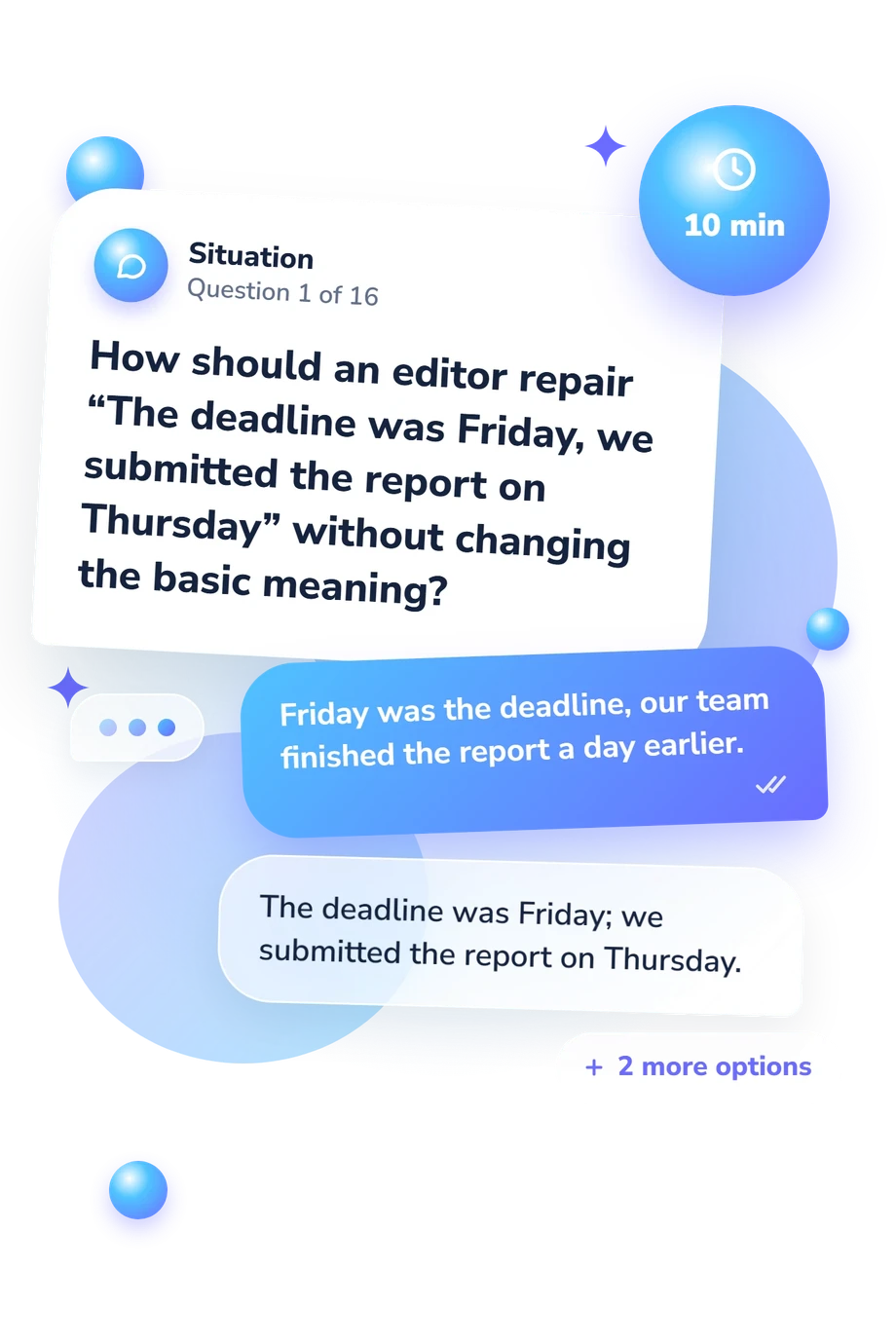
- Because the café was crowded, we ordered food to go.
- The printer jammed, I called the technician.
- I called the office, however nobody answered the phone.
- Although I called before noon, but the receptionist was away.
- I called the office, but nobody answered.
- The telephone rang several times nobody picked up.
Fragment Run-On Comma Splice Quiz - Description and methodology of the test
Anyone who edits essays, studies English grammar, or wants more reliable sentence-level judgment can use the fragment run on comma splice quiz to practise spotting boundary problems. It focuses on choices that determine whether a thought is complete and how two ideas should be joined. Its sentence-boundary questions identify a current level of control and point toward useful review topics.
What This Assessment Measures
These items examine sentence boundaries and meaning. They test whether a reader can recognize incomplete thoughts, fused clauses, comma splices, and revisions that connect ideas. The assessment suits students, writers, tutors, and editors checking grammar knowledge rather than terminology alone.
Key skill areas include:
- Fragment recognition shows whether an incomplete group of words is identified.
- Fused run-on recognition shows whether two independent clauses lack a proper boundary.
- Comma splice recognition shows whether a comma incorrectly joins complete clauses.
- Boundary repair shows whether punctuation or a conjunction preserves the intended relationship.
As a quiz on fragments, run-ons, and comma splices, it links labels to editing decisions. The Fragment, Run-On, and Comma Splice Knowledge scale runs 0-16. Foundations (0-6) indicates concepts to review; Developing (7-12) indicates many accurate judgments with some subtler errors; Strong (13-16) indicates consistent distinctions among the tested patterns.
Methodology and Evidence Base
Each item presents a sentence, editing task, or explanation prompt with four answer choices. The respondent identifies a boundary problem or selects a repair that preserves the relationship between ideas. These run-on-sentence items test recognition and repair of fused clauses. The items also distinguish complete sentences from dependent or incomplete word groups.
The result is reported through the displayed score bands. Because no points-per-option rule is stated, interpret the score through the displayed bands rather than reverse-engineering it from the choices.
Robinson and Jerskey (2021) discuss fragments, fused sentences, comma splices, and clause boundaries; the questions are conceptually consistent with that treatment. This separate online questionnaire is not an adaptation of the guide. Huddleston and Pullum (2002) provide an account of clause structure while Kilpatrick (2026) addresses the gap between declarative and applied editing knowledge.
This educational self-check uses displayed bands as descriptive feedback for this questionnaire, not established population norms. Performance can vary with attention, terminology, self-awareness, and the ease of recognizing an option over producing an independent revision.
- Robinson, Michelle Bachelor, Maria Jerskey, featuring Toby Fulwiler. Writing Guide with Handbook. OpenStax, 2021.
- Kilpatrick, Angela Jayne. “The grammar, punctuation and spelling test: an evaluation of the disconnect between declarative knowledge and applied knowledge.” English in Education, vol. 60, no. 3, 2026, pp. 179-200. 10.1080/04250494.2026.2681579.
- Huddleston, Rodney, and Geoffrey K. Pullum. The Cambridge Grammar of the English Language. Cambridge University Press, 2002. 10.1017/9781316423530.
Updated: