
HRM Quiz
How the Scales are Structured
Who Usually Takes This Test?
See How You Compare
Below is a preview of how scores are typically distributed across each scale.
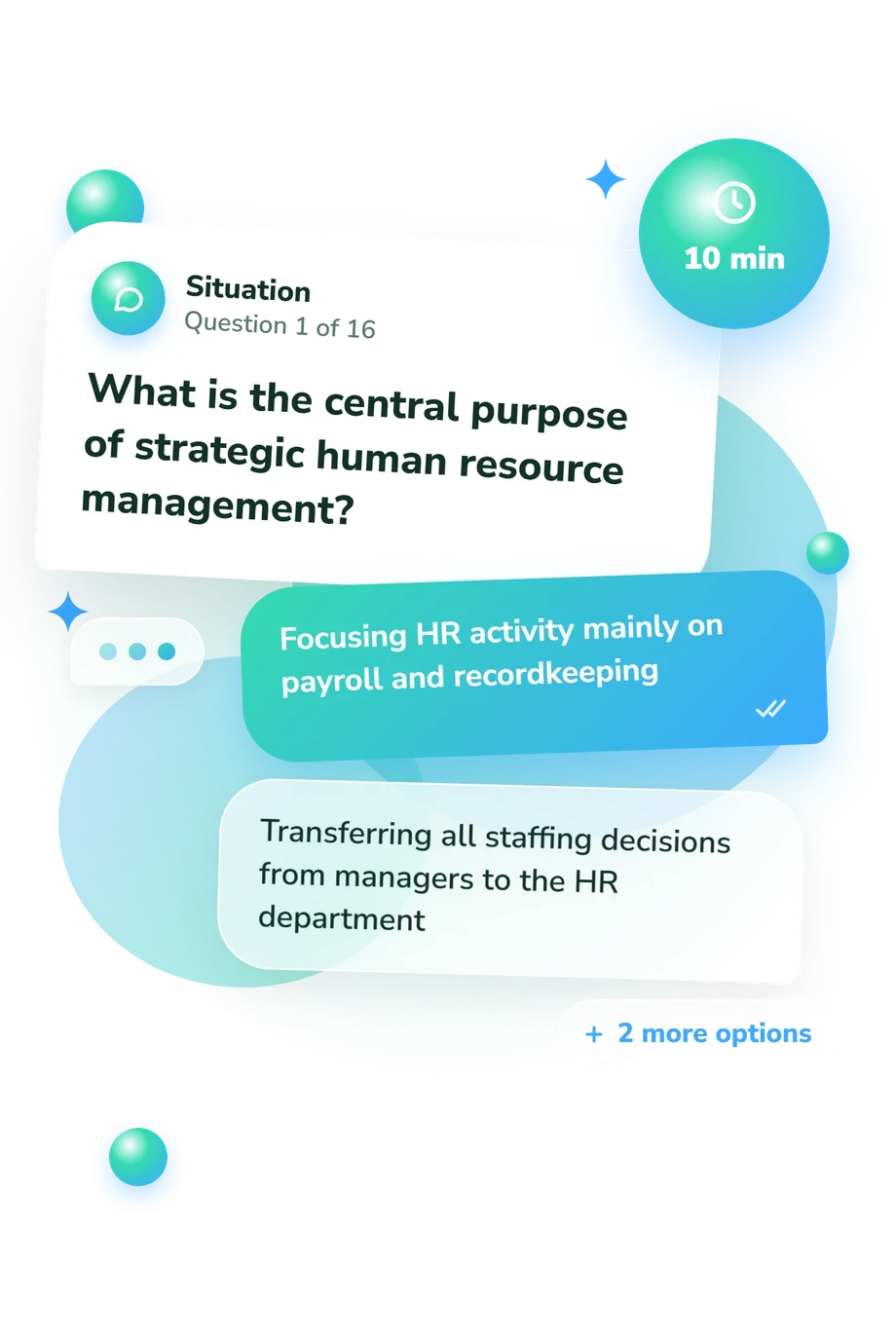
Example Questions From the Test
- They allow each interviewer to explore entirely different topics
- They eliminate the need to assess job-related competencies
- They use consistent questions and predefined evaluation criteria
- They guarantee that the most experienced candidate is hired
- Criterion-related validity
- Internal pay equity
- Inter-rater reliability
- Face validity only
- 120%
- 12%
- 90%
- 10%
HRM Quiz - Description and methodology of the test
For students, early-career practitioners, and managers who want to check practical people-management understanding, the HRM Quiz offers a focused way to review how common workplace decisions fit together. Viewed as a quiz about human resource management, this assessment turns selected answers into one overall knowledge result covering recruitment, development, employee relations, selection, performance, and workforce planning, supporting targeted study and reflection.
What This Assessment Explores
Questions measure applied HRM knowledge by connecting workplace problems with suitable practices, distinguishing related concepts, and recognizing measurable or defensible decisions. The content suits readers reviewing core terminology and managerial choices and measures HR knowledge rather than personality or job performance.
The HRM knowledge test uses workplace scenarios and defined concepts to cover these areas; its single overall result reflects performance across them:
- The HRM Knowledge scale records correct answers on 0-16 and places the result in Foundation (0-6), Developing (7-12), or Strong (13-16).
- Strategic alignment and workforce planning cover how people practices support organizational goals and future staffing needs.
- Recruitment and selection cover job analysis, structured interviews, standardization, validity, and hiring evidence.
- Learning, performance, and employee relations cover skill development, fair evaluation, psychological contracts, grievances, turnover, and employee feedback.
Methodology and Evidence Base
Each item presents a short HR situation or defined concept with four answer choices. The respondent selects the best answer rather than rating agreement. One point is awarded for each correct response, so the total reflects performance on this knowledge set.
The questionnaire is conceptually consistent with Rynes et al. (2002) and Armstrong and Taylor (2026), but it is not an adaptation of either source and makes no independent validation claim. Rousseau (1989) supports the psychological-contract concept, while Schmidt and Hunter (1998) provide relevant distinctions about standardization and criterion-related validity.
Read the result as a snapshot under these questionnaire conditions. A higher score indicates stronger command of the tested principles, but it does not establish workplace competence, predict job performance, or cover every HR function. This human resource management assessment has no stated population norms or independent reliability estimate; attention, guessing, and prior study experience can affect online responses. Use the feedback to choose further learning topics and make professional judgments with fuller evidence.
- Rynes, Sara L., Amy E. Colbert, and Kenneth G. Brown. “HR Professionals’ Beliefs About Effective Human Resource Practices: Correspondence Between Research and Practice.” Human Resource Management, vol. 41, no. 2, 2002, pp. 149-174. 10.1002/hrm.10029
- Armstrong, Michael, and Stephen Taylor. Armstrong’s Handbook of Human Resource Management Practice: A Guide to the Theory and Practice of People Management. 17th ed., Kogan Page, 2026.
- Rousseau, Denise M. “Psychological and Implied Contracts in Organizations.” Employee Responsibilities and Rights Journal, vol. 2, no. 2, 1989, pp. 121-139. 10.1007/BF01384942
- Schmidt, Frank L., and John E. Hunter. “The Validity and Utility of Selection Methods in Personnel Psychology: Practical and Theoretical Implications of 85 Years of Research Findings.” Psychological Bulletin, vol. 124, no. 2, 1998, pp. 262-274. 10.1037/0033-2909.124.2.262
Updated: