
Leaf Anatomy Quiz
How the Scales are Structured
Who Usually Takes This Test?
See How You Compare
Below is a preview of how scores are typically distributed across each scale.
Example Questions From the Test
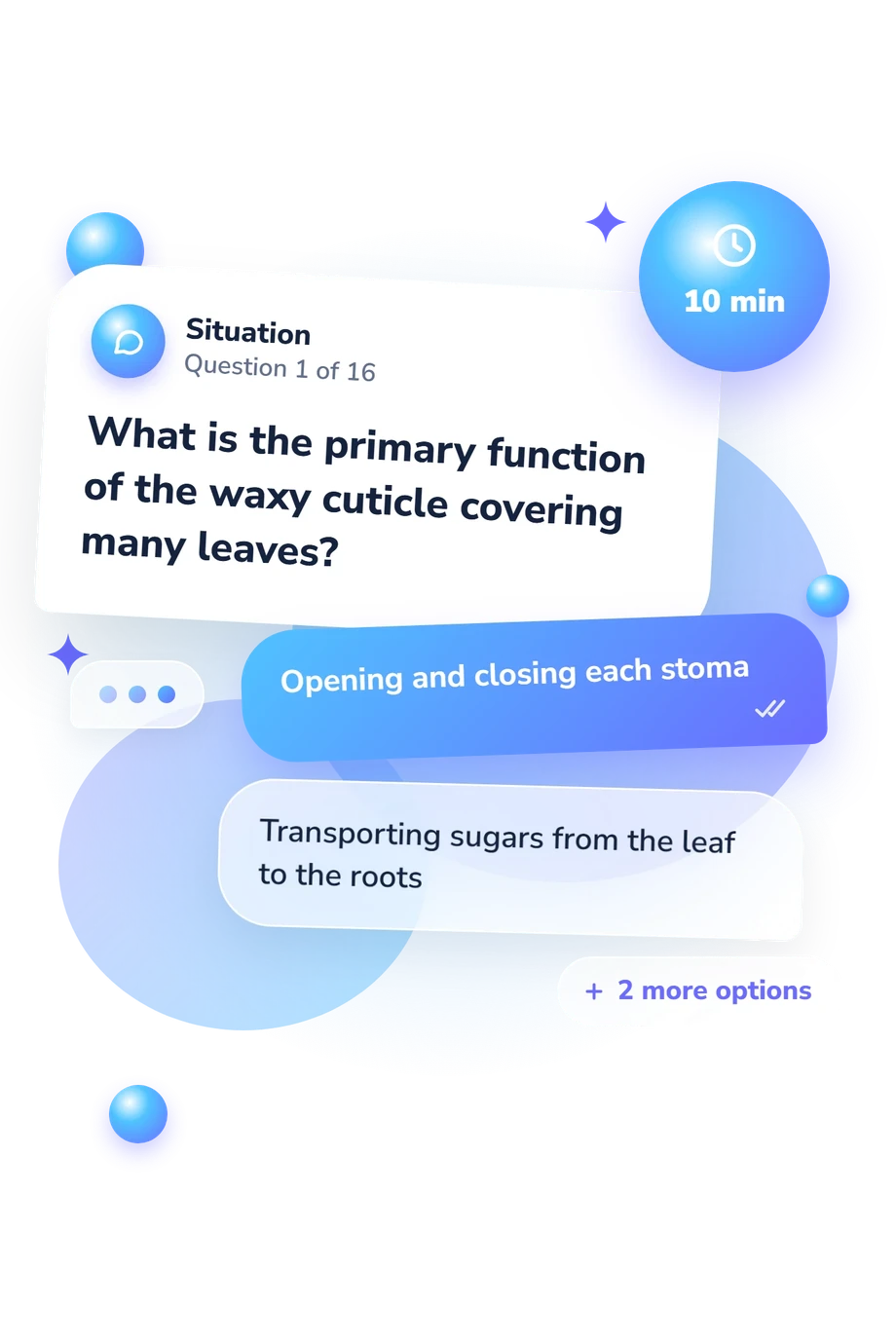
- Opening and closing each stoma
- Transporting sugars from the leaf to the roots
- Creating air spaces for internal gas movement
- Reducing uncontrolled water loss from the leaf surface
- Lower epidermis
- Spongy mesophyll
- Palisade mesophyll
- Phloem
- It pumps sugar directly into palisade cells
- It replaces the cuticle during dry conditions
- It converts xylem into phloem near the surface
- It allows light to pass to chloroplast-rich tissue beneath it
Leaf Anatomy Quiz - Description and methodology of the test
Students, gardeners, and biology learners who want to connect plant form with function can use this leaf anatomy quiz as a focused knowledge check. The leaf anatomy questions move from recognizable parts to the processes those parts support, including photosynthesis, gas exchange, and water movement. Its purpose is to show which relationships are secure and which concepts merit further study.
What This Assessment Explores
This leaf structure quiz examines how a typical leaf is organized and how its tissues cooperate. It covers the cuticle and epidermis, palisade and spongy mesophyll, veins, xylem, phloem, petiole, stomata, and guard cells. The questions also connect those structures with light capture, carbon-dioxide entry, sugar transport, transpiration, and control of water loss.
The intended result is a practical picture of plant-anatomy knowledge rather than a profile of personality or learning style. A strong performance suggests that the respondent can identify structures and apply structure-function relationships in familiar leaf situations; a lower result points to topics worth reviewing, not to a fixed ability limit.
The assessment is especially suitable for learners revising introductory botany or checking whether they can explain why a structure matters, not merely name it.
Methodology and Scientific Basis
Each item presents four answer options and one best response. The set mixes direct identification with short scenarios, asking the learner to trace gases or water and predict effects of changing stomatal control. This format checks recall and basic application of anatomy to function.
The result uses one scale, Leaf Anatomy Knowledge (0-16), with these displayed bands:
- Foundations to Review (0-6) marks tissues, locations, and functions needing review.
- Developing Knowledge (7-12) shows partial understanding, with more practice needed linking anatomy to transport, gas exchange, and environmental response.
- Strong Knowledge (13-16) reflects clear command of typical leaf anatomy and structure-function relationships.
As an online leaf anatomy test, the questionnaire is conceptually consistent with Raven, Evert, and Eichhorn (2013), whose account supports the leaf relationships assessed here. Its terminology also agrees with Esau’s treatment of plant cells and tissues and the leaf overview by Clark, Douglas, and Choi (2018). These sources provide a scientific frame, but the questionnaire is not an adaptation of any one source. Its score is interpreted through the displayed quiz-specific bands and does not represent every anatomical variation across plant species.
- Evert, Ray F., and Susan E. Eichhorn. Raven Biology of Plants. 8th ed. New York: W.H. Freeman and Company, 2013.
- Evert, Ray F. Esau's Plant Anatomy: Meristems, Cells, and Tissues of the Plant Body: Their Structure, Function, and Development. 3rd ed. Hoboken, NJ: John Wiley & Sons, 2006. 10.1002/0470047380
- Clark, Mary Ann, Matthew Douglas, and Jung Choi. Biology 2e. Houston, TX: OpenStax, 2018. Section 30.4, Leaves.
Updated: