
Latin Verb Conjugation Quiz
How the Scales are Structured
Who Usually Takes This Test?
See How You Compare
Below is a preview of how scores are typically distributed across each scale.
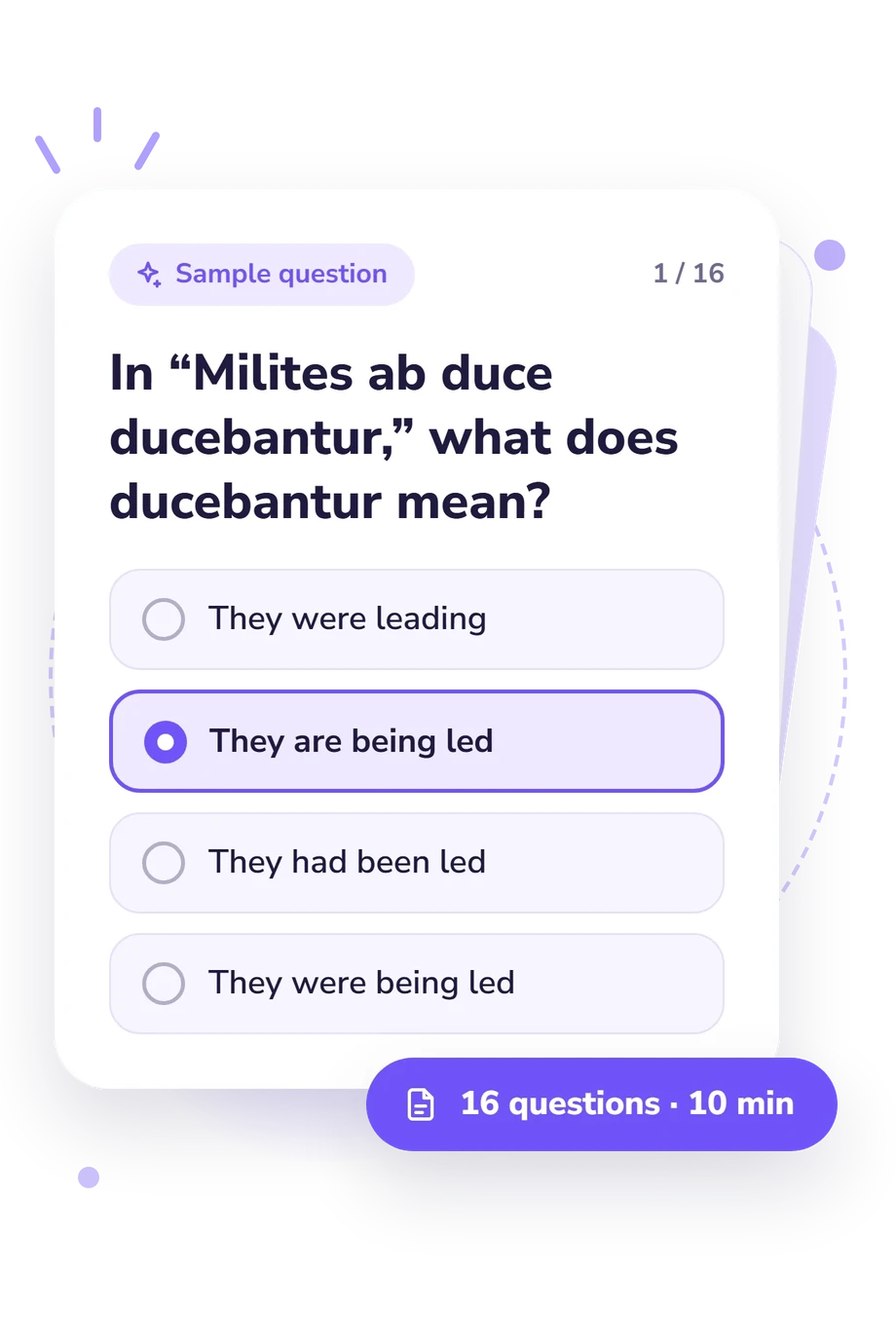
Example Questions From the Test
- They were leading
- They are being led
- They had been led
- They were being led
- They will praise
- They were praising
- They praised
- They had praised
- Si venit, eum video.
- Si veniret, eum viderem.
- Si venerat, eum videram.
- Si veniet, eum videbo.
Latin Verb Conjugation Quiz - Description and methodology of the test
Students reviewing classical Latin grammar, teachers checking a learner’s current command, and independent readers can use the latin verb conjugation quiz to examine form recognition in context. As a Latin grammar quiz, it suits readers deciding whether a focused check of tense, voice, mood, conjugation, and principal-part distinctions fits their study needs. Its result can organize these grammatical distinctions into areas for later study.
What This Assessment Explores
Questions examine how Latin verb forms work in context. By testing Latin verb endings in context, the quiz connects endings and stems with tense, voice, mood, conjugation, and meaning. Translation and parsing require recognition of both form and grammatical role.
The main thematic groups are:
- Tense and aspect recognition shows whether you distinguish present, imperfect, perfect, pluperfect, and future forms.
- Voice and mood show whether you identify active or passive relationships and recognize subjunctives in conditions or commands.
- Conjugation and principal parts show whether you can select the stem and ending a form requires.
Latin Verb Conjugation Knowledge runs from 0-16. Foundations (0-6) signals core review; Developing (7-12) reflects many common forms with gaps possible in the perfect system, passive voice, or subjunctive; Strong (13-16) indicates consistent command of the forms tested. The score reflects this coverage, not complete mastery of Latin grammar.
Methodology and Scientific Basis
Each item presents a Latin sentence or a form-selection prompt with four answer choices. The tasks ask you to translate a finite verb, parse person, number, tense, or mood, identify voice or conjugation, select a subjunctive or passive form, or connect a principal part with its stem. The format tests recognition and contextual application rather than free composition.
Performance is summarized in one overall score; themes are not separate subscales. Latin verb conjugation practice can then target endings, tense systems, passive forms, subjunctives, or principal parts that caused difficulty.
The grammatical distinctions in the quiz are consistent with the descriptions by Allen and Greenough (1903) and Bennett (1908). Kodner (2023) provides a modern morphological perspective. These references support the content framework, not psychometric validation of this online quiz.
Interpret the result as a snapshot of performance on the selected forms. Accuracy can vary with study history, attention, and familiarity with the sentences, so the score is best used to choose review topics rather than infer complete grammatical proficiency. The displayed bands describe performance on the forms included here and should not be interpreted as population norms.
- Allen, Joseph Henry, and James Bradstreet Greenough. Allen and Greenough's New Latin Grammar for Schools and Colleges: Founded on Comparative Grammar. Boston: Ginn & Company, 1903.
- Bennett, Charles Edwin. New Latin Grammar. Boston: Allyn and Bacon, 1908.
- Kodner, Jordan. What learning Latin verbal morphology tells us about morphological theory. Natural Language & Linguistic Theory 41, no. 2 (2023): 733-792. 10.1007/s11049-022-09553-2.
Updated: