
Office Desk Quiz
How the Scales are Structured
Who Usually Takes This Test?
See How You Compare
Below is a preview of how scores are typically distributed across each scale.
Example Questions From the Test
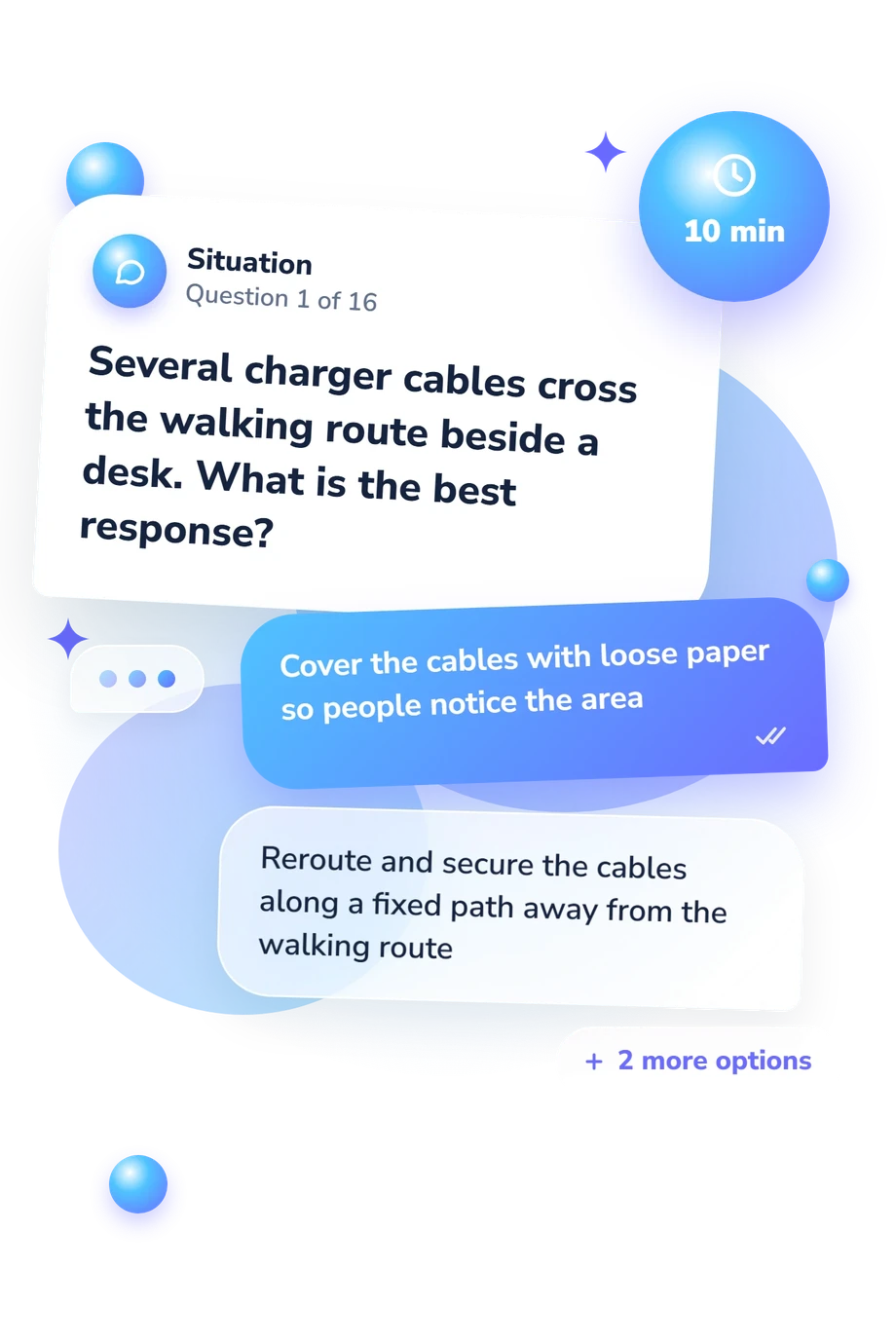
- Cover the cables with loose paper so people notice the area
- Reroute and secure the cables along a fixed path away from the walking route
- Stretch the cables tightly so they stay straight and take up less space
- Place a chair over the cables to discourage people from stepping there
- Place every item along the back edge to preserve a large empty area
- Keep frequently used items within easy reach and move occasional items farther away
- Stack the items beside the monitor in order of size
- Store all supplies in drawers and retrieve them whenever needed
- Place the phone flat on the desk and bend toward it
- Switch the phone between shoulders during each call
- Move the keyboard farther away to create room for the elbow
- Use a headset or speaker function appropriate to the setting
Office Desk Quiz - Description and methodology of the test
People who want to improve everyday workstation decisions can use this office desk quiz to examine practical knowledge rather than personal preference. It is suitable for employees, students, managers, and anyone arranging a shared or home workspace. Its office layout quiz questions address equipment placement and movement alongside paperwork, privacy, and desk safety, so the result indicates the respondent's level of knowledge of appropriate desk practices.
What This Assessment Explores
The questions turn desk situations into decisions about comfort, organization, security, and equipment use. The desk setup assessment checks knowledge needed for changing a workstation or improving routines in a shared office or home setting.
The themes are:
- Cable and power management tests knowledge of keeping routes clear and choosing sensible electrical arrangements.
- Ergonomic positioning tests knowledge of placing the chair, screen, laptop, input devices, lighting, and phone to support neutral working postures.
- Information protection tests knowledge of suitable disposal, storage, locking, and privacy measures for confidential papers and visible screens.
- Desk organization tests knowledge of arranging objects and paper stages for efficient access and retrieval.
The displayed scale is Office Desk Knowledge (0-16): Foundation (0-6) reflects some basics, Developing (7-12) reflects practical understanding with occasional uncertainty, and Strong (13-16) reflects consistent knowledge of effective, secure, and considerate desk practices.
Methodology and Scientific Basis
Each item presents a workplace scenario with four answer choices and asks for the best response, not a personal rating. The score reflects correct answers; its bands indicate increasing familiarity with desk practices. This is an educational score, not a professional ergonomic, medical, or safety assessment.
The closest evidence is the Ergonomic Knowledge Questionnaire (Sirajudeen et al., 2012), which measures ergonomic knowledge among computer professionals. This questionnaire is conceptually consistent with that work, not a direct adaptation. Sirajudeen and Pillai’s 2015 test-retest study concerns measurement stability in a published instrument; these studies do not establish reliability, norms, or standardization for this online form. Emerson et al. (2021) supports guidance on screens, input devices, seating, lighting, and remote evaluation, while NIST guidance from McCallister, Grance, and Scarfone (2010) supports privacy scenarios involving personally identifiable information.
Safety items in the office safety quiz contribute to the score; guessing, prior training, or setting familiarity may affect performance. The result places the respondent in an educational band and may indicate that desk guidance merits review. The bands are catalogue-defined educational categories for this knowledge score.
- Sirajudeen, Mohamed Sherif, Umama Nisar Shah, Nagarajan Mohan, and Padmakumar Somasekharan Pillai. "Content Validity of a Questionnaire to Assess the Ergonomic Knowledge of Computer Professionals." International Journal of Current Research and Review 4, no. 11 (2012): 114-121.
- Sirajudeen, Mohamed Sherif, and Padmakumar Somasekharan Pillai. "Test-retest Reliability of a Questionnaire to Assess the Ergonomic Knowledge of Computer Professionals." International Journal of Health and Rehabilitation Sciences 4, no. 4 (2015): 239-243. 10.5455/ijhrs.000000096
- Emerson, Susan, Katelyn Emerson, and Jane Fedorczyk. "Computer Workstation Ergonomics: Current Evidence for Evaluation, Corrections, and Recommendations for Remote Evaluation." Journal of Hand Therapy 34, no. 2 (2021): 166-178. 10.1016/j.jht.2021.04.002
- McCallister, Erika, Tim Grance, and Karen Scarfone. "Guide to Protecting the Confidentiality of Personally Identifiable Information (PII)." NIST Special Publication 800-122. National Institute of Standards and Technology, 2010. 10.6028/NIST.SP.800-122
Updated: