
Friends for Life Quiz
How the Scales are Structured
Who Usually Takes This Test?
See How You Compare
Below is a preview of how scores are typically distributed across each scale.
Example Questions From the Test
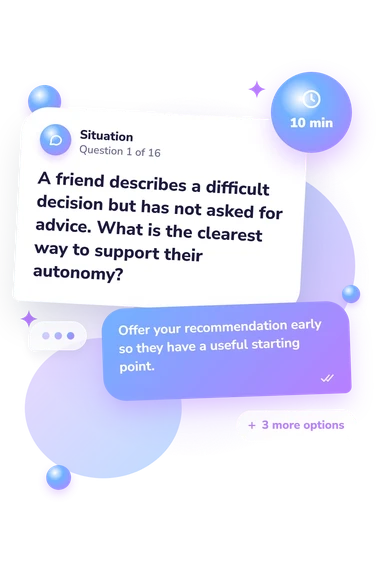
- Offer your recommendation early so they have a useful starting point.
- List the likely consequences without endorsing a choice.
- Ask whether they want listening, brainstorming, practical help, or another kind of support.
- Avoid responding until they decide what they need.
- Match their reduced contact so the effort remains balanced.
- Say you miss spending time together and invite a conversation about flexible ways to connect.
- Wait for the new relationship to become less intense before raising the issue.
- Remind them how much time they previously promised the friendship.
- Stop inviting them until they take the initiative.
- Ask for a detailed explanation so you can judge whether the reason is fair.
- Accept the answer without punishment and, if useful, suggest connecting another time.
- Persuade them to attend briefly as a compromise.
Friends for Life Quiz - Description and methodology of the test
People who want to understand the principles behind lasting friendships can use the Friends for Life Quiz as a focused educational reflection on judgment in everyday scenarios. The situations help readers consider healthy friendship principles: how they listen, communicate, respond to boundaries, share effort, and handle change or hurt. The result offers an educational profile that identifies principles you recognize well and may wish to practise.
What This Assessment Explores
The questions examine principles rather than asking whether a friendship is destined to last. Situations involve advice and autonomy, changing availability, boundaries, active listening, apologies, sincerity, reliability, reciprocity, distance, envy, safety, and the difference between intention and impact. These situations help readers review their understanding of lasting friendship principles in ordinary moments of closeness and strain.
The result uses one educational scale, Friends for Life Knowledge (0-16). It reflects recognition of habits linked to durable friendship, while the score cannot predict whether a particular relationship will continue. Three bands are shown:
- Foundations to build (0-6) identifies areas where boundaries, listening, reciprocity, and repair may need attention.
- Developing understanding (7-12) indicates recognition of healthy principles, with room to apply them in difficult moments.
- Strong understanding (13-16) reflects a well-rounded grasp of sincere, consistent friendship habits.
Methodology and Scientific Basis
Each item presents a situation with response options. The questionnaire presents a 0-16 educational result with bands describing levels of understanding, while no individual-answer weighting rule is specified. As an educational friendship assessment, it focuses on recognizing sound responses in context rather than measuring every feature of a real relationship.
Its conceptual reference point is Friendship Standards, which describes standards people hold for supportive, reciprocal relationships. The questionnaire is conceptually consistent with Friendship Standards and is not an adaptation of that instrument or the McGill Friendship Questionnaires. Research on friendship standards connects them with expectations for maintaining relationships, while the McGill Friendship Questionnaires offer a related precedent for assessing friendship quality.
The result bands describe levels of understanding. Interpret the outcome alongside the situations and any gaps between your understanding and your ideals. Responses can be shaped by memory, social desirability, current stress, and self-awareness; recognizing a healthy response does not establish how a person would respond in every real situation. The score can then help you choose a principle for reflection or conversation.
- Hall, Jeffrey A. (2012). Friendship standards: The dimensions of ideal expectations. Journal of Social and Personal Relationships, 29(7), 884-907. 10.1177/0265407512448274
- Hall, Jeffrey A., Larson, Kiley A., and Watts, Amber. (2011). Satisfying Friendship Maintenance Expectations: The Role of Friendship Standards and Biological Sex. Human Communication Research, 37(4), 529-552. 10.1111/j.1468-2958.2011.01411.x
- Mendelson, Morton J., and Aboud, Frances E. (1999). Measuring friendship quality in late adolescents and young adults: The McGill Friendship Questionnaires. Canadian Journal of Behavioural Science, 31(2), 130-132. 10.1037/h0087080