
Noun Adjective Adverb Clause Quiz
How the Scales are Structured
Who Usually Takes This Test?
See How You Compare
Below is a preview of how scores are typically distributed across each scale.
Example Questions From the Test
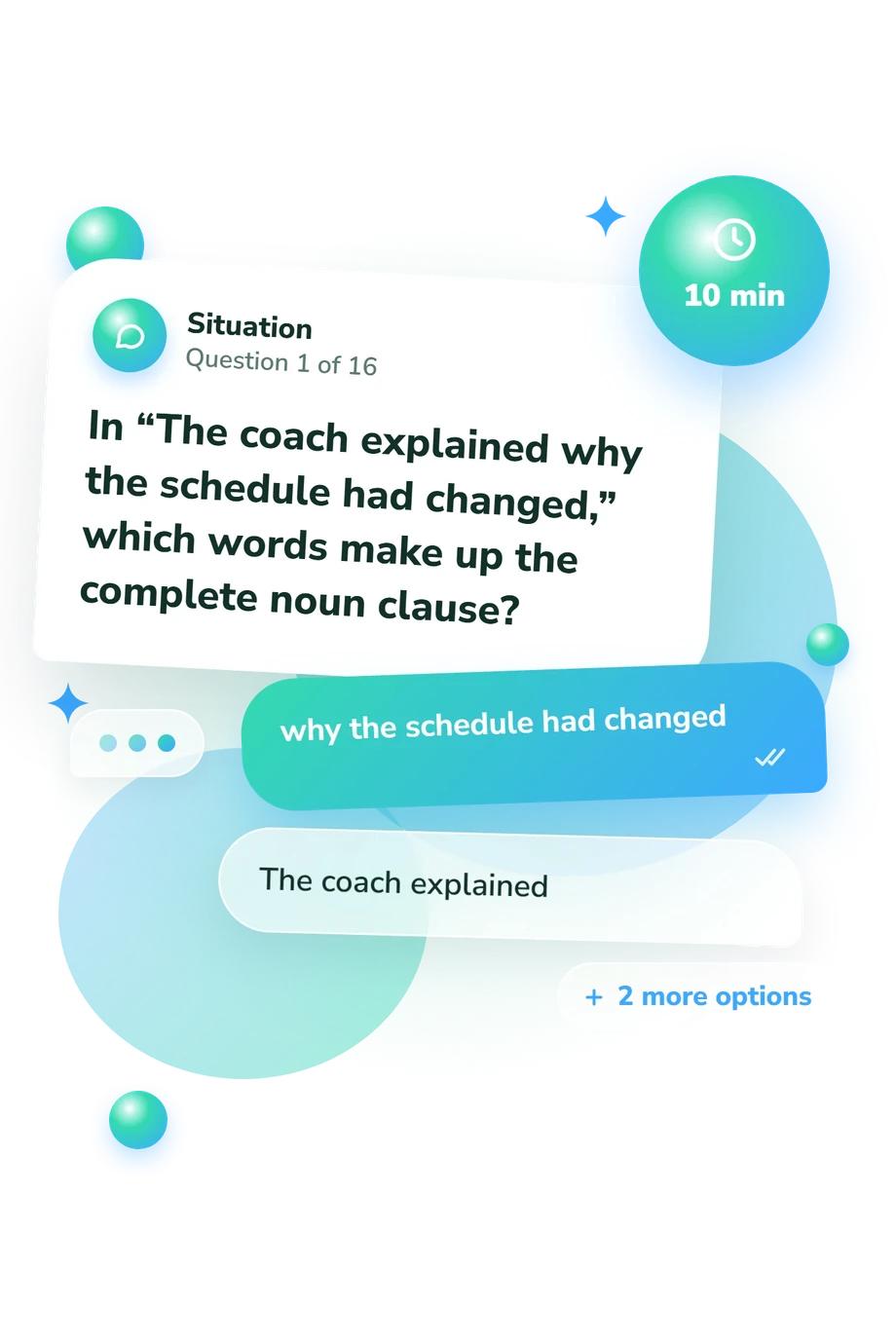
- why the schedule had changed
- The coach explained
- the schedule
- had changed
- It names the thing that the group left.
- It modifies “left” by telling when the action occurred.
- It acts as the subject of the sentence.
- It modifies “park” by identifying a particular park.
- We postponed the picnic because heavy rain was forecast.
- We will hold the picnic where the trail begins.
- Although heavy rain was forecast, we held the picnic.
- We will hold the picnic if the shelter is available.
Noun Adjective Adverb Clause Quiz - Description and methodology of the test
Students, teachers, and independent learners can use the Noun Adjective Adverb Clause Quiz to examine how dependent clauses function within complete sentences. It also serves as a clause grammar test for anyone preparing for classroom work, reviewing a writing lesson, or checking a specific point of uncertainty. The result indicates overall performance in recognizing and applying the three clause functions, giving review a clearer direction.
What This Assessment Explores
The questionnaire measures the job a dependent clause performs. Noun clauses fill noun-like roles, adjective clauses modify nouns or pronouns, and adverb clauses explain time, cause, condition, or concession. Items address boundaries and punctuation.
It suits learners reviewing grammar, writers checking sentence analysis, and teachers choosing practice topics. It provides grammar practice in distinguishing these clause functions in context.
The questions cover three clause functions:
- Noun clauses show whether you identify noun-like subjects or objects.
- Adjective clauses show whether you recognize which noun or pronoun a clause modifies.
- Adverb clauses show whether you recognize time, cause, condition, or contrast.
The Noun, Adjective, and Adverb Clause Knowledge scale runs 0-16: Foundation Building (0-6), Developing Knowledge (7-12), and Strong Knowledge (13-16). Because the questions cover all three types, the result can show which distinctions need review.
Methodology and Evidence Base
Each item presents a sentence or short grammar task with four answer choices. The respondent identifies a clause or selects its function, combines ideas, or applies punctuation. Each correct answer earns one point, so the total reflects overall performance rather than a separate score for each clause type.
The questionnaire combines recognition with application. Items ask for complete clauses or their roles and test condition, concession, relative-clause function, and punctuation. By placing dependent clauses in sentence contexts, it checks whether the definitions transfer to actual sentences.
The distinctions are conceptually consistent with Quirk et al. (1985) and Huddleston and Pullum (2002), whose frameworks distinguish clause function and modification. They supply terminology and analytical background; this questionnaire is a separate online knowledge check, not a reported adaptation or validation study.
Because no standardized norms are stated, the bands describe performance on these tasks rather than general language ability. Results may also reflect instruction, attention, familiarity with grammar terms, and performance on selected responses. Reviewing missed functions in new sentences can make the result more useful.
- Quirk, Randolph, Sidney Greenbaum, Geoffrey Leech, and Jan Svartvik. A Comprehensive Grammar of the English Language. Longman, 1985.
- Huddleston, Rodney, and Geoffrey K. Pullum. The Cambridge Grammar of the English Language. Cambridge University Press, 2002. 10.1017/9781316423530
Updated: