
Kinetics Quiz
How the Scales are Structured
Who Usually Takes This Test?
See How You Compare
Below is a preview of how scores are typically distributed across each scale.
Example Questions From the Test
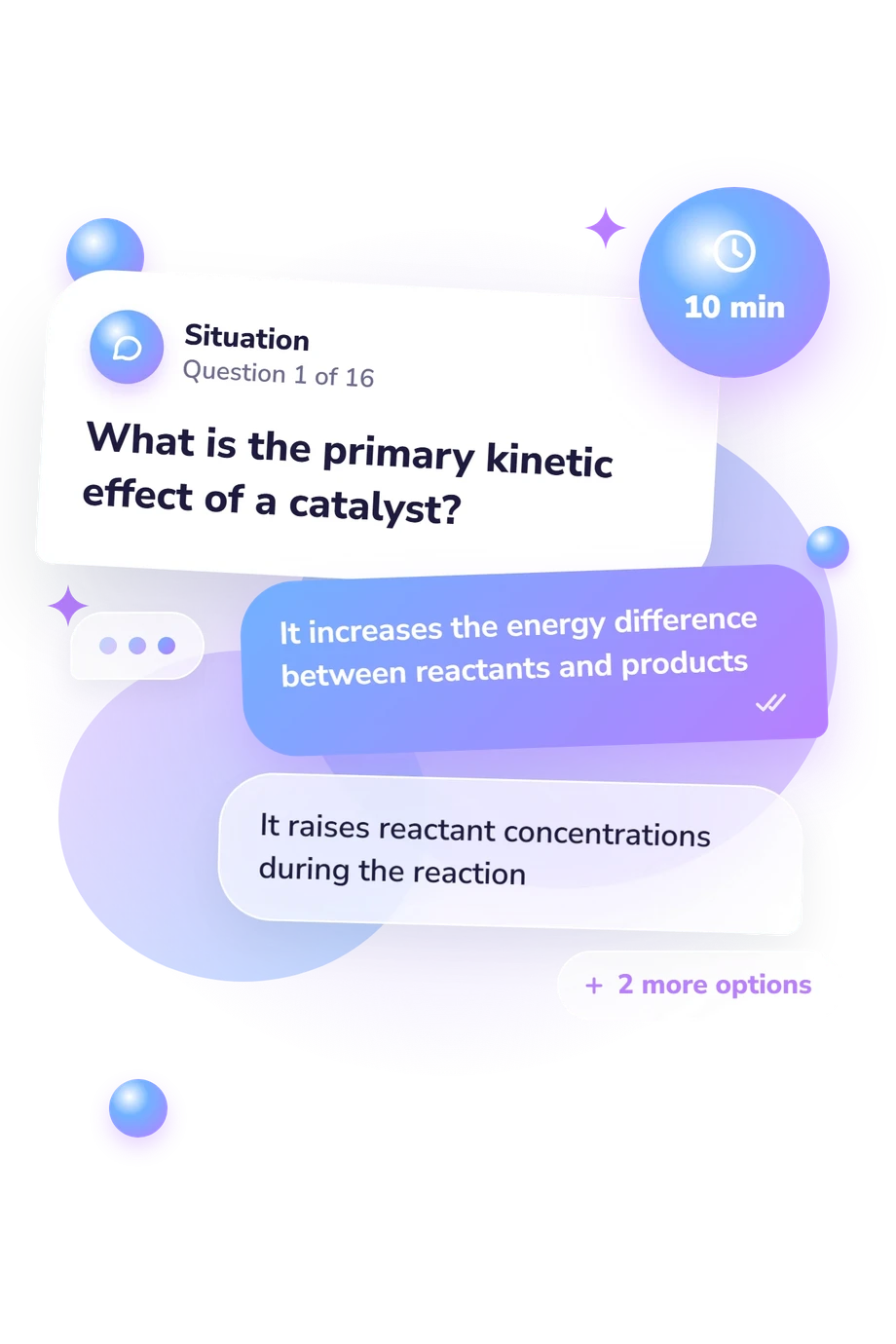
- It increases the energy difference between reactants and products
- It raises reactant concentrations during the reaction
- It makes every molecular collision produce products
- It provides an alternative pathway with lower activation energy
- NO₃, because it is produced in one step and consumed in the next
- NO₂, because it is present as a reactant in the first step
- CO, because it enters the mechanism during the second step
- CO₂, because it remains among the overall products
- 08 M
- 30 M
- 50 M
- 18 M
Kinetics Quiz - Description and methodology of the test
Students, teachers, and independent learners who want a focused check of reaction-rate ideas can use this kinetics quiz to see which parts of chemical kinetics are secure and which need review. It is a knowledge check, not a personality profile or measure of laboratory performance. This quiz on chemical kinetics offers a compact picture of conceptual and quantitative readiness for further study.
What This Assessment Explores
The questions test whether a learner can connect definitions with equations, graphs, mechanisms, and particle-level explanations. A chemical kinetics test is therefore useful for reviewing general chemistry, checking conceptual gaps, or deciding which topics deserve more practice.
The main topic groups are:
- Reaction rates, which describe how concentrations change over time and how conditions affect speed.
- Rate laws and orders, which show how concentration changes relate to observed rate.
- Integrated relationships, which link time, concentration, half-life, and linear graph forms.
- Mechanisms, intermediates, and molecularity, which connect elementary steps with an overall reaction.
- Activation energy and catalysis, which explain barriers, pathways, and temperature effects.
The result uses one scale, Chemical Kinetics Knowledge: 0-16. Foundations to build covers 0-6, Developing knowledge covers 7-12, and Strong knowledge covers 13-16. These bands indicate whether core ideas need building, are developing, or are applied consistently.
Methodology and Scientific Basis
Each item presents one question with four answer choices. Together, the items require concept recognition, data interpretation, equation use, graph reading, and short calculations. The questionnaire reports one overall score and defines no topic subscores or alternate weighting.
The questionnaire addresses chemical-kinetics concepts examined by Gultekin Cakmakci and Cemil Aydogdu (2011); it is a separate online questionnaire, not their published assessment. Research by Cakmakci (2010) addresses chemical kinetics, while Cakmakci, Leach, and Donnelly (2006) examine students’ understanding of reaction rate under changing concentration and pressure. Bain and Towns (2016) provide a broader review of teaching and learning in the field.
For a chemical kinetics assessment, the bands are best read as descriptive study guidance, not population norms or evidence of laboratory competence. Performance can also reflect recent instruction, notation familiarity, guessing, and testing conditions, so one score cannot represent every aspect of chemical understanding.
- Cakmakci, Gultekin, and Cemil Aydogdu. "Designing and evaluating an evidence-informed instruction in chemical kinetics." Chemistry Education Research and Practice 12, no. 1 (2011): 15-28. 10.1039/C1RP90004H
- Cakmakci, Gultekin. "Identifying alternative conceptions of chemical kinetics among secondary school and undergraduate students in Turkey." Journal of Chemical Education 87, no. 4 (2010): 449-455. 10.1021/ed8001336
- Cakmakci, Gultekin, John Leach, and James Donnelly. "Students' Ideas about Reaction Rate and Its Relationship with Concentration or Pressure." International Journal of Science Education 28, no. 15 (2006): 1795-1815. 10.1080/09500690600823490
- Bain, Kinsey, and Marcy H. Towns. "A review of research on the teaching and learning of chemical kinetics." Chemistry Education Research and Practice 17, no. 2 (2016): 246-262. 10.1039/C5RP00176E
Updated: