
Frenemy Quiz
How the Scales are Structured
Who Usually Takes This Test?
See How You Compare
Below is a preview of how scores are typically distributed across each scale.
Example Questions From the Test
- Whether undermining behavior recurs over time, across situations, and despite communication
- Whether the most recent incident caused embarrassment
- Whether another friend immediately applies the label “frenemy”
- Whether the person is popular with others
- Envy always damages a friendship, even when it is handled responsibly
- A person can feel envy without undermining someone; conduct and repeated patterns matter
- Frenemy behavior exists only when a person openly admits feeling envy
- Any competition between friends proves that hidden hostility is present
- Return a similar remark so the friend understands its effect
- Ignore every future incident regardless of how the pattern develops
- Describe the specific behavior privately, explain its impact, and state what needs to change
- Ask the group to judge which person is behaving worse
Frenemy Quiz - Description and methodology of the test
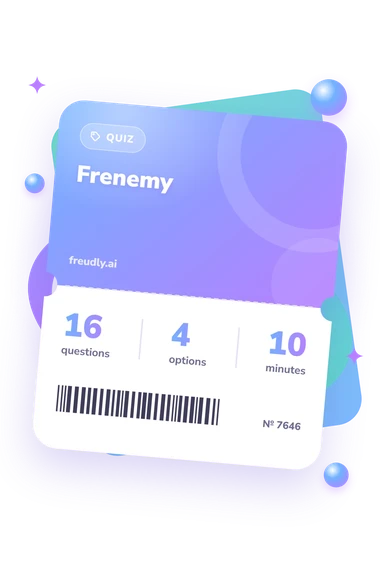
People unsure whether a difficult friendship reflects ordinary conflict or a recurring pattern can use this assessment to organize what they notice. The frenemy quiz focuses on mixed signals, social undermining, and fairer ways to respond. It gives readers a practical vocabulary for considering context instead of reacting to one striking incident. As a quiz on friend-or-frenemy dynamics, it shows whether respondents recognize patterns, boundaries, and reciprocity.
What This Assessment Explores
This assessment measures knowledge of mixed friendship dynamics, not whether a named person deserves a label. Its scenarios distinguish isolated mistakes from recurring envy, belittling, rumor-spreading, exclusion, unequal support, and indirect conflict. Its scenarios emphasize context, repetition, reciprocity, and boundaries.
The result draws on four connected areas:
- Pattern recognition separates repeated behavior from one awkward event.
- Envy and undermining cover belittling, backhanded praise, and status-lowering conduct.
- Relational processes include reciprocity, triangulation, rumor-spreading, and social harm.
- Constructive responses reflect communication, apologies, boundaries, and low-conflict distance.
Frenemy Knowledge runs 0-16: Foundations to build 0-6 signals a need to strengthen recognition of subtle patterns; Developing insight 7-12 reflects growing understanding; Strong understanding 13-16 reflects clear grasp of mixed friendship behavior and constructive responses. It measures knowledge, not whether a specific person is a frenemy.
Methodology and Scientific Basis
Each item presents four answer choices and asks for the most accurate interpretation of a situation, definition, or response. The format tests applied recognition: separating envy from conduct, a delayed reply from a repeated pattern, and a boundary from an attempt to control another person. The result is reported as a total; no separate weighting formula is stated, so the displayed bands should guide interpretation.
Conceptually, the questionnaire is consistent with Abetz, Romo, and Marr (2023), whose work describes frenemy relationships as combining apparent friendship with hostility, rivalry, or undermining. It is not an adaptation of that work. Mills, Yu, and Mongeau (2023) support the distinction between outward friendship and inward antagonism. Grotpeter and Crick (1996) provide context for relational aggression, including harm carried through relationships or social standing.
The questionnaire is a structured online knowledge check; no norms or validation data are stated for the score. A frenemy assessment is most useful for examining your understanding of patterns, not proving another person’s motives. Answers may reflect current emotions, incomplete context, and personal assumptions, so interpret the result alongside repeated behavior, reciprocity, and clearly stated boundaries.
- Jenna S. Abetz, Lynsey K. Romo, and Chandler Marr (2023). Defining and Exploring Frenemy Relationships. Southern Communication Journal, 88(2), 172-184. 10.1080/1041794X.2022.2131897
- Carol Bishop Mills, Panfeng Yu, and Paul A. Mongeau (2023). Frenemies: Acting like Friends but Feeling like Enemies. Western Journal of Communication, 87(5), 795-815. 10.1080/10570314.2022.2146458
- Jennifer K. Grotpeter and Nicki R. Crick (1996). Relational Aggression, Overt Aggression, and Friendship. Child Development, 67(5), 2328-2338. 10.1111/j.1467-8624.1996.tb01860.x