
Portion Control Quiz
How the Scales are Structured
Who Usually Takes This Test?
See How You Compare
Below is a preview of how scores are typically distributed across each scale.
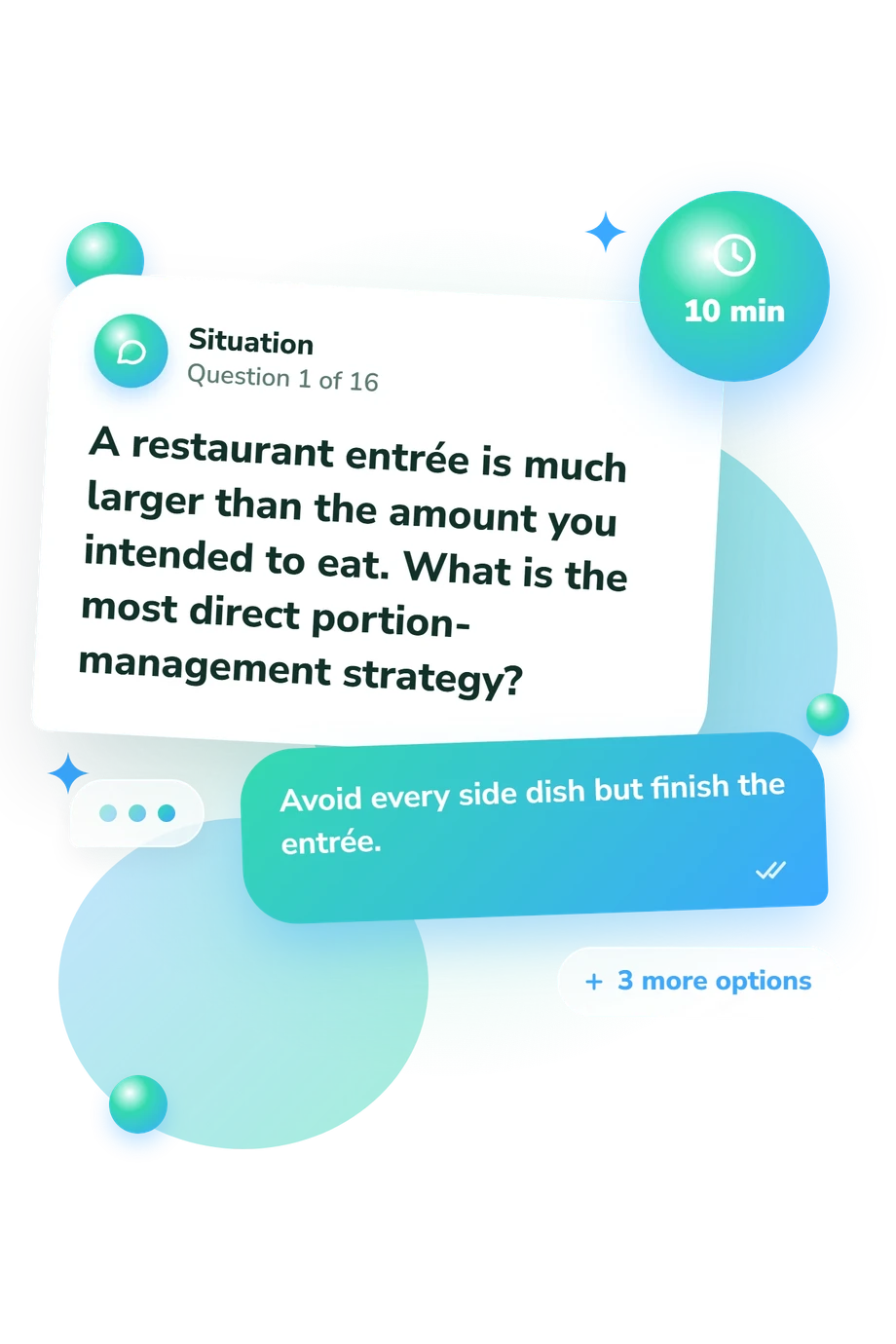
Example Questions From the Test
- Eating without a screen and pausing partway through the meal
- Finishing the meal before its temperature changes
- Choosing foods that require the least chewing
- Using the package's serving size as a fullness target
- It increases by about one-half.
- It stays the same because the food itself has not changed.
- It rises only if the food contains fat.
- It approximately doubles.
- Use the listed values once because it is one bottle.
- Use the listed values once unless the drink contains added sugar.
- Multiply the per-serving values by two.
- Average the per-serving values with the daily value percentages.
Portion Control Quiz - Description and methodology of the test
People seeking a clearer grasp of everyday serving decisions can use this portion size quiz to check how they interpret labels, estimate amounts, and respond to common eating situations. This portion control quiz focuses on reading labels, estimating amounts, noticing eating cues, and understanding why one amount cannot suit everyone. The quiz's portion-size content covers those areas, while its result reports an overall knowledge level rather than separate topic scores.
What This Test Measures
Across the items, the test checks whether someone can connect serving information with everyday choices at meals, snacks, restaurants, and home. The portion control assessment presents these questions as one broad knowledge profile rather than separate topic scores.
The result's main themes are:
- Label use and estimation show whether the respondent can interpret serving counts, grams, calories, scales, and hand cues.
- Context and management strategies indicate awareness of pre-portioning, storing food away, slowing down, fullness cues, and distracted eating.
- Balance and individual variation cover plate proportions, energy density, and why needs differ by person and situation.
Together, the themes feed one educational scale, Portion Control Knowledge: 0-16. Foundations to Build (0-6) signals concepts to review; Developing Knowledge (7-12) reflects essentials with some gaps; Strong Knowledge (13-16) indicates dependable understanding. The score does not determine exact personal portions.
Methodology and Evidence Base
Each item presents a practical situation or short calculation with four answer choices. The format asks the respondent to select the option that best reflects accurate portion knowledge, rather than report a personal diet history. The resulting score is organized as a single educational scale; the displayed bands describe levels of knowledge rather than a formula for prescribing meals or calories.
The questionnaire is conceptually consistent with the Weight Management Nutrition Knowledge Questionnaire developed by Mikhail and colleagues, while remaining a separate online questionnaire rather than an adaptation of that instrument. Its numeracy and portion-estimation items are conceptually consistent with Huizinga's 2009 work, while its label items correspond to serving-size issues discussed by Van der Horst and colleagues in 2019. The portion management test addresses these practical concepts without estimating exact nutritional requirements.
The displayed bands are educational categories, not calculations of the exact portions a person needs. Because responses depend on attention, memory, current eating circumstances, and self-awareness, the result is best used to guide learning and reflection about portion decisions.
- Mikhail D, Rolls B, Yost K, Balls-Berry J, Gall M, Blixt K, Novotny P, Albertie M, Jensen M. Development and validation testing of a weight management nutrition knowledge questionnaire for adults. International Journal of Obesity. 2020;44(3):579-589. 10.1038/s41366-019-0510-1
- Huizinga MM, Carlisle AJ, Cavanaugh KL, Davis DL, Gregory RP, Schlundt DG, Rothman RL. Literacy, Numeracy, and Portion-Size Estimation Skills. American Journal of Preventive Medicine. 2009;36(4):324-328. 10.1016/j.amepre.2008.11.012
- Van der Horst K, Bucher T, Duncanson K, Murawski B, Labbe D. Consumer Understanding, Perception and Interpretation of Serving Size Information on Food Labels: A Scoping Review. Nutrients. 2019;11(9):2189. 10.3390/nu11092189
Updated: