
Lifespan Psychology Quiz
How the Scales are Structured
Who Usually Takes This Test?
See How You Compare
Below is a preview of how scores are typically distributed across each scale.
Example Questions From the Test
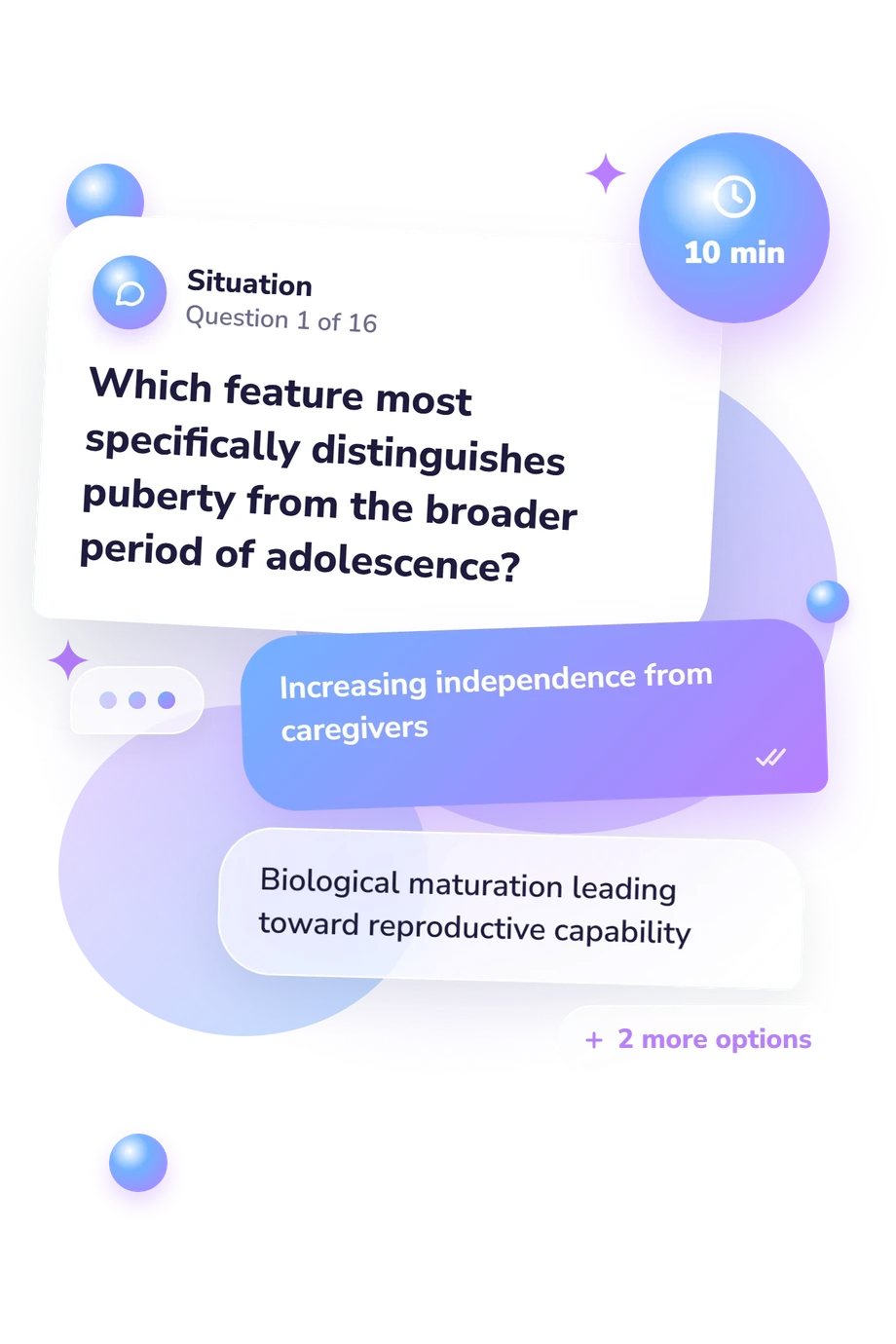
- Increasing independence from caregivers
- Biological maturation leading toward reproductive capability
- Greater interest in peer relationships
- Exploration of personal values and future roles
- Maturation alone determines the child's eventual musical skill.
- Genetic tendencies and environmental experiences can influence one another over time.
- Shared family environments make genetic differences irrelevant.
- Practice determines skill independently of inherited characteristics.
- A placebo effect
- Random assignment failure
- Selective attrition
- Observer habituation
Lifespan Psychology Quiz - Description and methodology of the test
Students, lifelong learners, and readers revising developmental science can use the lifespan psychology quiz to check their grasp of core ideas and see whether a broad review would be useful. A structured lifespan development quiz offers a clear way to revisit course material without requiring personal disclosure. The result is an overall educational knowledge summary for self-reflection, not a map of individually scored study priorities.
What This Assessment Explores
The questions test conceptual knowledge rather than symptoms or personal experiences. They ask you to separate biological maturation from social change, connect heredity with experience, and apply developmental theories to examples from infancy through later life.
The questionnaire is a quiz about psychology and lifespan development that tests recognition and application across several periods. Its main content areas are:
- Early development shows whether you recognize prenatal risk, habituation, object permanence, learning support, and attachment.
- Adolescence and adulthood indicate understanding of puberty, emerging adulthood, identity, parenting, and changing goals.
- Aging and adaptation test distinctions between fluid and crystallized abilities, cohort effects, and compensation.
- The lifespan perspective links development with biology, environment, culture, and historical context.
Together, these bullets describe content coverage; the single result summarizes overall knowledge of development across the lifespan rather than identifying individually scored weaknesses.
Methodology and Scientific Basis
Each item presents a brief scenario or conceptual question with four answer choices. You select the option that best fits the theory, finding, or method described, so the format tests recognition and application rather than narrative self-report. As a lifespan psychology test, it yields one educational knowledge score; the questionnaire does not specify how many points each response contributes.
Results appear on the Lifespan Psychology Knowledge scale, 0-16. The displayed bands are Foundations to build (0-6), Developing understanding (7-12), and Strong knowledge (13-16). They describe increasing command of the material, from needing review to applying concepts across several developmental periods.
The lifespan perspective associated with Baltes, Reese, and Lipsitt provides the closest conceptual framework: development unfolds across life and changes with context. Baltes's work supports the emphasis on gains, losses, and adaptation, while Carstensen's socioemotional selectivity theory aligns with the item about shifting social priorities when future time feels more limited. The questionnaire is conceptually consistent with these works, not an adaptation of them or a standardized instrument. Performance can vary with prior study, language, attention, and familiarity with textbook terms.
- Baltes, P. B., Reese, H. W., & Lipsitt, L. P. (1980). Life-Span Developmental Psychology. Annual Review of Psychology, 31, 65-110. 10.1146/annurev.ps.31.020180.000433
- Baltes, P. B. (1987). Theoretical propositions of life-span developmental psychology: On the dynamics between growth and decline. Developmental Psychology, 23(5), 611-626. 10.1037/0012-1649.23.5.611
- Carstensen, L. L., Isaacowitz, D. M., & Charles, S. T. (1999). Taking time seriously. A theory of socioemotional selectivity. American Psychologist, 54(3), 165-181. 10.1037/0003-066X.54.3.165
Updated: