
Huck Finn Quiz Questions by Chapter
How the Scales are Structured
Who Usually Takes This Test?
See How You Compare
Below is a preview of how scores are typically distributed across each scale.
Example Questions From the Test
- They question a traveler about the Wilks family, then pose as Peter’s expected brothers.
- They persuade Mary Jane Wilks to introduce them as distant American cousins.
- They copy the identities of two ministers listed in a local newspaper.
- They steal legal papers from Peter Wilks’s coffin before reaching town.
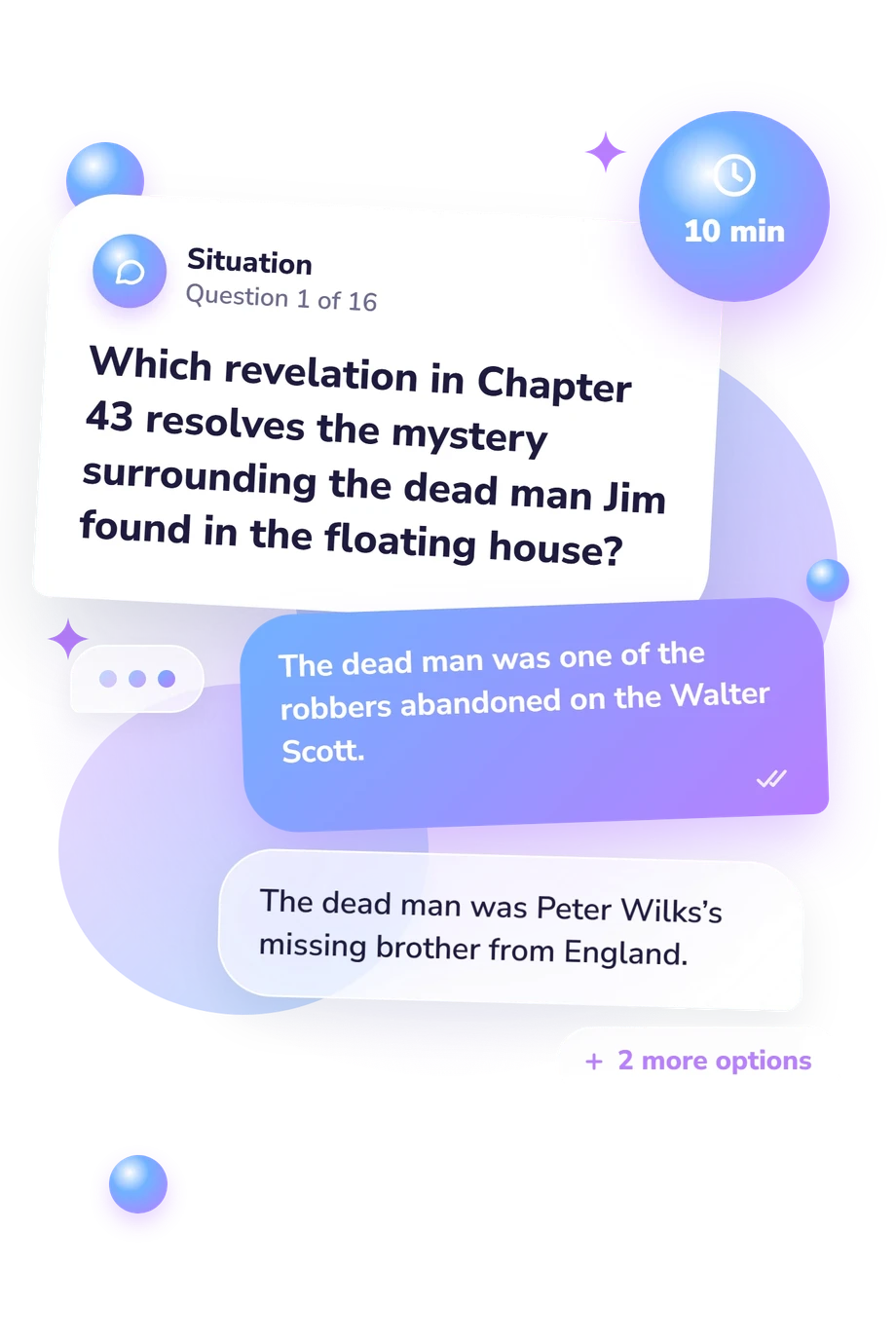
- The dead man was one of the robbers abandoned on the Walter Scott.
- The dead man was Peter Wilks’s missing brother from England.
- The dead man was Pap, and Jim had earlier kept Huck from seeing the body.
- The dead man was Boggs, whose death had been falsely reported in Arkansas.
- He catches a thrown lump of lead by clamping his knees together rather than gathering it in his lap.
- He identifies himself as a riverboat pilot while describing his family.
- He refuses to sew because he says only enslaved people mend clothes.
- He uses Tom Sawyer’s real name when she asks where he lives.
Huck Finn Quiz Questions by Chapter - Description and methodology of the test
Readers who want to check detailed recall rather than offer a general opinion can use Huck Finn Quiz Questions by Chapter as a focused reading companion. This Huckleberry Finn quiz is suited to students, teachers, and independent readers who want to connect individual scenes with choices, deceptions, escapes, and turning points. It shows where chapter knowledge is secure and where another look may help.
What This Assessment Explores
The questions draw on Mark Twain’s Adventures of Huckleberry Finn, emphasizing events that reveal motives, pressure, conflict, and irony. They ask why events occur, which evidence supports a conclusion, and how later revelations change earlier scenes. The result reflects chapter recall and cross-chapter connections, not a general opinion about the novel.
By tying questions to chapters, this Huck Finn chapter quiz shows gaps in sequence, motives, turning points, and consequences. It suits students, teachers, and independent readers revisiting the book.
The single scale, Huck Finn Knowledge (0-16), is divided into these bands:
- Starting Point (0-6) shows recognition of major elements, while sequence and central conflicts need review.
- Developing Knowledge (7-12) indicates understanding of much of Huck and Jim’s journey, with gaps in motives or later chapters.
- Strong Knowledge (13-16) reflects detailed grasp of events, decisions, and connections across the novel.
Methodology and Evidence Base
Each item presents one question with four answer choices, so the respondent selects the option that best matches the novel. This fixed-choice knowledge check produces a total score interpreted through the three displayed bands. The prompts test recall of events, motives, evidence, and consequences, allowing the result to summarize tested knowledge and connections among chapters rather than literary ability.
The question style is conceptually consistent with Albert R. Kitzhaber’s classroom question set, which treats plot knowledge and interpretation as teachable reading work; here, the answer choices ask readers to distinguish details, motives, and consequences across the chapter sequence. The novel supplies the narrative source, while the chapter sequence connects local details with later revelations.
As a Huckleberry Finn reading quiz, it works for study and self-checking, but performance can vary with memory, reading order, and recognition of an answer without the ability to explain it. Results describe performance on these questions, including recall of details and links among chapters, rather than a broader reading profile.
- Twain, Mark. Adventures of Huckleberry Finn. New York: Charles L. Webster and Company, 1885.
- Kitzhaber, Albert R. "The Adventures of Huckleberry Finn: A Comprehensive Set of Questions." In Literature-News That Stays News: Fresh Approaches to the Classics. Classroom Practices in Teaching English, 1984, pp. 27-29. National Council of Teachers of English, 1985.
- Howell, Emily, and Jeanne Dyches. "Sharpening Students' Racial Literacies through Multimodal Subversion." Journal of Adolescent & Adult Literacy 66, no. 2 (2022): 100-110. 10.1002/jaal.1255
Updated: