
Gulliver Quiz
How the Scales are Structured
Who Usually Takes This Test?
See How You Compare
Below is a preview of how scores are typically distributed across each scale.
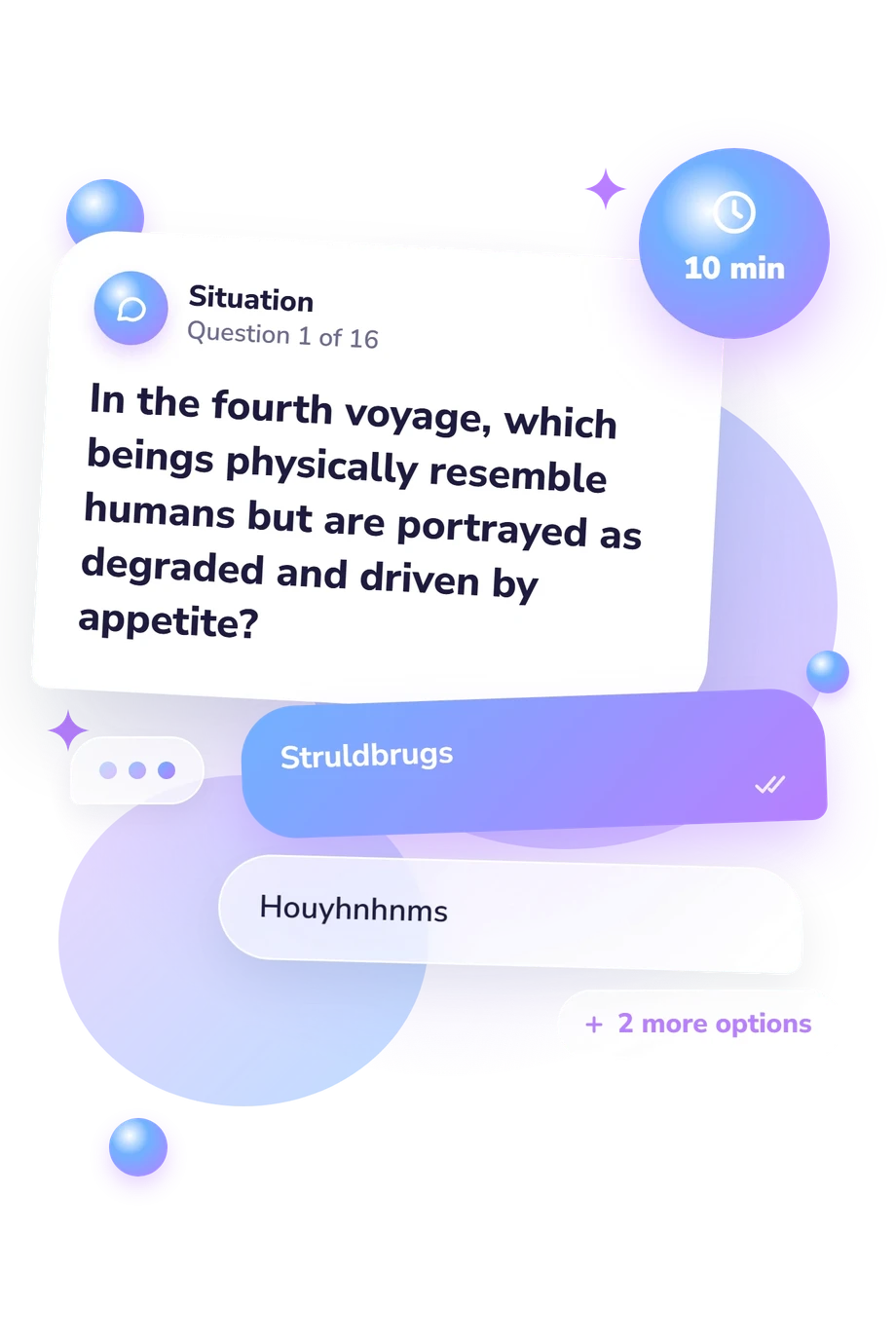
Example Questions From the Test
- Struldbrugs
- Houyhnhnms
- Yahoos
- Laputans
- Blefuscu, where exiles preserve secret histories
- Glubbdubdrib, whose governor can summon the dead
- Luggnagg, where the Struldbrugs remember every age
- Laputa, where mathematicians recreate historical voices
- A dispute about whether Lilliput should use paper money
- A disagreement over succession to the Brobdingnagian throne
- The Laputans’ debate over practical education
- The Big-Ender and Little-Ender controversy
Gulliver Quiz - Description and methodology of the test
Readers revisiting the novel, students checking recall, and curious fans can use the Gulliver Quiz to examine how securely they remember Swift’s four voyages and the ideas behind them. As a gullivers travels quiz, it links details to contrasts involving size and power, reason and appetite, learning and vanity. The result gives a broad snapshot of overall knowledge rather than identifying particular strengths or weak areas.
What This Assessment Explores
The questionnaire measures knowledge of Gulliver’s Travels, including recognition of its characters, places, events, contrasts, and major satirical ideas, rather than personality or mental health.
With its focus on the novel, this assessment is a Gulliver literature quiz that checks knowledge of the voyages, characters, episodes, settings, and satirical contrasts.
The result draws together four thematic groups:
- Voyages and places show how each book connects geography with a changing social world.
- Characters and peoples distinguish figures such as Glumdalclitch, Houyhnhnms, Yahoos, and Struldbrugs.
- Plot and consequences capture discoveries, dangers, causes, and departures.
- Satire and ideas connect details with criticism of politics, science, pride, and human behavior.
Gulliver's Travels Knowledge runs from 0-16: First Landing (0-6) marks partial recognition, Seasoned Traveler (7-12) marks developing-to-solid command, and Swift Scholar (13-16) marks strong knowledge across the narrative and its major satirical ideas.
Methodology and Evidence Base
Each item uses four-option multiple choice. Prompts ask for names, places, sequence, causes, and the meaning of particular satirical situations, so performance depends on knowledge of the novel rather than agreement with a statement. One composite result is reported; the thematic groups do not receive separate subscores.
Its content is anchored in Gulliver's Travels (Swift, 1726), which supplies the events, characters, settings, and satirical situations being tested. Daniel Carey's 2019 study treats the voyages as more than adventures, showing how travel exposes political habits, cultural assumptions, and unstable judgments. Nicolson and Mohler's 1937 study places Laputa's science, the Academy of Lagado, and Swift's parody of impractical inquiry in context. The questionnaire is conceptually consistent with these sources, not an adaptation of their arguments.
The questionnaire is a Gulliver knowledge test that offers a self-check of recall. Its displayed bands describe performance on this questionnaire. The result can reflect memory, prior rereading, interpretation of distractors, and guessing. A score therefore indicates current knowledge of the novel, including its major satirical ideas, rather than complete reading ability or interpretive expertise.
- Swift, Jonathan. Gulliver's Travels. Edited by David Womersley. Cambridge University Press, 2012. DOI 10.1017/9781139029087
- Carey, Daniel. "Swift, Gulliver, and Travel Satire." In The Oxford Handbook of Eighteenth-Century Satire, edited by Paddy Bullard, pp. 193-211. Oxford University Press, 2019. DOI 10.1093/oxfordhb/9780198727835.013.14
- Nicolson, Marjorie Hope, and Nora M. Mohler. "The Scientific Background of Swift's Voyage to Laputa." Annals of Science, vol. 2, no. 3, 1937, pp. 299-334. DOI 10.1080/00033793700200611
Updated: