
I Bet I Can Make You Poop Quiz
How the Scales are Structured
Who Usually Takes This Test?
See How You Compare
Below is a preview of how scores are typically distributed across each scale.
Example Questions From the Test
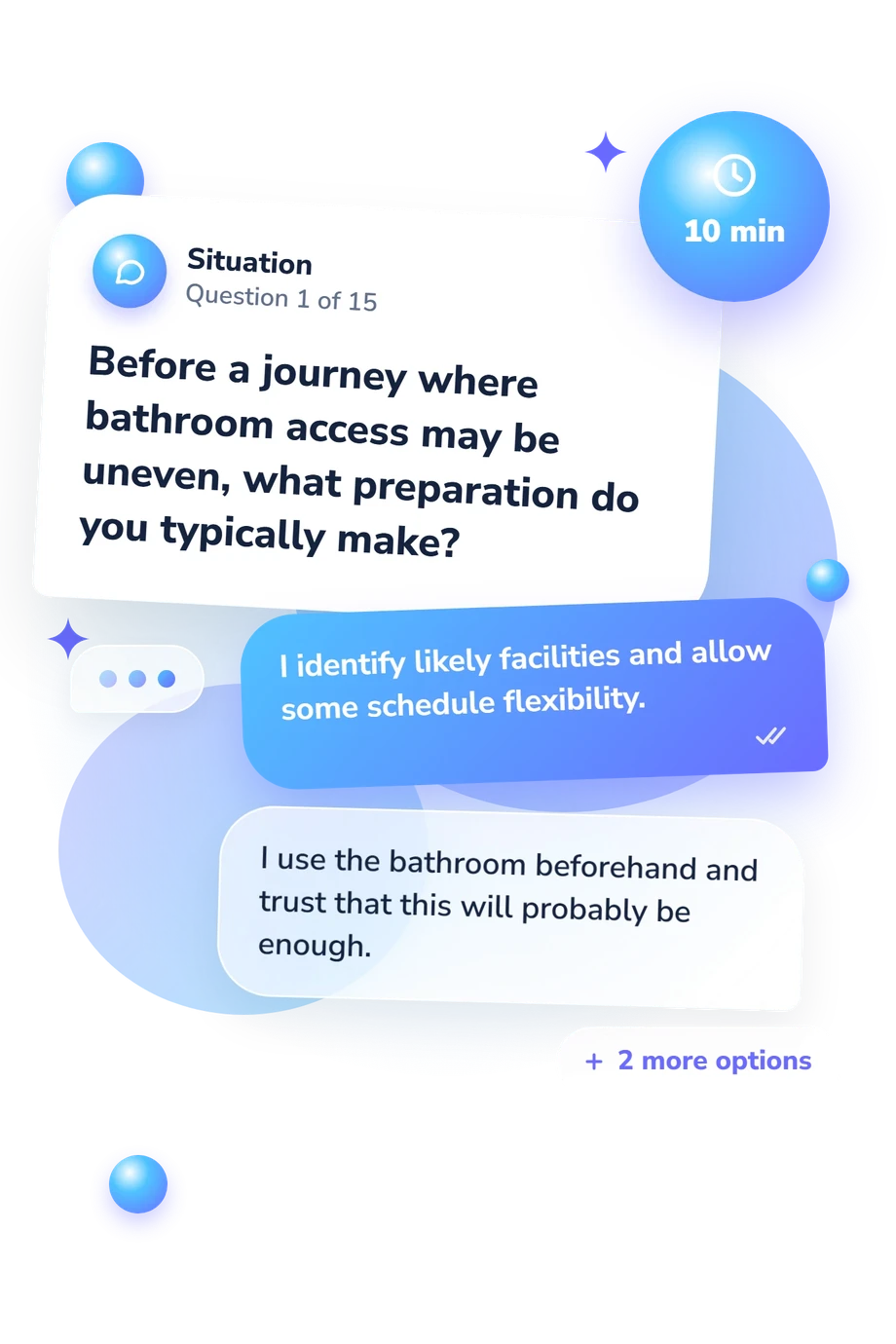
- I identify likely facilities and allow some schedule flexibility.
- I use the bathroom beforehand and trust that this will probably be enough.
- I limit food or drink more than usual to reduce the chance of an urge.
- I avoid planning because thinking about bathrooms makes me more tense.
- I avoid prolonged straining and try again later if there is no pressing need.
- I wait calmly for a moderate amount of time before moving on.
- I push harder because I have already set aside the time.
- I stay until something happens, even if the urge has faded.
- Notice how it develops while keeping bathroom access in mind.
- Treat it as a likely early cue and adjust my plans slightly.
- Ignore it unless it becomes hard to overlook.
- Assume I need a bathroom immediately because any movement means urgency.
I Bet I Can Make You Poop Quiz - Description and methodology of the test
Readers who want to examine how routines, bathroom access, and changing bodily signals shape everyday choices may find the I Bet I Can Make You Poop Quiz useful. It suits anyone considering a bowel habits quiz for personal insight when travel, meals, work, or uncertain access make ordinary decisions more noticeable. The result offers a practical profile rather than a challenge to force a bowel movement.
What This Assessment Explores
The scenarios cover uneven bathroom access, changing sensations, clear urges, and disruptions caused by meals, travel, or schedules. As a bowel movement self-assessment, it examines everyday choices rather than bowel function under clinical observation.
The three displayed dimensions describe the profile:
- Bowel-Supportive Habits (0-15) shows whether routines, access, and responses to urges support predictable timing without forcing or prolonged delay: Inconsistent support (0-5), Partial support (6-10), or Balanced support (11-15).
- Brief-Delay Management (0-15) reflects how you handle short, unavoidable waits by staying composed, locating access, and adjusting when urgency changes: Limited toolkit (0-5), Situational toolkit (6-10), or Flexible toolkit (11-15).
- Urge Awareness (0-15) reflects how clearly you notice and interpret bowel cues without treating every sensation as immediate urgency: Emerging awareness (0-5), Developing awareness (6-10), or Strong awareness (11-15).
Methodology and Scientific Basis
Each item presents a situation with four response options. Choices cover preparation, bathroom prioritization, signal interpretation, routine changes, and coping during a brief delay. Select the response closest to usual behavior, not the most health-conscious one; the profile reflects decisions.
Scoring produces three separate profile scores rather than a verdict. Responses are assigned to displayed dimensions, but the questionnaire does not state how individual answers contribute to each score, so the displayed bands should not be treated as clinical cutoffs. The playful tone of this bowel movement quiz keeps the subject approachable; prolonged withholding is not the goal.
The cited publications address related bowel-habit, defecation, continence, or shy-bowel constructs; this questionnaire is conceptually consistent with them but is not an adaptation or validated version of those instruments.
Interpret the profile as a self-report shaped by memory, self-awareness, and response bias. Scores are unvalidated, do not assess constipation or continence, and do not diagnose a bowel disorder; persistent changes merit professional advice, while severe pain, vomiting, blood, major swelling, or inability to pass stool or gas warrant urgent care.
- Meinds RJ, Timmerman MEW, van Meegdenburg MM, Trzpis M, Broens PMA. Reproducibility, feasibility and validity of the Groningen Defecation and Fecal Continence questionnaires. Scandinavian Journal of Gastroenterology. 2018;53(7):790-796. 10.1080/00365521.2018.1465993
- Bharucha AE, Seide BM, Zinsmeister AR, Melton LJ 3rd. Insights into normal and disordered bowel habits from bowel diaries. The American Journal of Gastroenterology. 2008;103(3):692-698. 10.1111/j.1572-0241.2007.01631.x
- Knowles SR, Skues J. Development and validation of the Shy Bladder and Bowel Scale (SBBS). Cognitive Behaviour Therapy. 2016;45(4):324-338. 10.1080/16506073.2016.1178800
Updated: