
Os Coxae Labeling Quiz
How the Scales are Structured
Who Usually Takes This Test?
See How You Compare
Below is a preview of how scores are typically distributed across each scale.
Example Questions From the Test
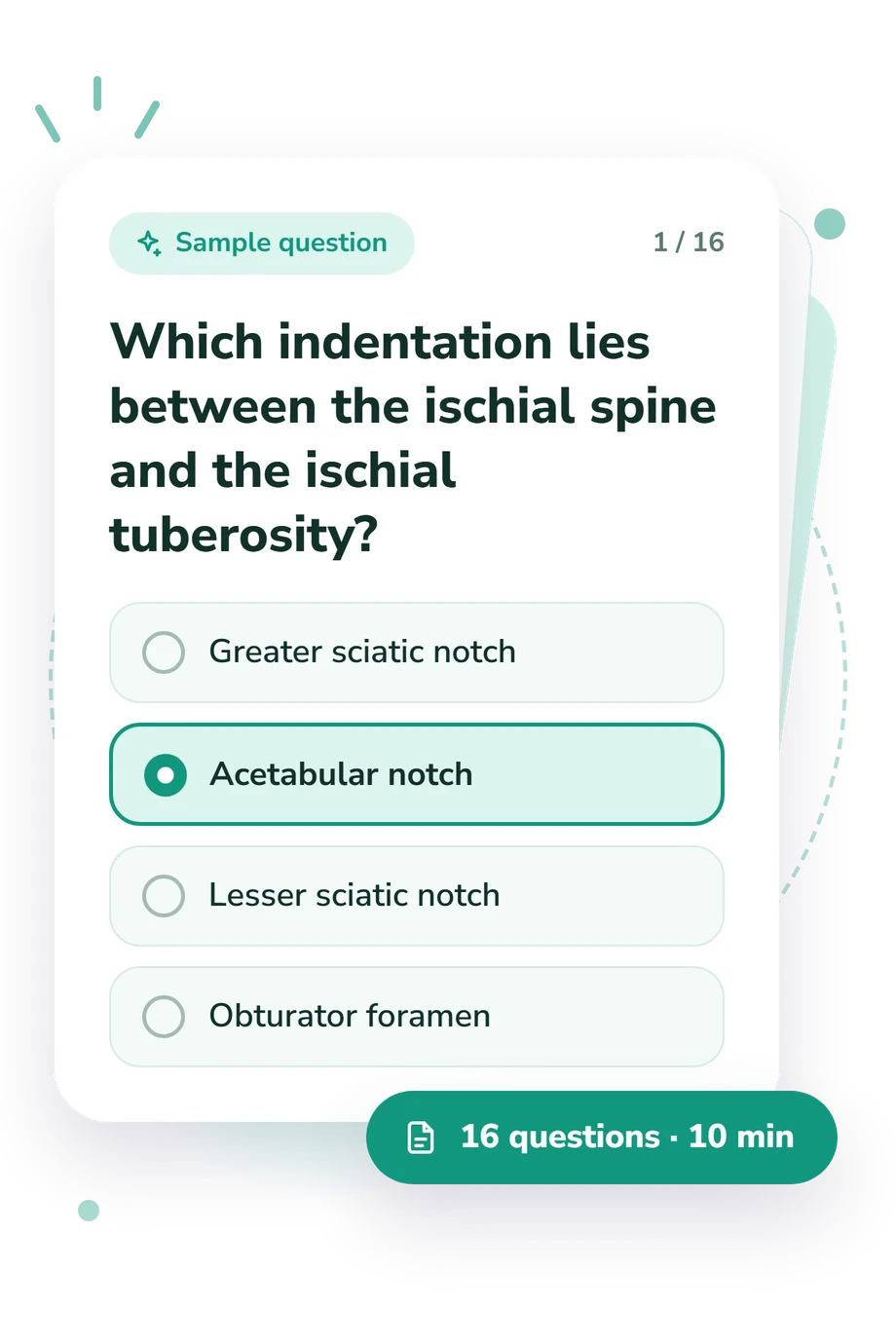
- Greater sciatic notch
- Acetabular notch
- Lesser sciatic notch
- Obturator foramen
- Ilium
- Ischium
- Pubis
- Sacrum
- Gluteal surface
- Acetabular fossa
- Pelvic surface of the ischium
- Iliac fossa
Os Coxae Labeling Quiz - Description and methodology of the test
Designed for students and other anatomy learners, this Os Coxae Labeling Quiz offers a focused check of your overall knowledge of the hip bone and pelvic anatomy. Taking this os coxae quiz can show whether your current anatomy knowledge is developing toward a secure grasp of the region, while giving you an overall result to interpret.
What This Assessment Measures
This assessment measures recognition of the os coxae as a three-dimensional structure. Prompts move among superior, anterior, posterior, medial, and lateral views, asking you to distinguish landmarks by location or function.
This assessment works as a hip bone anatomy quiz for learners testing a mental map of the pelvis.
Questions cover these topics; the single scale summarizes accuracy across them:
- Questions distinguish the ilium, ischium, and pubis within the os coxae.
- Landmark questions ask you to distinguish notches, spines, lines, rami, surfaces, and openings.
- The Os Coxae Knowledge scale (0-16) summarizes quiz accuracy: Foundations to review (0-6) calls for revision of the three bones and orienting landmarks; Developing command (7-12) reflects recognition with practice needed for neighboring features and surfaces; Strong command (13-16) reflects consistent identification of landmarks and spatial relationships.
Methodology and Evidence Base
Each item presents a clue followed by four answer choices. Prompts ask you to name structures such as the acetabulum, sciatic notches, iliac surfaces, pubic rami, and articular areas; success depends on linking terminology with position and function rather than recognizing a picture. This closed-response format asks you to select the option that matches the description.
Scoring in this pelvic girdle labeling quiz is an accuracy summary, not a clinical or personality scale. It reports performance across identifications and places the result in the displayed educational band. Wording, viewpoint, recent study, and familiarity with regional terminology can affect performance, so one result cannot represent anatomical mastery in every context.
Betts and colleagues and Phillips and O'Hara supply terminology for the anatomical features tested here. The questionnaire is conceptually consistent with those books, which provide anatomical references rather than evidence of its reliability, validity, or standardization. This online questionnaire has no stated standardization or published psychometric evidence and is not presented as an adaptation of either book. Attention and test-taking care can affect the result, so use it alongside anatomy practice.
- Betts JG, Young KA, Wise JA, Johnson E, Poe B, Kruse DH, Korol O, Johnson JE, Womble M, DeSaix P. Anatomy and Physiology 2e. Section 8.3, The Pelvic Girdle and Pelvis. Houston, TX: OpenStax; 2022.
- Phillips J, O'Hara M. Hands-on Anatomy. Chapter 6, The Hip and Thigh. Philadelphia, PA: North Broad Press; 2024. 10.34944/381c-cx44.
Updated: