
Legal and Ethical Nursing Quiz
How the Scales are Structured
Who Usually Takes This Test?
See How You Compare
Below is a preview of how scores are typically distributed across each scale.
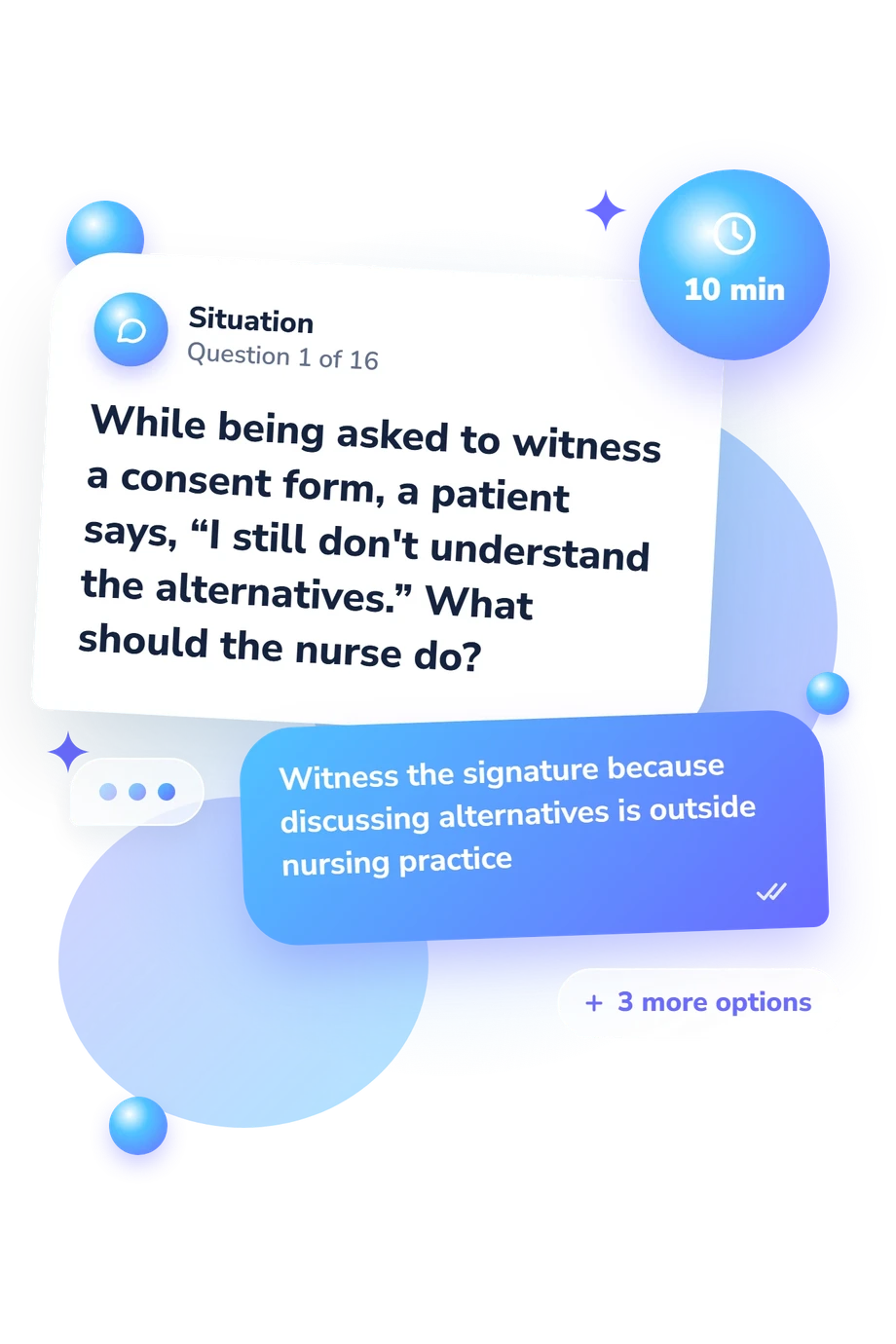
Example Questions From the Test
- Witness the signature because discussing alternatives is outside nursing practice
- Ask a family member to explain the alternatives in simpler language
- Pause the process and contact the clinician responsible for the informed-consent discussion
- Provide a personal recommendation and then witness the signature
- Justice
- Beneficence
- Autonomy
- Fidelity
- Intent, unauthorized contact, injury, and punishment
- A policy violation, witness, written warning, and financial loss
- Disagreement, poor communication, distress, and a complaint
- Duty, breach of duty, causation, and harm
Legal and Ethical Nursing Quiz - Description and methodology of the test
Designed for nursing students, practicing nurses, and anyone reviewing bedside responsibilities, this legal and ethical nursing quiz assesses how you apply broadly accepted legal and ethical nursing knowledge in common professional scenarios. It uses decisions about competing duties to test recognition of the safest, most accountable response. As a nursing ethics test, it can help identify topics worth revisiting before study, orientation, or reflective discussion.
What This Assessment Measures
The scenarios show how ethical principles and legal duties guide bedside action and documentation. They address consent, autonomy, confidentiality, delegation, restraint reduction, incident response, abuse reporting, impairment, advance directives, ethics consultation, and negligence. The emphasis is on recognizing nursing responsibility while respecting patient rights and applicable procedures.
In practice, this nursing law and ethics quiz connects principles with practical decisions, asking you to apply knowledge rather than recall isolated definitions. Your result is organized on one educational scale. The displayed scale, Legal and Ethical Nursing Knowledge (0-16), uses these bands:
- Foundation to Strengthen (0-6) indicates that core duties need focused review.
- Developing Knowledge (7-12) suggests that you recognize many duties but may need more practice.
- Strong Knowledge (13-16) reflects a solid grasp of broadly accepted legal and ethical nursing principles.
Methodology and Evidence Base
Each item describes a practice situation and offers four response options. The questionnaire presents a 0-16 result with displayed bands, but it does not state how many points any answer contributes; interpret the result through the displayed bands rather than infer a formula. Applied judgment links capacity, authorization, safety, accountability, and records.
The evidence includes a Barbados study examining ethics and law practice among healthcare professionals and a nurses’ ethics-knowledge study examining knowledge and attitudes; Guido’s Legal & Ethical Issues in Nursing supplies context for these duties. This questionnaire is not an adaptation of those works, and no standardized norms or independent reliability estimates are supplied for this online version.
Study planning is one practical use of this nursing ethics assessment: it identifies priorities and shows how local law, scope of practice, standards, and workplace policy affect an answer. The result is educational rather than legal advice; current rules govern care. Performance on knowledge-based scenarios varies with interpretation, prior experience, guessing, and familiarity with local rules, so a strong band does not establish complete clinical competence.
- Seetharaman Hariharan, Ramesh Jonnalagadda, Errol Walrond, and Harley Moseley. Knowledge, attitudes and practice of healthcare ethics and law among doctors and nurses in Barbados. BMC Medical Ethics. 2006;7:7. 10.1186/1472-6939-7-7
- Toska A, Latsou D, Saridi M, Sarafis P, and Souliotis K. The validity and reliability of a questionnaire on the knowledge and attitudes of nurses about ethics. Archives of Hellenic Medicine. 2022;39(2):253-263.
- Ginny Wacker Guido. Legal & Ethical Issues in Nursing. 7th ed. Pearson, 2020.
Updated: