
Hidden Movie Picture Quiz
How the Scales are Structured
Who Usually Takes This Test?
See How You Compare
Below is a preview of how scores are typically distributed across each scale.
Example Questions From the Test
- The Hobbit: An Unexpected Journey
- The Lord of the Rings: The Fellowship of the Ring
- The Lord of the Rings: The Return of the King
- The Lord of the Rings: The Two Towers
- Ferris Bueller's Day Off
- Sixteen Candles
- Say Anything...
- The Breakfast Club
- The Night of the Hunter
- Diabolique
- Peeping Tom
- Psycho
Hidden Movie Picture Quiz - Description and methodology of the test
For viewers who enjoy recognizing famous scenes, the Hidden Movie Picture Quiz presents a focused identification task based on distinctive cinematic clues described in words. As a movie scene recognition test, it suits film fans who want to see how readily props, settings, framing, and memorable actions bring a title to mind. The result captures performance across these films rather than a judgment of overall taste or expertise.
What This Assessment Measures
The assessment links a described film frame to a title. Its prompts cover iconic compositions, props, costumes, settings, effects, endings, and suspenseful moments, so the task relies on distinctive visual information rather than plot recall alone. A person taking this film identification quiz can see how consistently familiar cinematic images come to mind across genres and eras.
The result is reported through one displayed scale, Hidden Movie Picture Knowledge (0-16). Its bands are:
- Scene Spotter in Training (0-6) indicates that iconic visual clues are not yet consistently connecting to their films.
- Developing Frame Recognition (7-12) indicates recognition of many major scenes, with more difficulty when clues resemble one another or are less explicit.
- Sharp-Eyed Movie Expert (13-16) indicates reliable connections between distinctive props, settings, compositions, and titles; it reflects these 16 described frames, not all movie knowledge.
Methodology and Evidence Base
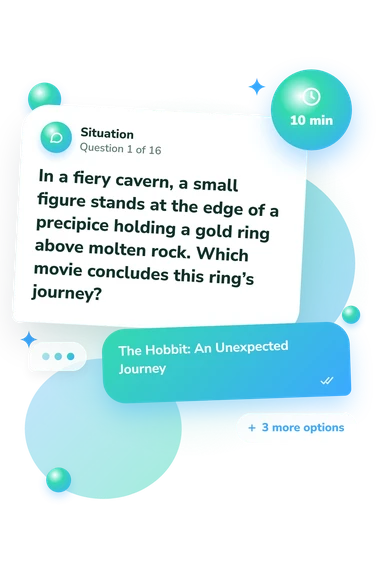
Each item gives a short description of a still or sequence and four answer choices. The respondent selects the title that best matches the clue; the score counts correct identifications. The hidden movie quiz format tests retrieval from verbal descriptions of visual scenes, without requiring the original image.
Conceptually, the questionnaire aligns with Arguello et al. (2021), who examined movie identification from partial remembered information. Research by Ferguson, Homa, and Ellis (2017) on memory for dynamic scenes, and by Furman et al. (2007) on long-term memory for audiovisual narratives, supports focusing on memorable film moments. These studies explain the task’s rationale, but do not establish this online questionnaire as a validated adaptation of any one instrument.
Interpret the result as performance on these described clues. A high score suggests accessible movie imagery in this set; a lower score may reflect unfamiliar films, ambiguous wording, or ordinary variation in recall. Performance may vary with prior film exposure, recall at testing, and clue clarity or ambiguity; without population norms or clinical cutoffs, the result is a structured snapshot, not a standardized measure.
- Jaime Arguello, Adam Ferguson, Emery Fine, Bhaskar Mitra, Hamed Zamani, and Fernando Diaz. “Tip of the Tongue Known-Item Retrieval: A Case Study in Movie Identification.” In Proceedings of the 2021 ACM SIGIR Conference on Human Information Interaction and Retrieval (CHIIR ’21), 5-14. Association for Computing Machinery, 2021. DOI 10.1145/3406522.3446021.
- Ryan Ferguson, Donald Homa, and Derek Ellis. “Memory for temporally dynamic scenes.” Quarterly Journal of Experimental Psychology, 70(7), 1197-1210, 2017. DOI 10.1080/17470218.2016.1174721.
- Orit Furman, Nimrod Dorfman, Uri Hasson, Lila Davachi, and Yadin Dudai. “They saw a movie: Long-term memory for an extended audiovisual narrative.” Learning & Memory, 14(6), 457-467, 2007. DOI 10.1101/lm.550407.