
Moroccan Quiz
How the Scales are Structured
Who Usually Takes This Test?
See How You Compare
Below is a preview of how scores are typically distributed across each scale.
Example Questions From the Test
- Tangier
- Casablanca
- Tetouan
- Rabat
- The High Atlas
- The Rif Mountains
- The Pyrenees
- The Tibesti Mountains
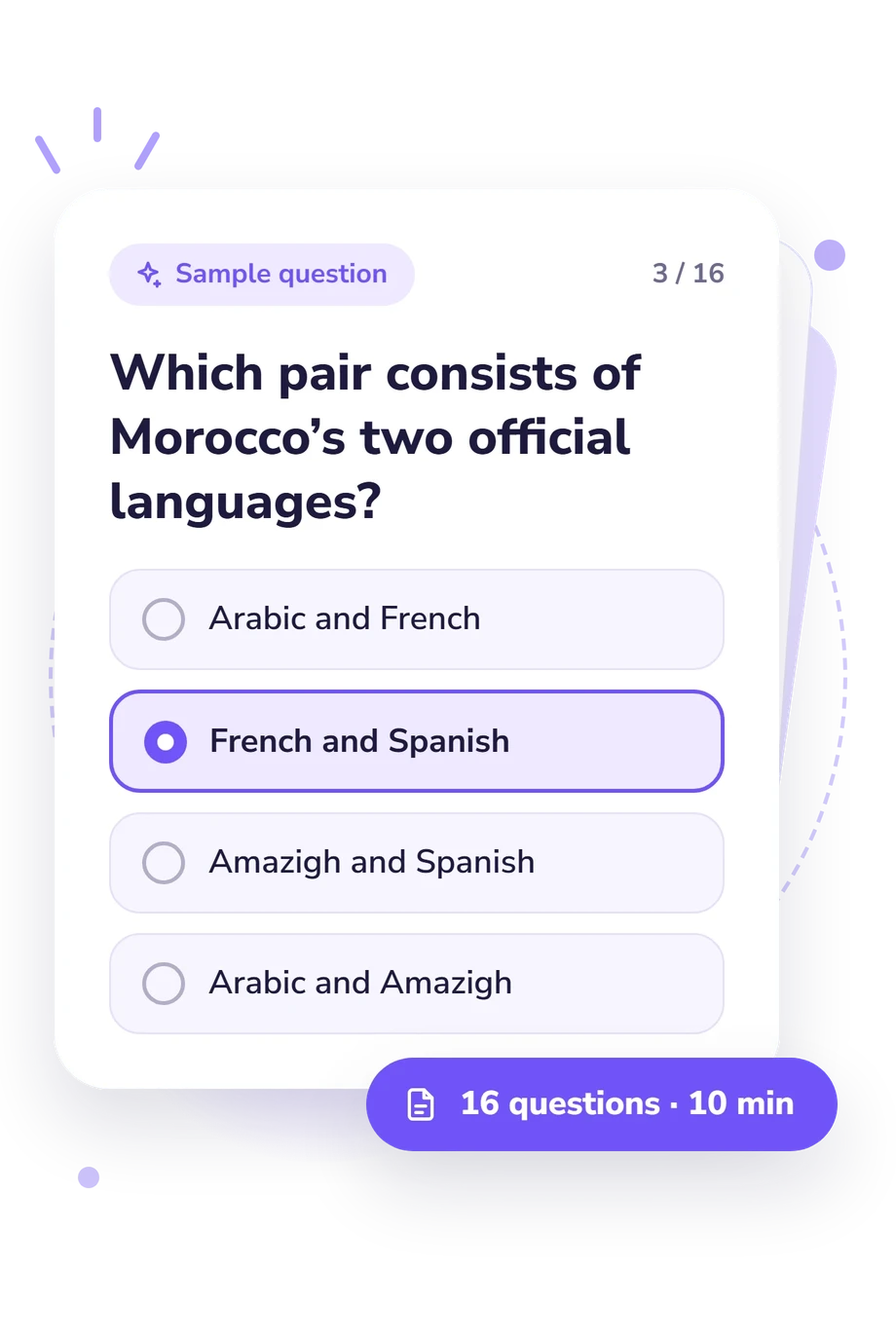
- Arabic and French
- French and Spanish
- Amazigh and Spanish
- Arabic and Amazigh
Moroccan Quiz - Description and methodology of the test
People seeking a focused way to check their knowledge of Morocco can use the Moroccan Quiz as a factual learning exercise, not as a measure of identity or personal experience. It is suitable for curious learners, travelers, students, and anyone preparing for further reading. A Morocco knowledge test of this kind can show which subject areas feel familiar and where new study may be rewarding.
What This Assessment Explores
Questions sample recognition across Morocco’s geography, history, and heritage. Topics include mountain ranges, coastlines, climate, independence, cities, languages, currency, Amazigh identity, food, medinas, and landmarks.
Across these factual topics, the Morocco trivia quiz indicates areas of stronger or developing knowledge. The result reflects recognition of names, locations, facts, and cultural references.
The content falls into four topic groups:
- Geography and climate cover recognition of Moroccan landforms, coastlines, and climate facts.
- History and civic knowledge connect independence, capitals, and historic centers.
- Language and identity clarify official languages and the meaning of Amazigh.
- Food, landmarks, and traditions identify distinctive places, objects, and practices.
The result provides one overall Morocco Knowledge scale, scored from 0-16, with three descriptive bands: Foundational (0-6), Developing (7-12), and Strong (13-16). These labels describe emerging, useful, or broad knowledge across the sampled topics.
Methodology and Scientific Basis
Each item presents a factual question with four choices. The respondent selects the option that best fits a geographic, historical, linguistic, civic, or cultural statement. Responses are reported on that displayed scale and interpreted through descriptive bands accompanying the result.
This Morocco quiz is an online knowledge measure, not a personality inventory. Its closest conceptual reference is the DoKnow Test (Rusche and Ziegler, 2023), which treats knowledge as domain-specific rather than general ability. A related 2022 study by Rusche and Ziegler likewise supports interpreting knowledge within a defined content area. The questionnaire is conceptually consistent with those studies, but is not presented as an adaptation or validation of either instrument.
Performance can vary with education, travel, media exposure, language familiarity, attention, and current context. A respondent may know a fact yet overlook the best option, or recognize a label without understanding its wider significance. The score reflects performance under these conditions, not a fixed level of knowledge.
The displayed result is a trivia summary rather than a measure of cultural identity or complete expertise.
- Marianna Massimilla Rusche and Matthias Ziegler. “Measuring Domain-Specific Knowledge: From Bach to Fibonacci.” Journal of Intelligence 11(3), 47 (2023). 10.3390/jintelligence11030047
- Marianna Massimilla Rusche and Matthias Ziegler. “The interplay between domain-specific knowledge and selected investment traits across the life span.” Intelligence 92, 101647 (2022). 10.1016/j.intell.2022.101647
- Defense Language Institute Foreign Language Center. Cultural Awareness Assessment. U.S. Department of Defense, n.d.
Updated: