
General Management Quiz
How the Scales are Structured
Who Usually Takes This Test?
See How You Compare
Below is a preview of how scores are typically distributed across each scale.
Example Questions From the Test
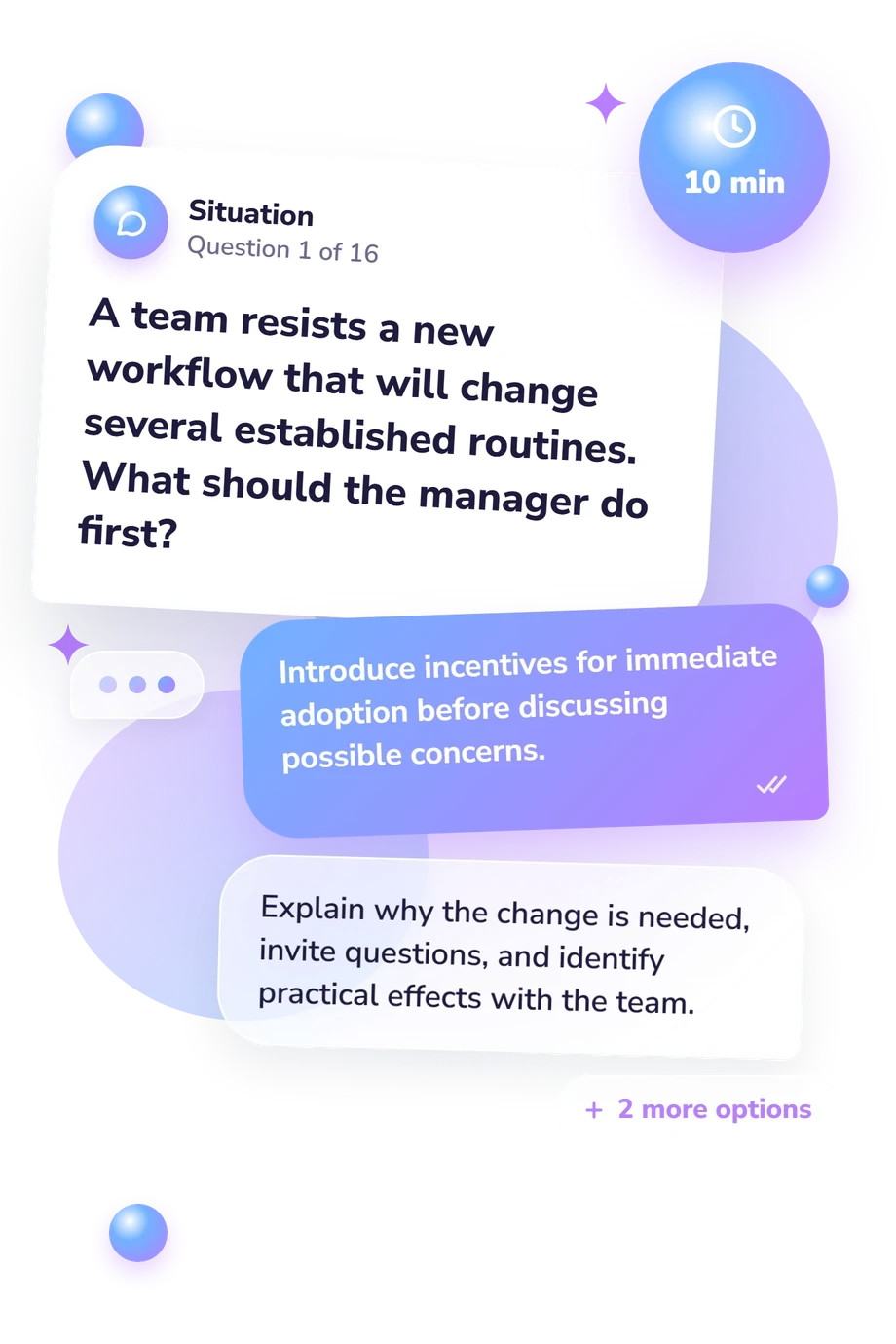
- Introduce incentives for immediate adoption before discussing possible concerns.
- Explain why the change is needed, invite questions, and identify practical effects with the team.
- Enforce the workflow consistently so employees adjust through experience.
- Allow each employee to decide whether the existing or new workflow suits them.
- Provide clear instructions, demonstrate the procedure, and use frequent check-ins.
- Let the employee choose an approach so confidence and ownership develop quickly.
- Focus mainly on encouragement and offer technical guidance only if requested.
- Assign the procedure to an expert until the employee learns through observation.
- The number of business functions the manager understands well
- The number of employees who report directly to the manager
- The geographic area covered by the manager's department
- The range of decisions the manager can make without approval
General Management Quiz - Description and methodology of the test
Managers, supervisors, project leads, and people preparing for broader responsibility can use this assessment to examine practical judgment in familiar workplace situations. The general management quiz asks you to choose responses that fit the facts, competing priorities, and likely consequences. As a management knowledge test, it can help you decide which principles to revisit before taking on a new responsibility.
What This Assessment Explores
To work through questions and answers in this quiz on general management, readers consider coordination, accountability, planning, communication, and everyday leadership. Together, the questions and their answer choices test whether you can identify a proportionate response rather than select an action that sounds appealing but misses the situation's needs.
The result helps people developing, refreshing, or checking practical judgment. It reflects choices in these scenarios, not a fixed leadership style or a complete picture of workplace performance.
The thematic groups represented by the scenarios are:
- Change and implementation show how you explain new processes, invite concerns, and support adoption.
- Delegation and coaching show how you balance direction, support, accountability, and autonomy.
- Planning and control show how you set goals, monitor leading signals, and follow through.
- Conflict, ethics, and feedback show how you address competing interests, disclosure, psychological safety, and observable behavior.
Methodology and Evidence Base
Items combine workplace situations with direct questions about management concepts and frameworks, and each offers four possible answers. The set therefore combines concept recognition with applied judgment across management functions.
The displayed result is General Management Knowledge, with a score range of 0-16. Foundations to build covers 0-6, Developing knowledge covers 7-12, and Strong knowledge covers 13-16. These bands describe alignment with expected approaches; the display does not state how many points each option contributes.
The questionnaire is conceptually consistent with the General Management In-Basket (GMIB), which uses managerial situations to examine applied judgment, but it is not an adaptation of that instrument. Research on applied management knowledge distinguishes knowing management ideas from applying them, while Dunning-Kruger research cautions that confidence can exceed competence. As a management skills assessment, it can identify topics for learning and reflection.
Choices can be shaped by scenario familiarity, current context, and socially desirable responding. The score reflects answers across the full quiz; it is not a validated measure of workplace performance. It indicates how consistently selected responses match expected principles in these situations.
- Joines, Richard C. Traditional In-Baskets vs. the General Management In-Basket (GMIB). Paper presented at the 15th Annual Meeting of the International Personnel Management Association Assessment Council, Chicago, June 23-27, 1991. ERIC ED341705.
- Baldwin, Timothy T., Jason R. Pierce, Richard C. Joines, and Shameem Farouk. “The Elusiveness of Applied Management Knowledge: A Critical Challenge for Management Educators.” Academy of Management Learning & Education, 10(4), 2011, 583-605. 10.5465/amle.2010.0045
- Sanguineti, Francesca, Lajos Szabó, Stefano Denicolai, and Giovanna Magnani. “The illusion of competence: Managers and the Dunning-Kruger effect.” European Management Review, 2026. 10.1111/emre.70081
Updated: