
Freud's Stages of Development Quiz
How the Scales are Structured
Who Usually Takes This Test?
See How You Compare
Below is a preview of how scores are typically distributed across each scale.
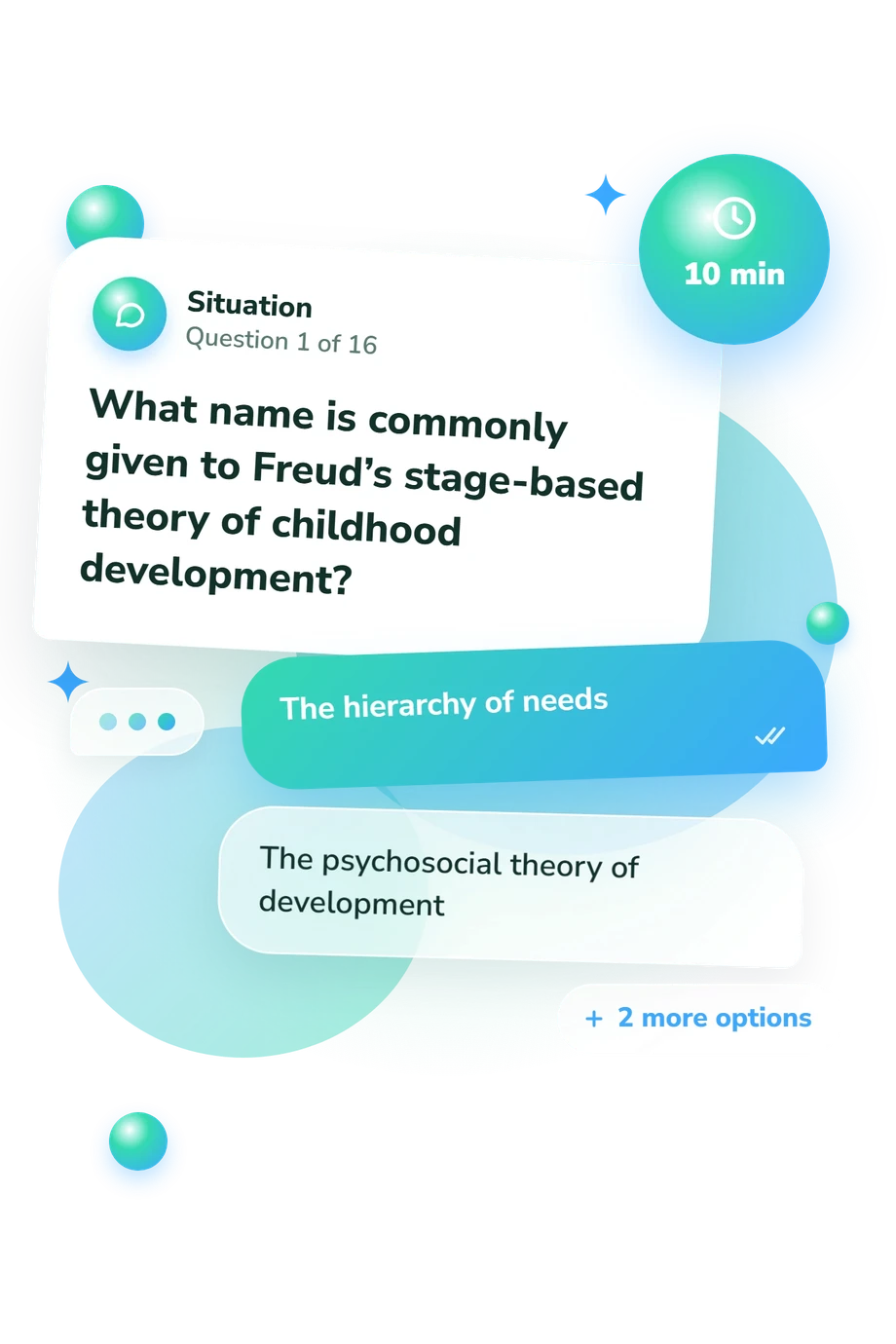
Example Questions From the Test
- The hierarchy of needs
- The psychosocial theory of development
- The cognitive-developmental theory
- The psychosexual theory of development
- Oral
- Phallic
- Anal
- Latency
- Oral
- Genital
- Latency
- Phallic
Freud's Stages of Development Quiz - Description and methodology of the test
Visitors who want a focused introduction to Freud’s developmental model can use this assessment to check conceptual understanding rather than personal symptoms. Freud's Stages of Development Quiz is intended for learners, psychology readers, and anyone revisiting the historical theory. It emphasizes recognition of concepts and their relationships. As a quiz on Freud’s stages of psychosexual development, it can show which parts of the model deserve closer study.
What This Assessment Explores
The questions cover Freud’s five stages-oral, anal, phallic, latency, and genital-along with fixation, regression, libido, the Oedipus complex, approximate age transitions, and the contrast with Erikson’s model. These questions therefore test whether a reader can recognize, compare, and apply concepts from Freud’s stages of development in brief scenarios rather than recall labels alone.
The result is organized through one educational scale, Freud’s Stages of Development Knowledge (0-16), with three interpretive bands:
- Foundations to review (0-6) indicates recognition of some ideas while stages, sequence, or terminology still need review.
- Developing knowledge (7-12) shows understanding of much of the model with some gaps in application or comparison.
- Strong knowledge (13-16) reflects accurate identification, application, and critical contextualization of the theory.
This scale describes knowledge of a historical theory, not personality, mental health, or developmental functioning.
Methodology and Evidence Base
Each item presents a short question and four answer choices, asking for the best stage, concept, sequence, or criticism. Responses are combined into a single knowledge result rather than a personality score. The choices ask the reader to distinguish stages, connect concepts with brief scenarios, order the sequence, and identify a major criticism. The displayed bands are educational summaries, not clinical cutoffs.
The content is conceptually consistent with Freud’s psychosexual theory, which organizes development around changing bodily sources of gratification and related conflicts. Van Haute and Westerink’s analysis adds historical context, while Chodoff’s critique explains the emphasis on empirical testability and falsifiability. A test of Freud’s psychosexual stages can assess understanding of these ideas without proving the theory itself.
Interpretation is strongest when the result is considered alongside the reader’s prior study and experience completing the questionnaire. Performance may reflect familiarity with textbook terminology or differences in reading the options, so the questionnaire is best used to guide review of a historically important but scientifically contested model.
- Freud, Sigmund. (1953 [1905]). Three Essays on the Theory of Sexuality. In James Strachey (Ed. and Trans.), The Standard Edition of the Complete Psychological Works of Sigmund Freud, Vol. 7: A Case of Hysteria, Three Essays on Sexuality and Other Works, pp. 123-246. London: The Hogarth Press and the Institute of Psycho-Analysis.
- Van Haute, Philippe, and Herman Westerink. (2016). Sexuality and its object in Freud’s 1905 edition of Three Essays on the Theory of Sexuality. The International Journal of Psychoanalysis, 97(3), 563-589. 10.1111/1745-8315.12480
- Chodoff, Paul. (1966). A Critique of Freud’s Theory of Infantile Sexuality. American Journal of Psychiatry, 123(5), 507-518. 10.1176/ajp.123.5.507
Updated: